Liquidity grew 50% in 2026, a latent pressure despite the temporary drop in USDT.
They project inflation of more than 600% due to the accelerated printing of money.
The Venezuelan economy seems to have entered a phase of contradictions that defies the logic of the common citizen. While the cost of living maintains its upward inertia, the price of USDT, the stablecoin issued by the Tether company and which serves as a refuge for thousands of savers, shows an unexpected decline.
On April 5, the asset was quoted close to 622 bolivars on platforms such as Binance, completing a drop of more than 6.5% in just one week after reaching a peak of 682 bolivars on March 28.
However, behind this exchange rate respite hides a statistical reality that specialists observe with caution. Hermes Pérez, economist and former head of the Exchange Desk of the Central Bank of Venezuela (BCV), documents a 50% increase in monetary liquidity (M2) between December 2025 and March 2026.
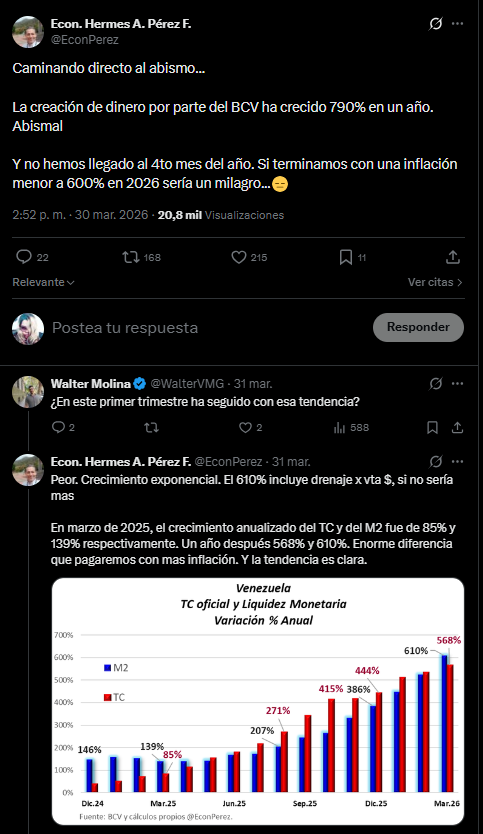
According to Pérez, this surplus of bolivars in the system is a determining factor, since historically The greater availability of national currency ends up putting pressure on the demand for foreign currency.
The current calm in the P2P market raises questions, especially when compared to the episodes of volatility experienced at the beginning of the year. This phenomenon caused the exchange gap to reduce significantly. As reported by CriptoNoticias, the differential between USDT and the dollar in bank auctions went from 21.4% to 10.6% in seven days, because while the cryptocurrency fell, the official and bank rates rose to around 474 and 570 bolivars respectively.
In contrast, in January 2026, periods of monetary expansion similar to the current one coincided with USDT peaks that rubbed the 900 bolivars. Why does the market seem to ignore, for now, the increase in the money supply?
Sector analysts, cited in CriptoNoticias reports, suggest that the answer lies in a balance of forces. On the one hand, the accumulated inflation of the first two months, which reached 51.94%, naturally pushes economic agents to seek protection in USDT. On the other hand, a more robust foreign exchange supply, driven by oil exports and BCV interventions, has managed to contain the exchange gap, momentarily stabilizing quotes.
USDT a trusted thermometer in Venezuela
Despite the stability of recent days, technical fundamentals suggest that the balance is fragile. The dynamics are similar to that of a reservoir that constantly receives water. It means that if the level rises but the outlet is narrow, the pressure increases.
Pérez highlights that only In the week of March 13, liquidity jumped 12.2%, a figure that usually acts as a preamble to price adjustments. “Monetary liquidity has grown 50% so far in 2026,” warns the economist, pointing out that this expansionary trend is the usual fuel for corrections in the exchange rate.
In this context, the behavior of USDT is consolidated as the true thermometer of trust in Venezuela. Although the inflow of foreign currency from crude oil acts today as a containment dam, the market is closely monitoring whether the Central Bank will be able to absorb the surplus of bolivars. If not, local economic history suggests that the value of the digital refuge will soon seek a new ceiling that reflects the reality of the monetary mass in circulation.