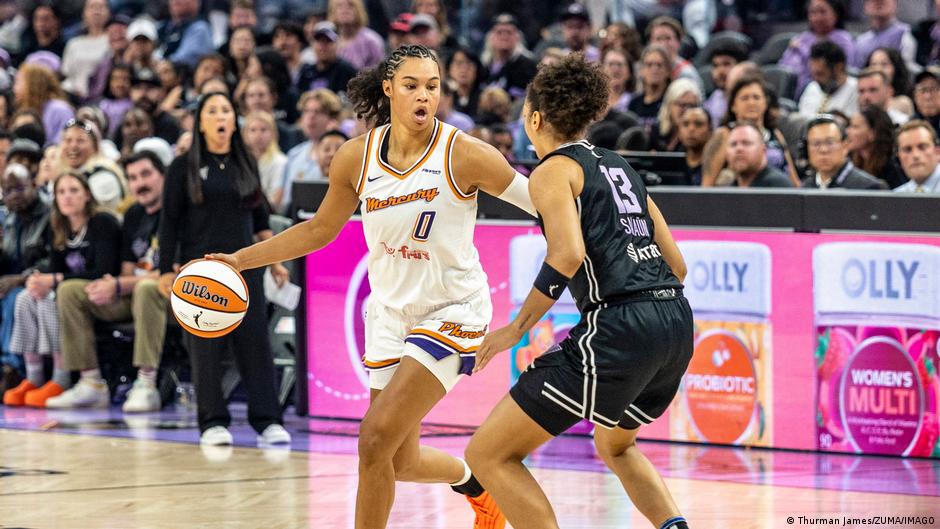
The collective bargaining agreement (CBA) of the Women’s National Basketball Association (WNBA) in the United States is a seismic moment in sports history.
The deal, agreed in mid-March 2026 after 17 months of negotiations, reportedly includes an increase in the salary cap, a significant increase in the minimum wage, revenue sharing and charter flights. This is considered a major step in the right direction for player empowerment and the growth of the league.
However, more than that, it is the headliner of a broader movement in women’s sports that is empowering players to earn better pay, conditions and help generate a larger share of the revenue.
“This agreement is historic not only for basketball, but for the structure of the women’s professional game globally,” Poppy Sotiriadou told DW.
Sotiriadou, an associate professor at Griffith University in Australia, is an expert in the business of women’s sport. She believes the WNBA deal reflects the commercial maturity of the women’s game, that investing in stars is a prerequisite for business growth, and that there is great power in coordinated collective action.
He said, “Structural changes to the revenue-sharing model that link player compensation directly to the league’s business growth. In essence, players are now economic co-owners of the league’s growth path, not salaried employees of a stagnant enterprise.”
“This reflects formal recognition by a professional women’s league that player value is the primary driver of commercial value. It represents a change in philosophy, not just in dollars.”
Women’s football is poised to profit
Women’s football is also well placed to benefit from the deal.
“We know there is a mentality of solidarity in women’s football, and this extends beyond football. What [WNBA’s] “The CBA connects female athletes around the world to recognize their value and fight for that value,” Alex Kalvin, director of women’s football at FIFPRO, the international football players’ union, told DW.
Kalvin believes the WNBA has benefited from gaining momentum since its inception in 1996. Women’s football is now in the midst of that, and Kalvin believes now is the time to ensure that plans are implemented.
“When we get to 2027, we’ll have a World Cup in Brazil, which is probably the most prestigious location for a World Cup. The upside is going to be inevitable, so the mindset of everybody around the game, players, associations, stakeholders is how can we take advantage of that? And I think the WNBA’s CBA has highlighted this almost before we get to the World Cup. It’s created a seismic shift on value,” Culwin said.
The impacts are already being felt, and are about to happen. This deal provides the perfect opportunity for professional women’s soccer (NWSL, the top league) in the US to take the next step.
“The NWSL’s 2026 minimum salary of $50,500 (€43,600) contrasts sharply with the WNBA’s new cap of $270,000-$300,000. This difference will be very difficult for NWSL ownership to defend publicly. With a performance-based reopener in the current agreement and full renegotiations occurring in 2030, the WNBA deal hands the NWSL players a powerful reference. Point,” Sotiriadou said.
“The WNBA deal shows what organized players and a commercially mature league can accomplish together.”
While a global CBA in soccer is unlikely, both the WNBA’s actions and CBA policies could be highly influential tools for growing women’s sports. Shared revenue is the obvious headline, but improving the minimum salary, covering and improving travel, and protecting players through policies like no-release or -trade clauses during pregnancy could make a big difference. Kalvin believes that the non-tangible impact of the deal, such as its use as a reference in pitches, should also not be underestimated.
“The question for our unions and the players who are members of those unions is what is the role of the unions as custodians of the game to ensure that the revenue that is generated is distributed fairly. You can be obviously micro and cherry-pick, saying this section is wonderful or this article is wonderful. And then you can be macro and ask, ‘What does this say to football as an industry?'” Kalvin said.
what happens next?
Billie Jean King, Flor Isava-Fonseca, the Williams sisters, Allyson Felix, Simone Biles, Kathrine Switzer, Megan Rapinoe are on the list of those who have changed the women’s game. Each has moved the needle, and reminded the next generation of what has gone before.
“You have a responsibility to make sure you make the most of that opportunity and strive for everything you’re worth,” Kalvin said.
Sotiriadou sees other sports, such as women’s tennis, golf and emerging rugby competitions, as potential beneficiaries of the deal.
“In each case, the WNBA deal now stands as a benchmark: proof that a professional women’s league, at commercial scale, can sustain a salary model tied to revenue,” Sotiriadou said.
For Kalvin and FIFPRO, it’s all about creating the conditions to capitalize on the growing wave of momentum in women’s football.
However, perhaps the most telling thing is what this deal tells us. It’s certainly about good and smart business of the women’s game, but it’s also about the message. The women of the WNBA recognized their value, organized themselves and worked tirelessly to capture the long-developed momentum so they could get the pay they deserved. This deal will change their game forever. It will likely be remembered as a watershed moment in all of women’s sports, with many women asking the same questions as Calvin.
“It’s about lighting that shines a little brighter,” she said. “We are here. What brought us here will not take us there. Where do we want to go next?”
Edited by: Chuck Penfold