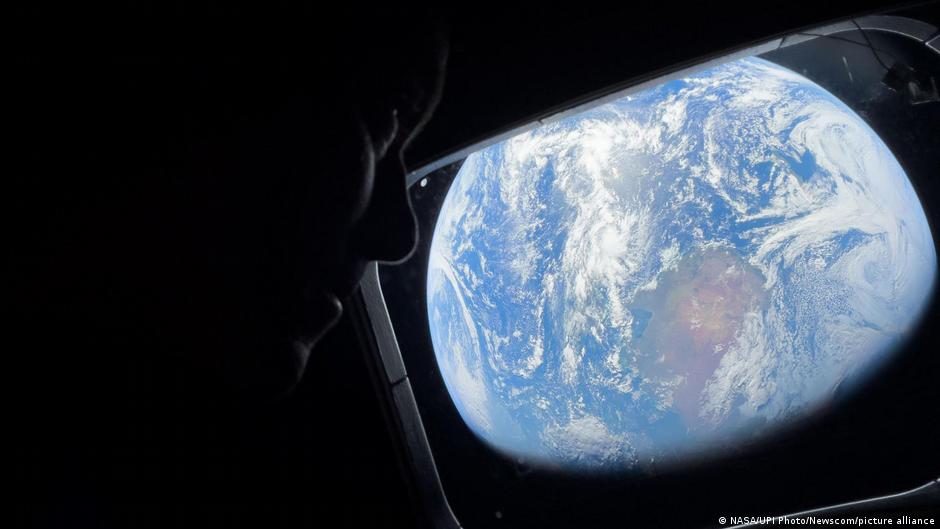
NASA said Monday that astronauts on the Artemis II mission have reached the moon’s gravitational field, meaning the spacecraft is more affected by the moon’s gravity than Earth’s.
When entering the moon’s gravitational influence, the Orion capsule was about 63,000 kilometers (39,000 miles) from the moon and about 232,000 miles from Earth, a NASA official said.
In the next few hours, the spacecraft is expected to make its closest approach to the moon, at a distance of about 7,500 kilometers.
The flight path of the Artemis 2 flight looks like a figure eight around the Earth and the Moon.
Why is the Artemis II mission historic?
When the spacecraft comes closest to the Moon, astronauts will be able to see Earth and the Moon at the same time – and even a solar eclipse in which the Sun disappears behind the Moon from Orion’s perspective.
The astronauts entered what NASA calls the lunar impact zone at 0442 GMT on Monday and will soon record the first lunar flight since 1972, during which a crew will travel farther from our home planet than any human before.
It is the first time in more than 50 years that a crew, including American astronauts Victor Glover, Christina Koch and Reed Wiseman, and Canadian astronaut Jeremy Hansen, has visited the Moon.
Victor Glover would become the first person of color to fly around the Moon, and Christina Koch would be the first woman.
What have astronauts seen so far?
Astronauts are tasked with documenting the Moon during lunar flights.
They have already begun to see features of the Moon that have never been seen before with the naked human eye.
In the early hours of Sunday, NASA published an image taken by the Artemis crew showing the distant moon along the Orientale Basin.
“This mission is the first time the entire basin has been seen with human eyes,” the US space agency said.
Edited by: Natalie Muller