
The trading volume of ether (ETH) futures, Ethereum’s cryptocurrency, has surpassed the spot market by seven (spot) so far in April 2026.
This disparity places the relationship between spot volume and derivatives at 0.13, the lowest annual level on record for the cryptocurrencyas seen in the graph.
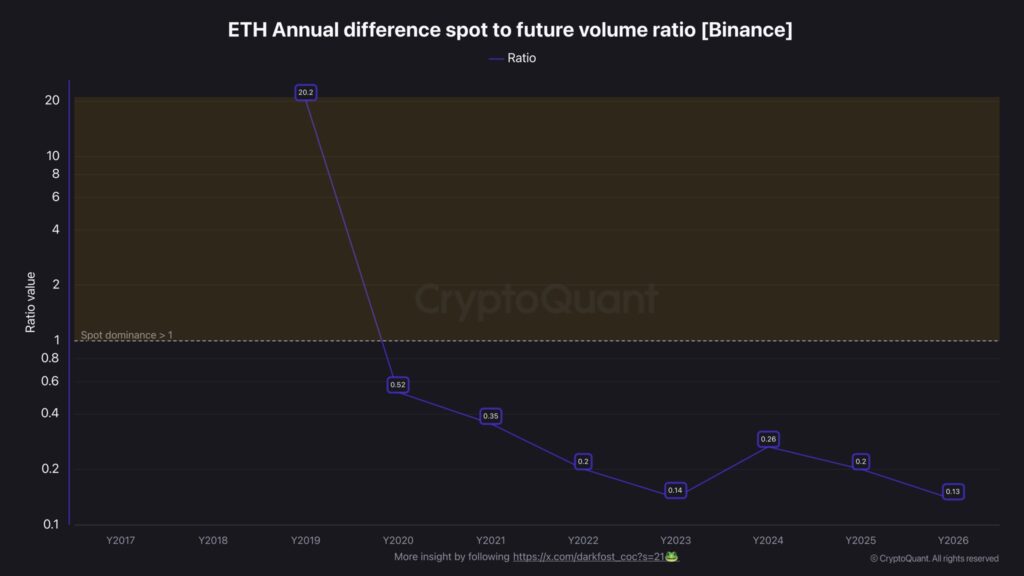
This gap arises because investors remain cautious in the face of global geopolitical and economic uncertainty. “The current situation remains difficult to interpret, which is generally not a good sign for the markets,” says the analyst which is identified as “Darkfost”. While market buyers spot —where the actual cryptocurrency is acquired to own—are withdrawn, speculators trade futures contracts.
As Criptopedia, the educational section of CriptoNoticias, explains, these contracts are agreements to buy or sell an asset at a future date at an agreed price, allowing speculation on the price without the need to own the asset in the present.
“Right now, ether derivatives markets are still very active,” Darkfost adds of the capital flow. Open interest, which measures the total value of contracts that have not yet been settled, reaches 6.4 million ETH. This figure is close to 7.8 million of the historical maximum of July 2025even though the current price is lower.
Risks of a fragile financial foundation for Ethereum
The disconnect between the high number of futures contracts and the actual price indicates that the market is saturated with orders waiting for a sharp movement.
“This dynamic suggests that speculation is currently driving price movements in ether,” warns the specialist. Without enough purchases in the spot market—where the actual cryptocurrency is purchased—the price lacks physical support.
To understand this imbalance, it should be noted that a significant portion of the activity comes from Binance. This exchange alone represents 2.3 million ETH in open positions, which represents a dominance of 36% of the market.
Such a concentration of leveraged bets, where trading is done with borrowed money, creates a highly unstable market structure.
“Extensive use of leverage does not provide a solid structural foundation,” Darkfost says of ecosystem health. Leverage allows you to multiply profits, but It also forces the exchange to automatically close positions if the price drops, known as liquidation..
Because futures volume is so higher than actual volume, any minor fluctuation can trigger these on-chain settlements. This process of force-closing contracts injects massive selling pressure in seconds. “This can amplify volatility through position adjustments or liquidation events,” concludes the analyst regarding the danger of a violent correction.
This speculation dynamic is what is currently driving the price of ether, which has increased about 5% in the last week, but without a real savings base. As long as futures volumes are seven times that of spot, the stability of ETH will depend exclusively on the sentiment of short-term traders.