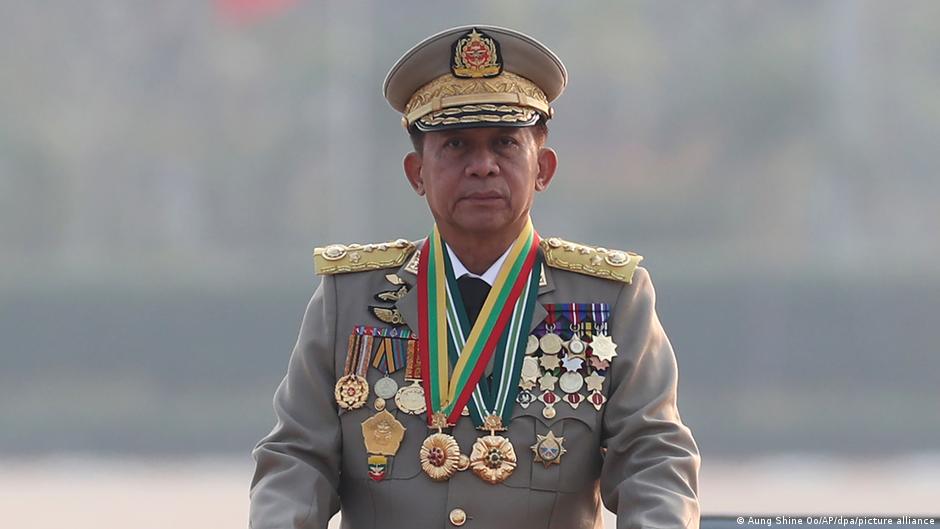
Myanmar’s new parliament elected Min Aung Hlaing as president on April 3, formalizing the junta chief’s hold on power under civilian rule.
The 69-year-old general won 429 votes out of 584 in a parliament dominated by the military-backed Union Solidarity and Development Party (USDP) and a separate large group of junta-appointed representatives.
The parliamentary vote was the culmination of a tightly managed transition designed to place the armed forces at the center of power.
Min Aung Hlaing led the February 2021 military coup that overthrew the democratically elected National League for Democracy (NLD) government of Aung San Suu Kyi and plunged Myanmar into civil war.
After decades of direct or indirect military rule, the NLD won a landslide victory and formed the government in 2015, followed by another victory in 2020. The generals alleged fraud and staged a coup in early February 2021, despite international observers finding no evidence of serious irregularities.
was a never ending citizen
Even after five years, Myanmar is stuck in civil war. The army still captures the main cities and key state institutions, but it controls only less than half of the country’s total territory, with border areas and large parts of the countryside contested or captured by resistance forces.
This February, the United Nations reported that about 6,800 civilians have been killed and 3.6 million displaced in the conflict since 2021, although other groups have put the death toll far higher.
Recent elections paved the way for Min Aung Hlaing to become president, bringing an end to the bloodshed that never seemed likely. While the junta managed to hold elections in three phases between late December and late January, voting took place in only 265 of Myanmar’s 330 townships due to fighting.
The United Nations, Western governments and rights groups said the competition was neither free nor fair. Anti-junta parties were shut down and criticism of the election was effectively criminalized. Former civilian leader Suu Kyi, now 80, is currently serving a 27-year sentence on charges including corruption.
The USDP won 81% of the available elected seats. Under the current constitution, one-fourth of the assembly seats are reserved for the military.
Min Aung Hlaing eyes strong recovery in 2021
Min Aung Hlaing has also created new mechanisms to ensure that even this nominal civilian government does not undermine military authority.
Most notable is the new five-member Central Advisory Council, which analysts describe as a super-body sitting above the executive, legislature and judiciary. In fact, the army chief has not walked away from power but has redistributed it among the institutions that he and his allies still dominate.
This transition to “civilian government” is far from democratization, Yoshihiro Nakanishi, a professor at Kyoto University’s Center for Southeast Asian Studies, told DW.
“Rather, it is an attempt to formalize military rule and treat a 2021 military coup as fated,” he said.
Myanmar’s collapsed economy faces new fuel crisis
The country’s economy has been torn apart by war, sanctions, capital flight and chronic power shortages. Now, Myanmar also faces the war in Iran and disruption to shipping through the Strait of Hormuz.
Because Myanmar relies heavily on imports of refined fuel from Singapore and Malaysia, higher oil prices and shipping costs are likely to directly impact transportation costs, inflation and daily hardship in cities already struggling with blackouts.
Myanmar’s junta has already started fuel rationing for private vehicles.
“The energy crisis presents a serious additional challenge for any administration that is trying to revive a weak economy while facing competition for control across the country,” Mo Thuzar, senior fellow and coordinator of the Myanmar Studies Program at the ISEAS-Yosof Ishak Institute, told DW.
“The state of civil war in Myanmar has not abated over the past five years, nor has the military’s determination to ‘fight effectively against terrorists,'” Thujar said.
Junta increased use of drones
Recent battlefield trends also do not suggest any imminent success for either side.
After suffering major reverses in 2023 and 2024, the junta adapted by expanding membership, increasing the use of drones and leaning more on air power.
In December, the army made limited gains in some areas, although no single force dominates front lines across the country.
At the same time, airstrikes have intensified and are causing heavy civilian casualties, especially in Sagaing, Rakhine and other conflict-affected areas.
Civil war ‘could intensify’
Min Aung Hlaing stepped down as military chief last month after spending 15 years in the post, before assuming the presidency.
He has been replaced by close aide General Ye Win Oo. The new junta leader is a former spy who led the troops who arrested Suu Kyi during the 2021 coup. Analysts and defectors say Ye Win Oo’s rise is largely attributable to personal loyalty and patronage, and his appointment points to continuity rather than moderation.
Resistance forces, for their part, have remained resilient and announced a new umbrella organization just ahead of Min Aung Hlaing’s presidential vote.
“The Spring Revolution and the country’s civil war are likely to continue and may intensify,” Sabe So, director of the NGO Burma Center Prague, told DW.
“Even amid these ‘formal’ political developments, the military has continued to carry out airstrikes against civilians. The humanitarian situation and the level of repression are expected to worsen in the coming months,” he said.
The activist also said it is important for the international community not to be misled by these “developments” and to provide legitimacy to the junta-led political system.
ICC prosecutor wants arrest warrant against Min Aung Hlaing
There is still room for some movement inside the regime camp, especially as the military, civilian representatives and business interests adapt to the new structure.
One person to watch is USDP chairman and former police chief Khin Yi, who was elected speaker of the lower house of parliament in March.
Hunter Marston, a non-resident adjunct fellow at the Center for Strategic and International Studies (CSIS), told DW that Khin Yi’s initial steps will reveal whether parliament is expected to do anything beyond rubber-stamping decisions from above.
“Parliament will likely try to enact modest political and economic reforms to stimulate growth and re-attract international investors,” he said.
“But I’m not holding my breath for any overnight change or democratization more broadly.”
Even as president, Min Aung Hlaing remains under international scrutiny for alleged atrocities.
The International Criminal Court prosecutor sought an arrest warrant for him in 2024 over alleged persecution of the Rohingya.
More democracy or more dictatorship?
China has already congratulated the new administration, and some neighboring states may find it easier to engage with a nominal civilian government than a direct junta. But the diplomatic approach does not change the underlying balance of power inside Myanmar.
Nakanishi said, “The fact that the military’s top commander has taken off his uniform and assumed the presidency shows that the military’s accountability system is not working.”
“The new government is likely to become even more of a personal dictatorship,” he said.
Edited by: Srinivas Majumdaru