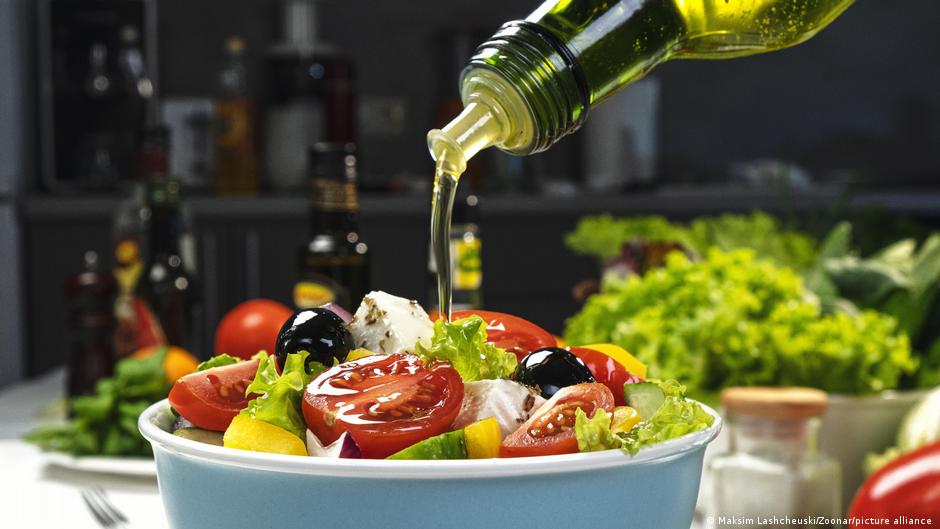
It makes sense to squeeze every last drop of milk into our coffee and drizzle the remains of our expensive olive oil onto our salads – so we stand in our kitchens holding bottles or cans at awkward angles, waiting and watching with varying degrees of patience.
How long do we have to wait? That’s what two physicists from Brown University in Providence, in the US state of Rhode Island, wanted to know. their conclusions were published in the magazine physics of fluids.
Thomas Dutta, a PhD candidate, recalls how his grandmother had to struggle in her last few years to drop out of school. And his physics professor, Jay Tang, also knew what it felt like to stand in his kitchen, wondering how long it took for the water to drain from his cast-iron pan after washing it.
examining everyday science
Tang typically researches the biophysics of bacteria – specifically, how single-celled organisms move and how bacterial swarms spread on wet surfaces. This research requires a deep understanding of fluid mechanics. To help Dutta understand these concepts, Tang decided to focus on everyday physical phenomena.
Take, for example, the problem of washing his pan. Professors do not dry it with a cloth as this can remove the vital oil layer that prevents food from sticking. But, if the pan remains wet for too long, the remaining water can evaporate and cause rust.
“When I pour out the water after washing, there is always a film of residual water,” Tang said. “So I usually wait a few minutes to let a layer of water collect at the bottom and then dump it out again.”
But are those few minutes enough to collect as much of the remaining water as possible so it can be flushed out? To find out, the researchers calculated the waiting time required for the fluids to drain out. Among other things, he examined the milk, olive oil, maple syrup, and water collected in Tang’s cauldron.
Fluid Mechanics and Maple Syrup
Tang and Dutta calculated the time required using the Navier–Stokes equations, which measure the motion of fluids and gases such as water, oil and air.
After physicists estimated how long it would take for a fluid to flow down an inclined surface, they tested it in experiments. He allowed the liquid to fall down a plate inclined at an angle of 45 degrees. By weighing the flowing volume, they determined when 90% of the liquid had evaporated.
Experiments basically confirmed his hypotheses. The water ran out within a few seconds. For a low-viscosity fluid such as milk, it took about 30 seconds for a 90% thin liquid film to drain. Thick olive oil, on the other hand, took more than 9 minutes to make. It took several hours to make the chilled maple syrup.
And the “woke problem”? Using fluid dynamics equations, Dutta developed a computer simulation to determine the optimal waiting time to collect the water remaining in the pan.
“I was surprised and actually a little disappointed,” Tang said. “I usually only wait a minute or two, but it seems I need to be more patient.” Dutta’s calculations showed that it took about 15 minutes for 90% of the remaining water to collect at the bottom of the pan.
A German prize for ‘playful’ science
An award has been created for scientists working to answer strange questions. Mario Marcus Prize for Ludic Science Honors research in the natural sciences that is known for its inventive curiosity. Ludus comes from Latin and means “to play.”
The prize, worth €10,000 ($11,600), is being awarded by the German Chemical Society from 2022. The award was initiated by Mario Marcus, a German-Chilean physicist who conducted research at the Max Planck Institute for Molecular Physiology and was influential in the field of “ludic science”.
Discoveries that have left their mark on the way we live our lives often emerge from playful experimentation and a dose of curiosity.
Element of chance helps researchers
Alexander Fleming discovered penicillin only because spores of molds of the genus Penicillium accidentally fell on bacterial cultures that he wanted to use for experiments. Fleming observed that many bacteria died as a result.
Charles Nelson Goodyear accidentally dripped a mixture of natural rubber and sulfur onto a hot stovetop – after this, the rubber became significantly more elastic, stronger and stable. Just like that, vulcanization of rubber was discovered.
And we have a lady named Kay Random to thank for Play-Doh. A kindergarten teacher realized that a moldable wallpaper cleaner was popular for entertaining kids — and she came up with the name Play-Doh, which is now used in nurseries and playrooms around the world.
This article was originally written in German.