
The tokens were issued and released in several batches of 250 million each.
Despite the rise of USDC, the stablecoin is still far from its main rival, USDT.
The Circle company marked a historic milestone so far this year by issuing more than 3.25 billion tokens of its stablecoin, USD Coin (USDC), between the last week of March and the first week of April 2026.
This operation, executed entirely on the Solana network, represents the largest weekly issuance volume of a stablecoin recorded so far in 2026, according to records from the Woo Blockchain portal.
The creation of these new assets was carried out through an organized technical process, where the tokens were issued and released in several batches of 250 million eachas seen below.
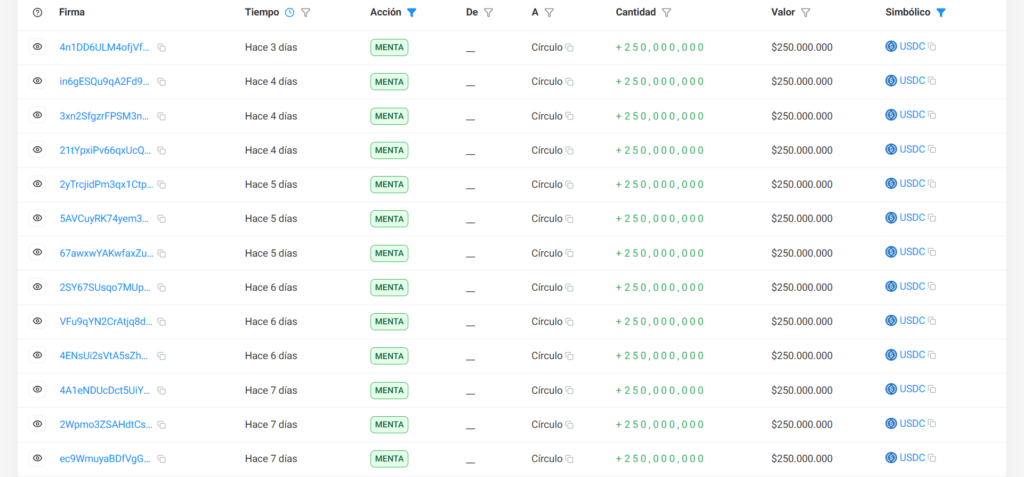
The choice of Solana as a base for this expansion may respond to the technical advantages of its infrastructure. This network is characterized by having high speed and low transaction costs.
The constant flow of capital is the direct result of increasing demand within the sector. As reported by CriptoNoticias, on March 12, records confirmed that stablecoin activity in Solana tripled in the first quarter of the year, going from $306 billion to $972 billion annually. This 3.2x growth in activity underlines operators’ confidence in Solana’s architecture to manage massive financial flows.
The competitive gap versus Tether’s dominance
Currently, USDC has a global market capitalization of 77,462 million of dollars. Of that total, 7,967 million dollars circulate specifically within the Solana network.
Despite the record growth experienced by Circle, the stablecoin continues to occupy the second position in the market, considerably far from reaching its main rival, USDT, issued by the Tether company.
The gap between both organizations remains deep, while Circle’s assets approach $78 billion, USDT boasts a total capitalization of 184 billion of dollars.
Curiously, Competition within the Solana network is won by USDC with 8 billion dollarsexceeding the $2.67 billion that Tether maintains on the same network.