The search for stability in an economy marked by volatility finds a new playing field in cutting-edge technology. In exclusive coverage by CriptoNoticias during the recent Global Crypto Summit 2026 on Margarita Island, the Venezuelan Chamber of Electronic Commerce (Cavecom-e) presented a proposal that seeks to integrate Artificial Intelligence (AI) and the infrastructure of cryptocurrencies to try to mitigate the effects of the country’s financial deterioration.
The initiative arises at a critical moment. This taking into account that Venezuela closed 2025 with a inflation of 475.28%, the highest in the world, after a dramatic acceleration compared to the 48% registered the previous year. This context accelerates the need for innovative solutions.
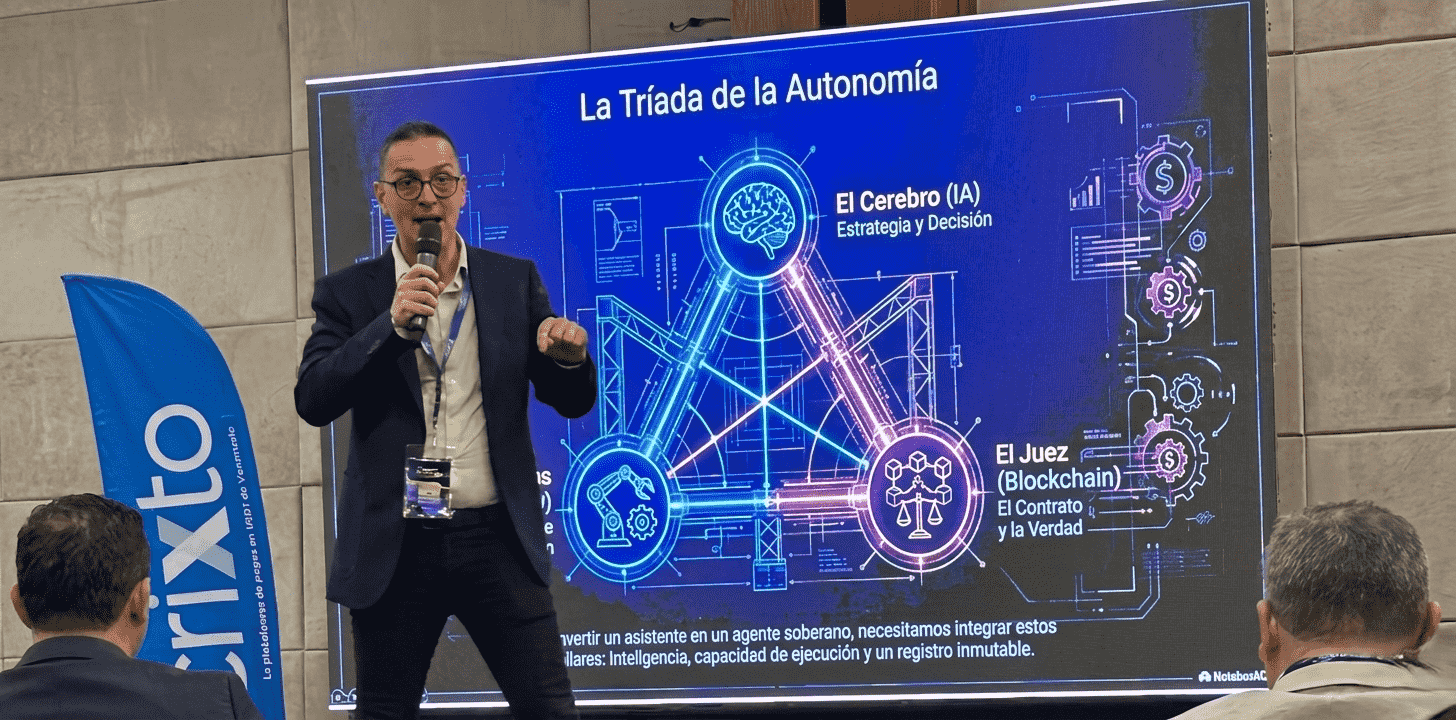
Engineer Carlos Moreno, national director of Cryptoactives of the chamber, detailed what it calls a “machine-to-machine economy” (M2M). The concept proposes moving the execution of financial processes from institutional discretion to an immutable code, which promises greater transparency.
Artificial intelligence can help economists and the Central Bank solve hyperinflation, allowing decisions to be made in real time and monitoring variables that previously took months to process. Within an interconnected economy, these tools allow an immediate response to volatility, transforming citizen resilience into a structural solution.
Carlos Moreno.
Under this model, treasury systems would operate through algorithms that execute payments and arbitration in real time, seeking to reduce transaction costs and opacity to operate in the Venezuelan market. Thus, an automation that responds directly to the current economic panorama is sought.
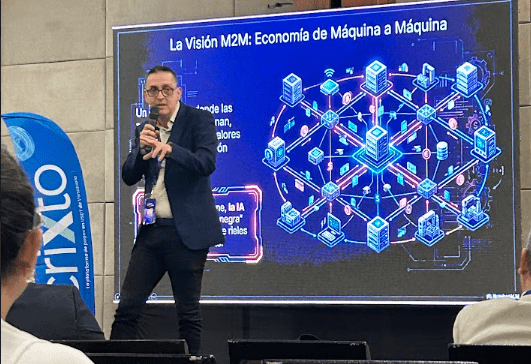
We can hack country risk by converting political volatility into mathematical confidence. If the funds are managed by autonomous on-chain auditable agents, the rules of the game cannot be changed arbitrarily, which guarantees the transparency necessary to attract foreign investment.
Carlos Moreno.
This urgency for automation responds to a complex panorama; After a year of editorial silence, the Central Bank of Venezuela (BCV) revealed in March 2026 that the accumulated inflation of the first two months already reaches 51.94%, raising the annualized projection to 617.8%. These recent data underscore the persistence of the problem.
However, faith in technology collides with a persistent economic reality. Although AI can bring efficiency to the supply chain, analysts they point out the need to correct the fiscal imbalance. Without reforms that stop the inorganic monetary issue, a strictly human and institutional faculty, The impact of digitalization will be limited.
Meanwhile, price dynamics remain tied to an aggressive depreciation of the bolivar, which lost 82.7% of its value in the official market during 2025. At the end of the first quarter of 2026, the gap between the official dollar (474 bolivars) and the parallel dollar (650 bolivars) exceeds 30%, a distortion that makes the implementation of any automated pricing system difficult.
Organic survival with cryptocurrencies vs state policy
“AI and cryptography are not magic,” Moreno acknowledged, emphasizing that any digital architecture requires the coordination of economists and the issuing entity. The proposal would be generating an inevitable debate about the effectiveness of “top-down” digital governance in a country where the use of cryptocurrencies was born as a citizen survival response and not as a State plan, as CriptoNoticias has previously reported.
AI is seen as a black box: we know that it does things, but not how it does them. By integrating blockchain, we turn that uncertainty into a 100% traceable and immutable record; This is where we remove the ‘black box’ label and build true rails of trust for finances.
Carlos Moreno.
Regarding the role of Cavecom-e in the face of citizen decentralization, Eleazar Colmenares emphasized the urgency of mass training. According to the spokesperson, the primary objective is also decentralize knowledge, ensuring that digital tools and their technical understanding reach all levels of Venezuelan society. This vision complements the technical approach.
Doubt remains about whether a system based on AI and blockchain can be functional in an environment of irregular electrical infrastructure and connectivity like that of Venezuela, which represents a key practical obstacle.
For now, this roadmap remains in the technical field of Cavecom-e, although with a clear vocation for openness. During his speech, Moreno made a direct call to researchers and academics to deepen the development of alternatives that allow scaling the use of AI and cryptocurrencies as monetary stabilization tools.
The success of this ambitious architecture will ultimately depend on whether the country manages to transform its digital resilience into a coordinated policy; one that is capable of attacking the root causes of inflation beyond the necessary efficiency in its digital processes.