
Nic Carter, Bitcoin investor and analyst, stated that in the face of the quantum threat “these times require a dictator.” According to their analysis, the network needs centralized leadership to coordinate a response that Bitcoin’s current governance would be unable to produce.
“Bitcoin governance is spectacularly inadequate for a threat that has an uncertain timeline and requires full mobilization,” he said in a statement. interview published this April 6.
Carter also stated that «the system (Bitcoin) is now in a state of total stasis (paralysis, immobility) with people who are influential»he said, “but no one will admit that they have any real influence on what is implemented in Bitcoin.” He added: “The whole structure is leaderless… it basically runs on autopilot.”
Additionally, in mid-February, Carter had stated that the Bitcoin developers “They are not doing anything” against the quantum threat, a statement that prompted a public response from Adam Back, co-founder of Blockstream, who described it as “false and insulting,” as reported by CriptoNoticias.
Carter is an investor, not a cryptographer or Bitcoin developer. His statements about governance and timelines are readings from the financial world, not technical analysis.
Like any investor, you might be motivated by your interests. If the quantum threat creates urgency in the market, that directly affects the value of your positions and your work. That possibility doesn’t invalidate his arguments, but it might explain his perspective.

The deadlines that Carter estimates
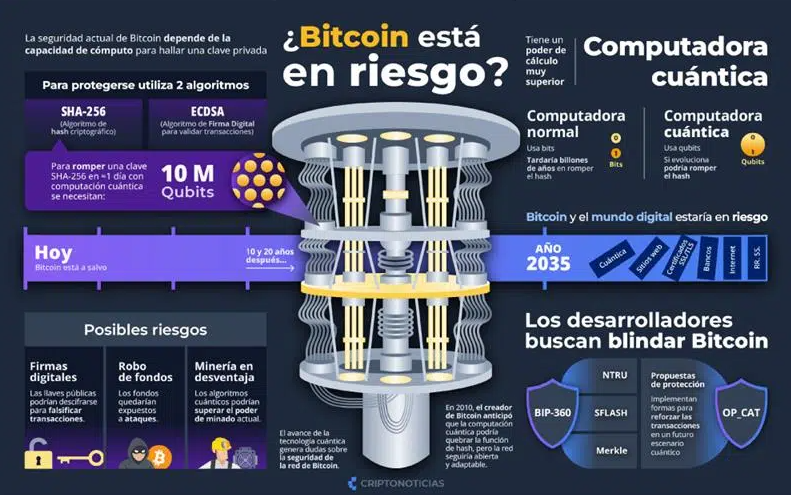
On when a quantum computer could compromise Bitcoin’s cryptography, Carter offered his own estimate: “between 2030 and 2035based on the extrapolation of progress rates. With the concept of “progress rates,” the investor assumes that the pace of quantum hardware advancement will remain constant, although other experts warn that this progress tends to occur in irregular leaps, not linearly.
That range is shorter than that of other participants in the debate: Samson Mow, the firm ARK Invest and Adam Back place the threat between 10 and 20 yearswhile Vitalik Buterin and Charles Edwards place it in 2028.
On the other hand, with respect to the time needed to complete the transition once it has begun, Carter estimated that “a reasonable horizon is 7 years and maybe you can push it to 2 years”.
That means that if Q-Day comes in 2030, Bitcoin should have started the migration before 2028 to have any chance of completing it in time.
Satoshi coins and institutional power
Nic Carter also referred to Satoshi Nakamoto’s coins: the approximately one million bitcoins (BTC) attributed to the protocol’s creator that have not been moved for years and whose private keys probably no one controls. In a post-quantum scenario, those currencies would be vulnerable because their public keys are exposed on-chain.
If you burn Satoshi coins, we will have arbitrarily changed the supply of Bitcoin… the whole point of Bitcoin is that no one interferes with the money supply.
Nic Carter, investor.
Burning those coins would reduce the total supply of 21 million BTC, something that contradicts one of the protocol’s founding principles.
However, Carter predicts that decision could be forced from outside the developer ecosystem. “My guess is that the top 10, 15 or 20 custodians will sign a letter saying: we will only honor a fork where Satoshi coins are burned.” And he added that “institutions will be forced to choose: either delist Bitcoin or insist that the coins be burned.”
That prediction is a projection by Carter, not an announced fact. But if it were to materialize, it would imply that decision-making power over Bitcoin supply would be in the hands of centralized actors, a structural contradiction with the philosophy of the protocol that Carter himself recognizes.
In this framework, Carter proposes that Bitcoin does not have the governance structure to respond to a threat with an uncertain schedule, that ‘Q-Day’ could arrive sooner than the ecosystem assumes, and that the decision on Satoshi coins could end up being forced by institutions external to the protocol.