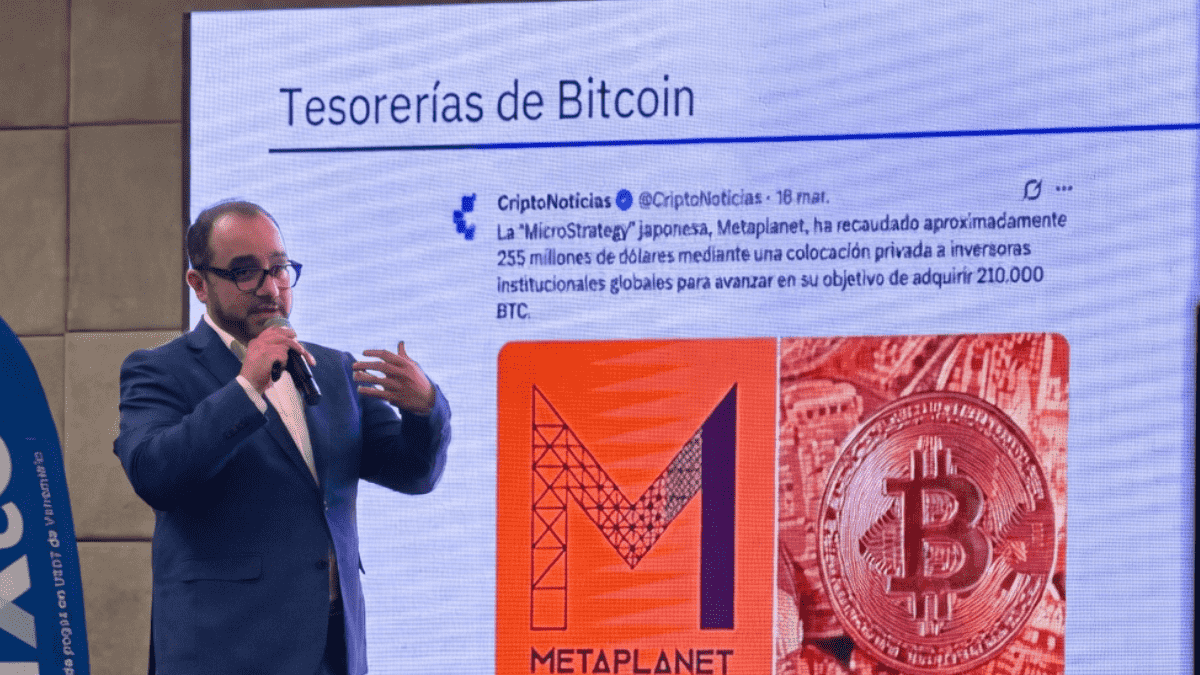
The search for a financial refuge in Venezuela ceased to be an individual survival tactic and was integrated into the planning of some boards of directors. In an ecosystem that is still assimilating the 475.28% inflation recorded in 2025, a sector of the business community is looking for alternatives to the de facto dollarization that prevails in the country.
During the recent Global Crypto Summit 2026 held in Margarita, a trend that is handled with caution was analyzed: the fact that Local firms already allocate part of their assets to bitcoin (BTC) as a strategic reserve.
This evolution in capital management responds to a technical need. For the private sector, the persistent volatility of the bolivar transforms value preservation into a highly precise task.
“Yes, there are companies with the vision of accumulating BTC as part of their treasury in our country,” confirmed Aníbal Garrido, director of the BT&C Academy at the Andrés Bello Catholic University, exclusively to CriptoNoticias.
Despite the confirmation of this trend, the names of the companies involved and the amounts of their positions are kept strictly confidential. Garrido explains that This information secrecy is a self-protection measure in an environment where the exposure of financial assets can entail unnecessary risks.
“Any person, whether natural or legal, has the power to safeguard their financial information as a measure to protect their assets,” said Garrido. Not exposing the possession of assets to third parties is a right of protection that, in the Venezuelan context, reinforces the thesis of bitcoin not only as a financial tool, but also as an institutional privacy shield.
The institutional mirror of Strategy and the Venezuelan contrast
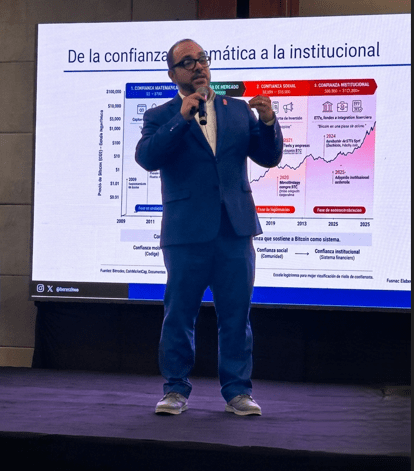
The Venezuelan phenomenon attempts to follow the institutional maturation seen in global markets, where giants like BlackRock have legitimized bitcoin through exchange-traded funds (ETFs). Based on this, Garrido presented the model of Michael Saylor and Strategy to those attending the Summit. as the global reference of this transition towards digital assets.
Explaining how a publicly traded corporation has transformed its balance sheet through the systematic accumulation of bitcoin, the specialist caught immediate attention of the auditorium. Many of the entrepreneurs present showed a marked interest in replicating this reserve of value strategy, adapting it to the particularities and challenges of cash flow in the Venezuelan market.
Following in Strategy’s wake, some local companies see supply limited of 21 million coins a mathematical scarcity that central banks cannot offeras explained by the director of BT&C.
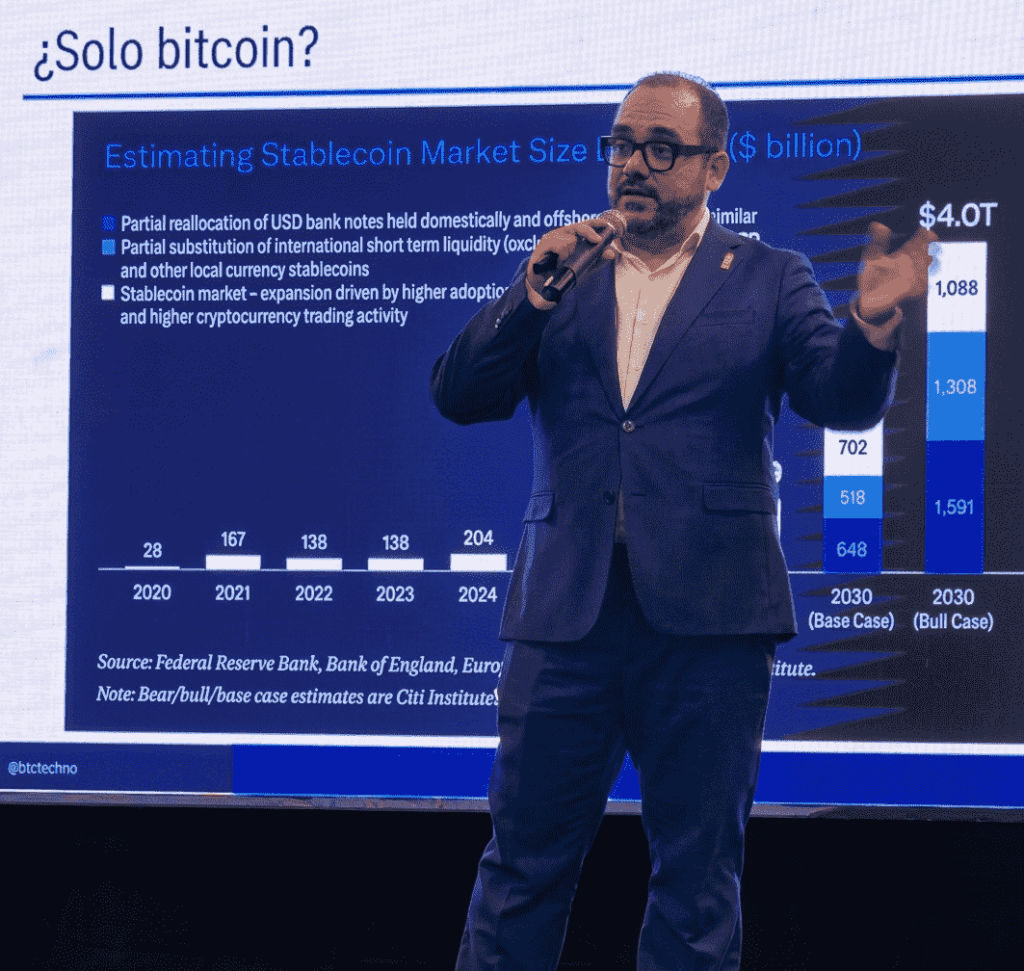
In that sense, Garrido highlighted that cryptocurrencies are no longer a case study, but a necessity for Venezuelans. Thus it became clear that in the country a hybrid model prevails. While 30% of companies mainly use stablecoins such as USDT for daily operations, others are already beginning to look towards bitcoin as a long-term store of value asset.
Is a new standard born for the national industry?
The path to creating digital treasuries with cryptocurrencies faces structural challenges. Bitcoin price volatility remains the main argument for caution. Added to this is Venezuela’s regulatory framework, which, after periods of institutional restructuring, requires millimeter surveillance to guarantee tax compliance and avoid sanctions.
In this context, some Business sector participants evaluate the mechanisms necessary to incorporate bitcoin into treasuries. Some have already begun to deploy the strategy. As an example is the case of Ramón Otero, representative of a firm with eight years of operation in Puerto Cabello, Carabobo, in the central region of Venezuela.
The businessman commented to this medium that his company already allocates approximately 20% of your invested capital to bitcoin as part of its long-term value preservation strategy.
Otero added that he has provided advice to other companies to take a similar approach. However, to date there is no independently verified information on the real volume of its operations or external audits of its portfolio.
At this point, Garrido gives a warning to those interested in integrating BTC into their treasuries: “Preparation in accounting and cybersecurity is essential.” The specialist points out that adopting bitcoin as a store of value requires much more than just buying it.
Companies need personnel trained in cryptoasset accounting, proper treasury management, robust cybersecurity protocols, and clear regulatory compliance. “Without this professional training, the risks are too high,” he insisted.
This is how, despite the difficulties, the incorporation of digital currency as a reserve is emerging as a new trend in the Venezuelan market, while the country’s transactional reality maintains its pillars intact. The use of physical and digital dollars together with USDT continues to be the main driver of the economy.
On a day-to-day basis, the US currency and stablecoins are used as backup. They dominate due to their immediate stability, facilitating trade.
In this context, what defines this emerging group of companies is the differentiation of its assets: the dollar to spend and bitcoin to save. This coexistence reflects a financial architecture that seeks to diversify risks in one of the most complex environments in the world, where technology tries to offer the predictability that traditional institutions have not yet managed to consolidate.