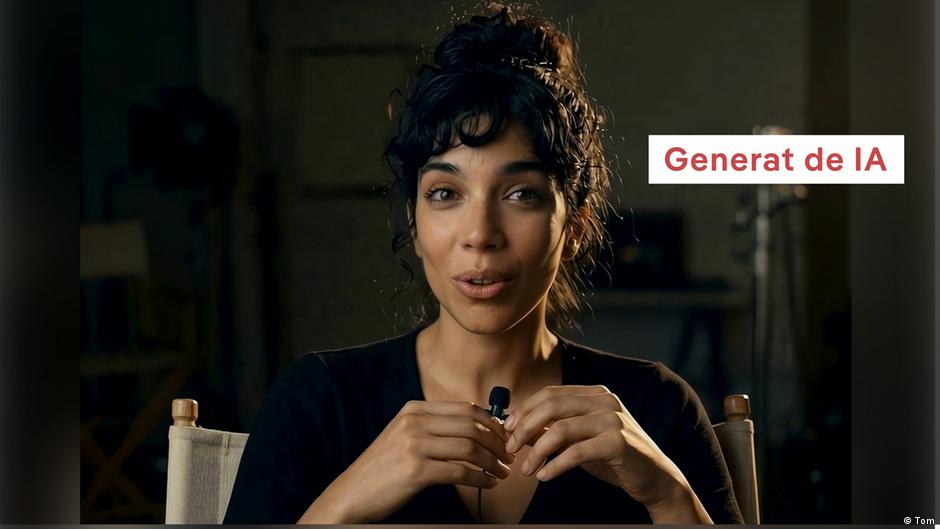
Millions of Romanians are listening to Lolita Circel, a sharp-eyed singer who highlights the plight of those on the margins of society. His videos have received millions of views on social media. But Cercel does not exist in reality.
She was completely created by AI. Circel, which means “earring” in Romanian, is the title of the virtual singer’s first song and became her last name. Every aspect of Lolita Circel, from her face to her voice, was created by a Romanian graphic designer who wishes to remain anonymous and is known only by the name “Tom”.
Tom has described his musical style of composition as “Balkan trip-hop”. But for many listeners, it sounds a lot like Romanian manele, a genre of pop folk music that has Ottoman influences and can be compared to the turbo-folk of the former Yugoslavia. In Romania, the music is often associated with the Roma community, although it has long since become mainstream.
Inspired by a 1941 poetry collection
Tom used to rap when he was in school and then he studied to become a film director without any great success. Years later, he received a collection of poems titled “Cantes Tignesti” by Romanian poet Miron Radu Paraschivescu in 1941. Today, many members of the Roma community consider the title, which translates as “Gypsy Song”, to be offensive. The book was published during World War II, when the Roma community of Europe was going through the worst period in its history. Thousands of people were murdered and deported by the Nazis and their Romanian collaborators in the Romanian capital, Bucharest.
Paraschivescu, who was not a member of the community, wrote sympathetically about the Romani people. However, he was an outsider writing poetry, not a historian of a distressed community.
But it was his songs that inspired Tom to try his hand at music again. And he was able to do this thanks to new technological possibilities. He said, “Lolita was created when my curiosity and the tools I had got to the point that I could create the sound I wanted.”
He worked on his character for four months and said he was inspired by his hometown in eastern Romania, as well as people living in precarious conditions in the southern European periphery. He reportedly found inspiration during evening walks with his dog – “unfiltered, grammatically imperfect, vivid words.”
‘If it looks like a duck and quacks like a duck, it’s a duck.’
Tom claims that he made it clear from the beginning that Lolita Sercel was an AI-generated character. However, he insists that he did not create the Roma character. She says her character is “just a woman from the Balkans”.
For many people in the Roma community, this is not the issue.
Alex Stein of the non-governmental Budapest-based Roma Education Fund says there is something problematic about Lolita Sercel. He says their name, appearance, musical style and references to spiritual practices common in Romani culture come together to form a clear pattern: “If it looks like a duck and quacks like a duck, it’s a duck,” the Roma human rights activist told DW. She said Tom’s project was fraudulent because Lolita Cercel could not relate to “the highly complex experiences of a Romantic woman” and neither could its creator.
Alexandra Finn, a young Roma activist from the north-western city of Cluj, was one of the first to publicly criticize the project as “the instrumentalization of Roma culture”. He said that while actual Roma artists were often devalued, “virtual, racialized and dehumanized Roma identities” had suddenly found success. “The difference is racism,” she said with biting sarcasm.
Experience is an ‘ingredient, not the entire recipe’
Tom rejected the criticism, saying that art should not be based on personal experience. In a video message prepared for DW, Lolita Sercel defended herself: “A writer does not have to be a murderer to write a compelling crime novel; a deaf musician can create a symphony.” Experience is “an ingredient, not the entire recipe.”
Alex Steyn isn’t convinced: “It’s particularly the live performance that makes Romantic music so special,” he said. “It’s a completely different experience from a studio recording, let alone an AI-generated product.”
Besides, he said, there are a lot of genuine voices that want to be heard: “We have many Roma artists who want to make a name for themselves.”
The problem is structural, he said: While a fictional character can go viral, many real artists remain invisible, held back by barriers in the music industry. “It gives the impression that there is a platform for Romani music – but without Romani people.”
Stan cited as a counterexample the Bosnian composer Goran Bregovic, who achieved international success with music influenced by Romani culture. He explained that his success came after years of collaboration with Romani musicians. She notes that German producer Stefan Hentel, known in the music industry by her stage name Chantel, has also worked with real musicians to create her Balkan pop – including some from Romania. Tom, on the other hand, left the process to an algorithm, Stan said.
For Romanian musician Cristian Stefanescu, whose stage name is “Electric Brother”, Lolita is more interesting than what can be heard on commercial radio. But he admits that “If she were a real singer with this material, she probably would have been rejected. Because she’s different. And the industry doesn’t want anything else.”
Tom does not share the broader concern and is continuing to work on the world of Lolita Sercel as well as new characters and potential partnerships. For him, AI means that creativity can be democratized. But to his critics, it is a tool of exploitation that has allowed him to appropriate the stories of a minority group, of which he is not a member, and monetize them without including anyone from the Roma community.
Whether poetic or satirical, Lolita Sercel summarizes the paradox: “When you listen to my music and feel something, you are not thinking about me, but about yourself. I’m just an excuse.”
This article was translated from German.