
Debt and equity issues will have automatic authorization to expedite credit.
A cap of 5% investment per project is established to protect the assets of savers.
Access to the capital market in Argentina is going through a paradigm shift that reduces the historic gap between small savers and corporate financing. Through General Resolution 1125/2026, the National Securities Commission (CNV) formalized a scheme that debureaucratizes financing and formally integrates digital assets, such as bitcoin (BTC), into the legal system, placing the country on a cutting-edge regulatory terrain in the region.
The great novelty of this regulations is that, for the first time, the holding of bitcoin, ether (ETH) and stablecoins It will be counted as part of the assets necessary to achieve the category of “qualified investor.”
To access this status, the interested party must demonstrate assets equivalent to 350,000 UVA, a pre-existing requirement that now recognizes the legitimacy of digital assets.
By including these holdings, the regulation allows those They prefer the solidity of bitcoin about traditional savings use that support to participate in complex financial instruments, validating an economic reality that was already operating de facto in the country.
As a counterweight to this openness, the rule maintains specific caution to protect the general public. Investors considered “non-qualified” will only be able to commit up to 5% of their net assets in a single project.
Likewise, the regulations clarify that the individual contributions of these investors may not exceed 3,000 UVA per operation, a safety cord designed to mitigate exposure to the volatility of variable income assets.
Crowdfunding with automatic authorization for Argentines
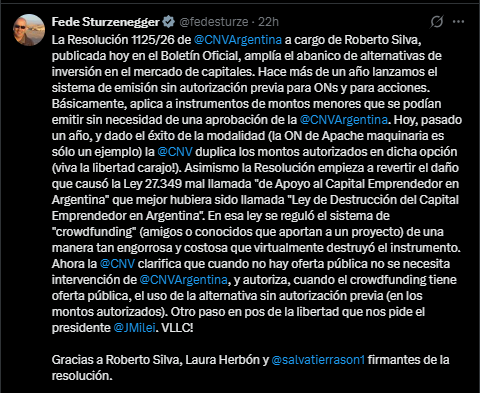
Crowdfunding, or crowdfundingis the other great beneficiary of this reform. The Government introduces an “automatic authorization” regime for the issuance of shares and bonds, eliminating the bureaucratic toll of previous state intervention that, according to productive sectors, made the instrument expensive and inoperative.
Under this new scheme, small businesses will be able to raise capital more directly. The Minister of Deregulation and Transformation of the State, Federico Sturzenegger, pointed out that the measure “expands the range of alternatives”, doubling the amounts authorized compared to the previous year to reverse the damage of previous regulations that suffocated entrepreneurial capital.
Despite the clarity of Official Gazette about the new legal framework, notable doubts persist to understand the real scope of the measure. Although the regulations now define “Virtual Assets” as any digital representation of transferable value, it does not specify the technical audit and valuation criteria for assets.
It is not detailed whether an official reference cash price will be used or what type of custodians or wallets will be valid to certify the ownership of these funds before the CNV.
Likewise, an unknown remains regarding the numerical impact and the census of investors, since the document does not offer projections on how many Argentines could achieve the status of qualified investor with this opening.
Finally, although the new limits of 3,000 UVA per transaction are established for the general public, it remains to be seen the immediate response of the fintech sector and which companies will be the first to use this automatic issuance system to capture the savings that today already reside in bitcoin.
Although the legitimization of these assets places the fintech industry under a new legal focus, The change sets a precedent on the nature of heritage.
Although the CNV has not yet specified whether all stablecoins (such as algorithmic or fiat-backed ones) will fall into the same category, the industry receives the signal as progress towards formalization.
The regulations, in force since April 7, represent a deregulation experiment that tests the maturity of the inversery the effectiveness of an environment with greater financial freedom. In this new scenario, bitcoin stops being an external guest and becomes a protagonist of Argentine capital.