The enigma surrounding Satoshi Nakamoto’s identity has become one of the most persistent investigative stories of the 21st century. After almost two decades of silence, the search for the creator of Bitcoin regains prominence this week, driven by the coincidence between a new investigation by the New York Times (NYT) and the upcoming premiere of the documentary Finding Satoshi.
This time, the scrutiny focuses on a direct counterpoint: the extensive article in The New York Times published on April 8, 2026 provides evidence that points towards Adam Back, while the documentary promises to rule out several recurring suspects.
On the one hand, the NYT points to new evidence about the origin of the protocol, forcing observers to compare versions found in real time, as reported by CriptoNoticias.
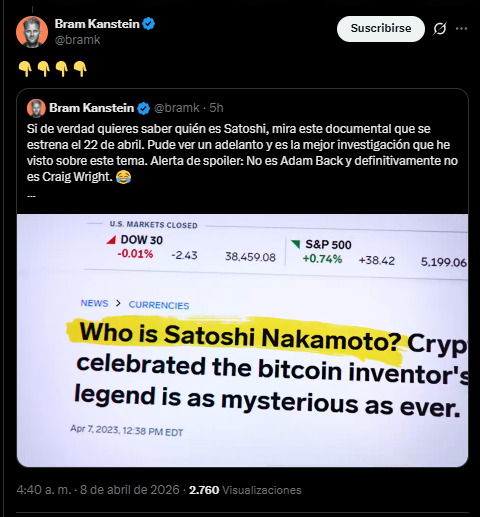
On the other hand, there is the promotion of Finding Satoshiwhich generates high expectations after four years of private monitoring. This is a production that, according to figures of the ecosystem as Bram Kanstein, host of the podcast Bitcoin for Millennialsassures have evidence to exclude recurring suspects like Adam Back and Craig Wright.
In any case, the text of the New York newspaper acts as a direct counterpoint to the documentary that It will be released on April 22where financial journalist William D. Cohan and private investigator Tyler Maroney seem to go in a different direction.
This synchrony of revelations reflects a current tension such as attempt to assign a human identity to a technology that today supports a global scale economy.
Evidence vs. narrative
In the midst of these new revelations, skepticism prevails as the majority response among users.
The initial reaction in the community has been largely skeptical. Adam Back immediately denied being Satoshi, attributing the coincidences to his long career in the cypherpunk world. Figures such as Jameson Lopp (Casa) pointed out that stylometric analysis does not constitute definitive proof, and recalled that only the movement of Satoshi coins would be irrefutable evidence.
This cautious attitude has as its close context an HBO documentary made in 2024, which tried to close the mystery by pointing out the Canadian developer Peter Todd as the real Satoshi Nakamoto.
That episode, after an intense debate, concluded without a clear consensus. That experience reaffirmed that, in the Bitcoin ecosystem, the community demands irrefutable cryptographic proof, such as the signature of a message from the original Nakamoto wallets. This, before accepting any conclusion as true.
The relevance of this discovery transcends biographical curiosity. According to online data analysis, Satoshi Nakamoto would have accumulated a fortune in bitcoin that has remained motionless since the creation of the system; a factor that generates constant attention among investors regarding the possibility that the creator, or his heirs, regain control of those assets.
Each new investigation, like the one published today by the New York Times, reopens the debate about the impact that A revealed identity would have on the stability and governance of the protocol.
Despite renewed media interest, a school of thought persists that Satoshi’s identity is, by design, irrelevant to the functioning of the system.
Bitcoin was conceived as a decentralized protocol that does not depend on a central figure for validation. While the public awaits the premiere of Finding Satoshithe fundamental contradiction of the ecosystem remains between the persistent human desire to identify an author versus a technology whose strength lies, precisely, in its impersonal nature.