The closure of shipping in the Strait of Hormuz does not just mean the stopping of oil tankers. Iran was creating a one-two punch to the world’s fertilizer supply, blocking exports and one of its key ingredients from moving out of the Persian Gulf. It remains to be seen whether Tuesday’s temporary ceasefire will significantly ease that disruption.
Nearly half of the world trade in urea, the most widely used nitrogen-based fertilizer, comes from the Gulf. As does one-fifth of the world’s liquefied natural gas (LNG).
A quick chemistry refresher: century old Haber-Bosch process Combines nitrogen from the air with hydrogen (that’s where LNG comes in) to create ammonia, which you need to make nitrogen fertilizer.
“This is literally a move out of the worst-case scenario,” Josh Linville, who tracks global fertilizer markets for commodities firm StoneX, told DW.
Fertilizer and LNG plants from Qatar to Bangladesh have already begun to shut down. What happens next depends on how quickly the strait reopens now that a two-week ceasefire agreement has been reached.
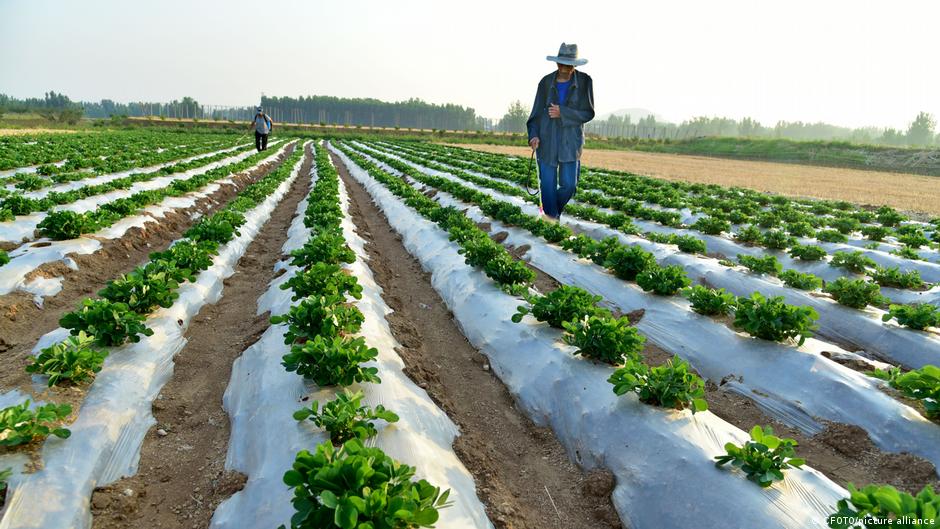
Amid fuel shortages and fertilizer problems, food prices are very likely to rise, with the world’s poorest countries bearing the brunt. Meanwhile, governments and farmers alike face tough choices about how to adapt.
Governments try to fill the loopholes
The quickest solution is for governments to increase market pressure to control supply or demand.
India has large reserves of rice and wheat which the government can use in case of a decline in supply. China, the world’s largest fertilizer producer, has huge reserves of fertilizer.
As fertilizer prices rise, some governments may even absorb those costs rather than passing them on to farmers. When Russia first invaded Ukraine in 2022, fertilizer supplies were dealt another major blow, India increased its fertilizer subsidy by 233% Above your original budget.
Countries can also limit the amount of their trade while keeping resources for their population China has done this several times since 2021.
The problem with any of these options is that they can often be zero-sum. When a country like China stockpiles fertilizer or chooses not to trade, it may help Chinese producers, but at the same time, it hurts farmers around the world. And these options are only available to rich countries. While India is able to subsidize fertiliser, nearby Bangladesh, Nepal and Sri Lanka probably cannot.
turn to other crops
Another option for farmers is to turn to less fertilizer-intensive crops.
Soybeans and other legumes have the natural ability to capture nitrogen from the air, requiring much less fertilizer than crops such as corn.
America has predicted that soybean sowing will increase An agriculture report released in late March projected a 4% decline from last year and a 3% decline in corn — and these forecasts are actually based on surveys conducted slightly before the fertilizer crisis began.
However this option is not available to all farmers. In Asia, there are a limited number of crops that can tolerate such heavy rains during the monsoon season, and staying away from rice while it is a dietary staple is not at all realistic.
“If you’re a rice producer in Southeast Asia, you don’t have as many crop options,” Joseph Glauber, former chief economist at the U.S. Department of Agriculture who now works with the International Food Policy Research Institute, told DW.
Distribute fertilizer more efficiently
If they can’t change what they plant, farmers can change the way they care for their fields.
Many farmers use too much fertilizer in the beginning. Estimates suggest that the world’s crops effectively use only about half of the fertilizer applied.; the rest dissolves in groundwater or evaporates into airAs nitrous oxide, a potent greenhouse gas.
There are all kinds of technologies that can help with applications: drones, cameras, even AI. This is an emerging field called precision agriculture that closely monitors crops and detects when and how much fertilizer they need.
While helpful, these tools may be expensive and inaccessible in the short term for farmers in poor countries. Even more important than the method is motivation, according to Avinash Kishore, a food systems researcher at the International Food Policy Research Institute.
When fertilizers are subsidized, farmers have little incentive to be careful in their application. But when urea prices rose in Bangladesh in 2022, farmers were able to use less and rice production remained stagnant.
“There is a lot of scope to use this resource efficiently,” Kishore said. “You don’t need a sudden injection of very expensive or complex technology.”
produce fertilizer differently
There have also been efforts to make fertilizer differently, so that worldwide shipping chokepoints don’t impact farmers as much.
Pivot Bio, an American startup, has developed a method of implanting microbes into seeds that can naturally convert nitrogen from the air into a form that plants can use. The company says its products could be used on 5 million acres in the US by 2023, reducing reliance on LNG.
But like precision farming equipment, the introduction of new technology is a medium to long-term solution, not one that can solve a short-term crisis. Countries first need to stabilize fertilizer supplies.
“We’re losing massive amounts of supply at a rate we’ve never seen before,” StoneX’s Linville said.
Edited by: Sarah Stephan