
Back considers that the bitcoin ecosystem still has “a decade” to prepare before ‘Q-day’.
Google and other companies foresee the arrival of the quantum threat by 2029.
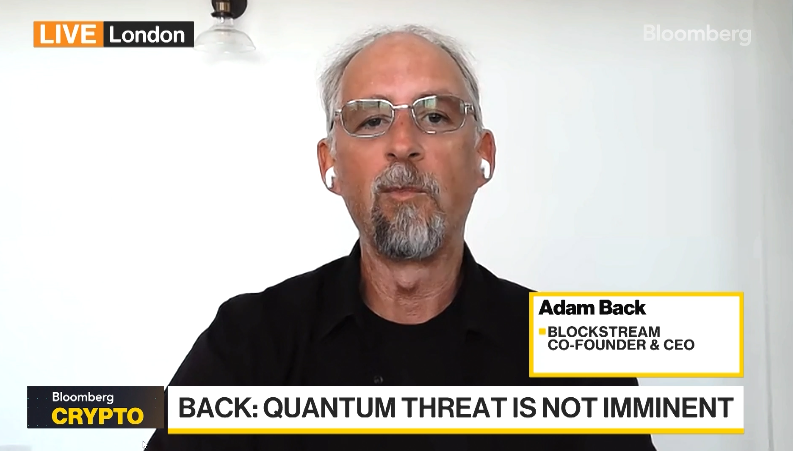
Adam Back, cryptographer, co-founder of Blockstream, ruled out yesterday during an interview with Bloomberg that the quantum threat to Bitcoin is imminent.
Their arguments are based on three points: that the current state of quantum hardware is “too basic” to represent a real risk; that preparation work is already underway; and that the ecosystem has enough time to migrate in an orderly manner.
As he explained, the most complex operation that quantum computers available today can perform is factoring the number 21 into 7 times 3, “the kind of thing that children can practice.” He added that this hardware, in addition, generally does not have bug fixes and? today it is “much slower than a calculator.”
Additionally, their estimate is that the ecosystem It’s about “a decade” old to prepare the migration of keys to post-quantum formats.
This perspective of the co-founder of Blockstream was already reported by CriptoNoticias previously, since in December 2024, Back maintained that the distance for the arrival of ‘Q-day’ was between “one and two decades.”
Another of Back’s most relevant arguments in the interview is not technical but communicational. “Negative news sells,” he said, “which is why advances in quantum hardware or algorithmic research get a lot of attention when talked about in terms of Bitcoin, while a team of 20 people publishing papersdeploying things and putting them into production doesn’t generate as much attention.
For Back, this imbalance creates a distorted perception: “There is a discrepancy between the recognition of the work being done and reality: things are on the right track,” he stated.
That observation coincides with what developer Greg Maxwell pointed out days before on the Hacker News forum, where he argued that part of the quantum panic in Bitcoin is deliberately fueled by actors with commercial interestsa fact reported by CriptoNoticias.
The work already in progress and Back’s vision
Back noted that the perception of inaction in the Bitcoin ecosystem does not reflect reality. “Blockstream has a 20-person research team that has been working on this for this year and the year before,” he said during the interview.
And it is not the first time Back has made that statement. The cryptographer, as reported by CriptoNoticias on April 2, had already said the same thing in a response to investor Nic Carter, who maintained that Bitcoin developers “are not doing anything” to protect the network.
In the April 7 interview, Back also mentioned that Blockstream presented several post-quantum signature proposals optimized for Bitcoin and some have already been implemented in the Liquid Network, the Bitcoin sidechain operated by the company. These developments correspond to SHRIMPS and SHRINCS, two of Blockstream’s own post-quantum signature schemes.
The Blockstream co-founder also noted that the post-quantum standards of the United States National Institute of Standards and Technology (NIST) were only formalized in November 2024, which would partially explain why the development of specific solutions for Bitcoin is relatively recent.

Companies and scientists urge to protect digital systems from quantum
Back’s statements come days after the paper published by Google Quantum AI, which states have reduced up to 20 times the necessary quantum resources to compromise the cryptography that protects the signatures of Bitcoin transactions.
Back’s description and estimate directly collide with the narrative of urgency promoted by reports such as the one from Google mentioned and other studies such as that by scientists from Caltech and Oratomic, published on March 30, the same day as that of Google Quantum AI.
This latest report, according to its researchers, drastically decreased the hardware needed to run the algorithm Shorthe quantum method capable of breaking the cryptography that protects Bitcoin signatures.
The milestone of the Caltech and Oratomic research was that the amount of physical hardware required to run Shor’s algorithm at a cryptographically relevant scale was theoretically reduced by two orders of magnitude (i.e., about 100 times), through advances in new types of error-correcting codes, more efficient logical operations, and optimized circuit design.
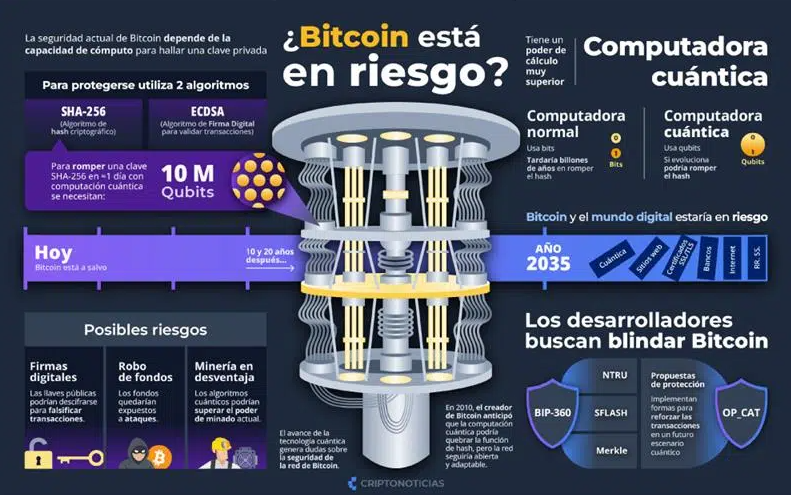
On the other hand, the company Cloudflare announced on April 7 a drastic restructuring of your security roadmapsetting the year 2029 as the new goal to achieve comprehensive post-quantum protection, coinciding with another Google report.
In this way, the post-quantum debate in Bitcoin now seems to lead to two defined narratives: that of those who point out that the deadlines are shortening and that the governance of the protocol is not prepared to respond, and that of those who argue that the technical work is progressing in a reasonable way and that the panic is disconnected from the real state of the hardware.