
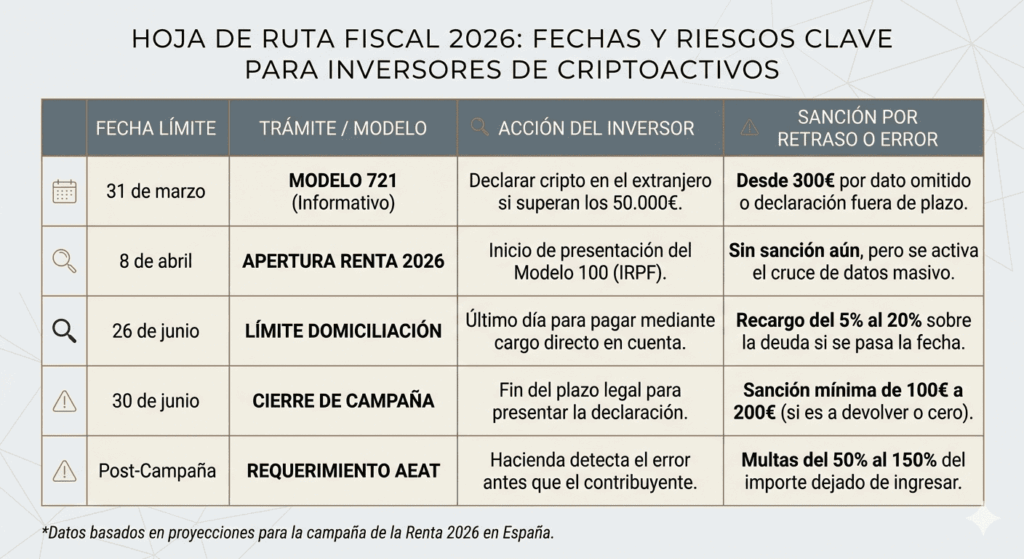
This April 8, the start of the Income 2026 campaign in Spain represents the consolidation of automated control over bitcoin (BTC) and cryptocurrencies. While thousands of taxpayers begin to report for the 2025 fiscal year, the Tax Agency activates a massive data crossing supported by artificial intelligence (AI) algorithms, closing the siege on an ecosystem that, until recently, many considered invisible.
Thus, the scenario for the investor changes its nature. If in previous years the main concern was market volatility, today the real risk shifts to regulatory compliance.
Errors or omissions in Form 100, such as ignoring small returns from remunerated accounts or not declaring swaps between crypto assets, They can lead to penalties of between 100 and 300 euros per omitted data.
However, this environment of greater scrutiny also offers a technical counterpart: the possibility of offsetting gains against capital losses to reduce the tax burden.
This strategy requires, above all, documentary precision. In practice, the declaration requires a rigor that Martins Sulte, a member of the digital investment sector, defines as essential to protect profitability. According to Sulte, The Treasury draft is just a starting point which often omits activity on international platforms.
“Document chaos” is the main risk for the user of digital assets
“The investor must have the reports from all his platforms in front of him and cross them with the Model 100. Without this step, the probability of error skyrockets,” he warns in an email sent to CriptoNoticias. He added that the final responsibility for the veracity of the data always falls on the taxpayer.
To delve deeper into the technical aspects of this campaign, we spoke exclusively with Esteban Rivero, the auditor behind the CeroUnoCrypto account. With a career forged in financial consulting, the specialist explains to CriptoNoticias that the investor’s greatest enemy is not the norm itself, but the lack of historical record. In his statements he offers a preventive vision:
My first advice is for the investor to know the tax impact of investing in cryptocurrencies. The second thing is that they keep good accounting; That is, they always have a good record of their history of what they did within the crypto world. They must always have all the transaction histories, either in Excel or in their wallets, to have that traceability available.
Esteban Rivero.

This traceability is, ultimately, the only defense against an administrative requirement. According to Esteban, the complexity of operating in centralized, decentralized exchanges or through P2P (peer-to-peer) transactions turns the declaration into a logistical challenge if it has not been planned in advance.
When you have to prepare the profit and loss report, if you do not have that order, it can be a real mess to leave the traceability clearly. If you buy P2P, make sure you save all those purchase receipts. The more information you have and the more organized it is, the better, because you will be able to defend yourself much better against any request.
Esteban Rivero.
This surveillance even extends to sectors such as gaming. As Rivero clarifies: «everything play-to-earn It is also taxed by the Personal Income Tax (IRPF). All those returns are collected and obviously taxed.
The bitcoiner’s dilemma: compliance or digital exile
On the other hand, tax pressure in Spain, which includes information tools such as Form 721 for assets abroad exceeding 50,000 euros, has generated responses that go beyond technical compliance.
For a part of the community, the solution is not accounting, but digital exile. This is the case of Rorschach, a Spanish bitcoiner who spoke with this medium under anonymity after moving his residence and assets outside the conventional system. Rorschach describes Spain as “the museum bar”, an excellent place for leisure, but sterile for building a future under a burden that he defines as suffocating.
From its “financial sovereignty” perspective, Rorschach criticizes taxes such as the Estate Tax, which taxes the mere possession of assetsconsidering it a “scheduled expiration of property.”
His story exposes a growing reality in the sector: the migration of capital and talent to jurisdictions with less aggressive fiscal frameworks. This “suffocation” is what Esteban seeks to mitigate through financial education, pointing out that “the reality is that in 99.9% of the cases [la planificación] “It doesn’t happen and only investors remember about taxation when the campaign opens, becoming a giant headache.”
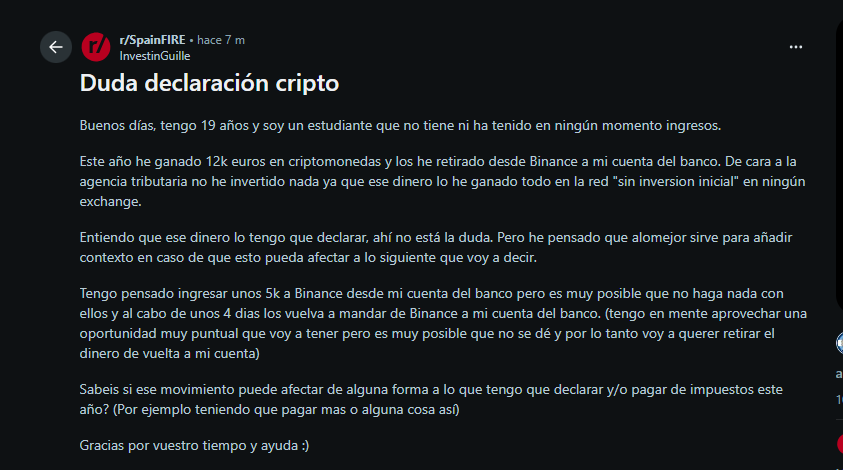
However, while the debate on tax equity continues to rage, the Tax Agency continues tightening the fence through the analysis of lifestyles and banking movements. Meanwhile, the Income 2026 campaign will remain open until June 30, leaving a narrow margin for those who have not yet organized their portfolios.
The lesson of this year, as Esteban concludes, is that improvisation has a direct cost in profitability. In a system where algorithms already know a large part of the taxpayer’s movements, order and information transparency become the only survival strategy for the digital investor.