
Melker rejects the super bullish positions that some analysts have shown.
In the past, bitcoin has had long periods of lateralization and this time would be no different.
Financial markets analyst Scott Melker warned that bitcoin (BTC) could remain without a clear direction for several more months, and even did not rule out a further decline.
His thesis goes against the most bullish readings of the market and is based on a simple argument: What’s happening now has happened before, and periods of lateralization in bitcoin tend to last much longer than investors would like.
On April 6, 2026, through a publication on his X. Melker account pointed out who found an uninspiring data in the historical price chart: “bitcoin made a low on February 5 at $62,353. Since then, it has been trapped in this range for 60 days in a row. And if you have been in this market long enough, you know that 60 days is nothing.”
That is the central point of his analysis. Melker maintains that the market could still be in a very early phase of consolidation. “If history is any guide, this could easily be extended another 100 days, or resolved downwards and restart the entire process. That’s the inconvenient truth that most don’t want to hear,” he said.
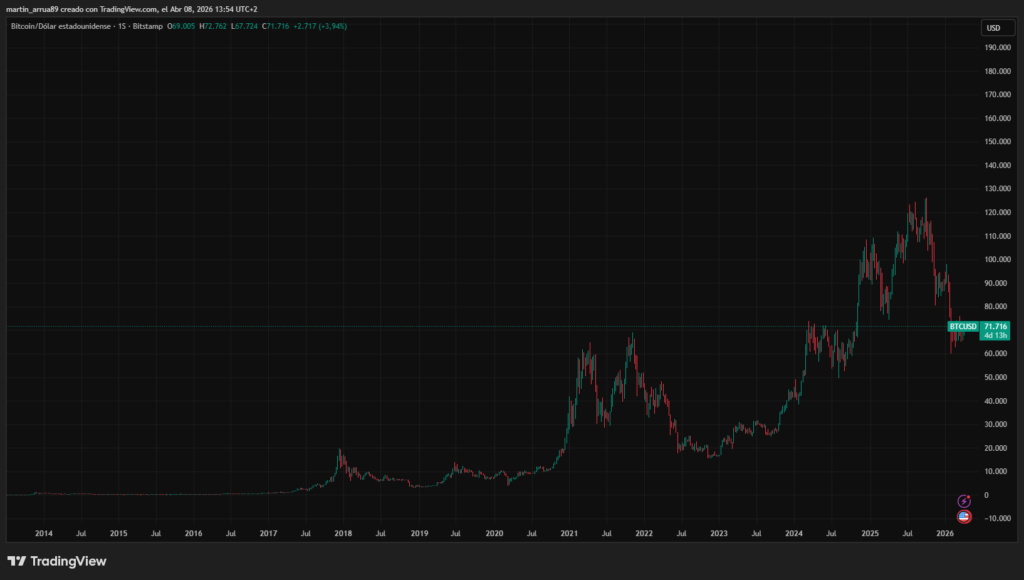
To support this idea, he recalled several antecedents. In 2023, after the rally derived from the banking crisis, BTC spent about 220 days lateralizing between $25,000 and $30,000. In 2019, after the rally towards $14,000, the asset spent around 161 days slowly wearing down.
And in 2022, after the collapse of Terra-Luna (Terraform Labs’ algorithmic “stable” coin whose collapse triggered a market crisis), BTC remained for almost five months without a clear direction between $18,000 and $22,000.
These price movements can be seen in the following graph:
According to Melker, what defines these stretches is not fear, but wear and tear. “All of these cases spread long enough to exhaust investors. Not through fear, but through boredom,” he said.
For him, the market does not always punish with violent falls: Many times it erodes conviction simply by letting time pass without resolving anything.
Even so, the analyst also sees a flip side to this process. “These are the stretches that give you time to buy, even if it never feels that way in the moment,” he noted, while adding that when the breakout finally comes, “it doesn’t go up slowly: it moves fast, and most of the move has already happened.”
That is why he insists that there will be no perfect entrance or a clean signal of security. “There will be no neat entrance, no sign that everything is safe again; just the difficult decision to enter before you feel comfortable,” he emphasized.
That doesn’t mean Melker sees a recovery imminent. In factremains skeptical of the bullish consensus.
“It still seems that the consensus is leaning towards a further decline, and if the price follows, those expectations will simply continue to shift downward,” he warned. In this framework, he recommends patience and gradual purchases, not impulsive bets.
Melker is not alone in his analysis
Melker’s reading also finds a partial echo in the analysis that Ray Dalio shared on April 7. The founder of Bridgewater warned that markets are reacting too short-term to specific episodes, such as the conflict with Iran, without paying enough attention to larger-scale structural forces.
In his post, he argued that “most people tend to focus on and react to the most striking events of the moment… and overlook the much more important and far-reaching factors driving the current situation.”
Dalio went even further and stated that “we are in a world war that is not going to end soon,” not necessarily in the sense of a single, formal war, but as an accumulation of armed, commercial, technological and geopolitical conflicts that will continue to condition the global economy.
Although Donald Trump announced a two-week bilateral ceasefire with Iran, Conditional on the reopening of the Strait of Hormuz, the truce does not completely remove the uncertainty. As Dalio warned, these types of pauses can be part of a broader dynamic of escalation, not necessarily resolution.
And that matters for the currency created by Satoshi Nakamoto because The Strait of Hormuz remains a key passage for global oilas CriptoNoticias has explained. Any threat on that route can once again put pressure on energy, inflation and, consequently, assets considered risky, such as bitcoin and cryptocurrencies.