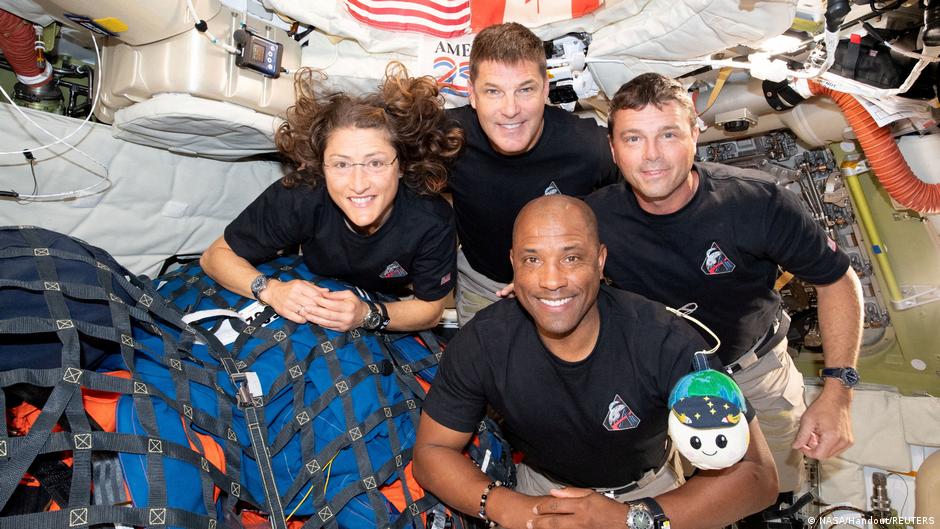
Four astronauts aboard the Artemis II mission’s Orion spacecraft spoke to the press from space for the first time after completing a lunar flight that took them a record distance from Earth.
After becoming the first humans to directly look at the far side of the Moon, emotions are running high as the crew prepares to re-enter Earth’s atmosphere and splash down in the Pacific Ocean off the California coast on Friday.
“The human brain shouldn’t have to go through what it went through,” said Reed Wiseman, NASA’s Artemis II mission commander.
“We have a lot that we need to think about, journal about, and write about, and then we’ll have a fuller sense of what we’ve been through,” he said at the press conference.
Wiseman said that seeing the solar eclipse from space had a deep impact on him. “I’m actually freezing right now just thinking about it, my palms are sweaty.”
Mission specialist Jeremy Hansen, a Canadian member of the crew, said he saw things “I never imagined” while flying around the far side of the moon.
“We live on a fragile planet in the vacuum and void of space.”
On Monday, the crew’s position at a distance of about 252,000 miles (400,000 kilometers) from Earth set a record held for 56 years by the Apollo 13 crew.
‘Riding a ball of fire in the atmosphere’
Mission pilot Victor Glover said they “haven’t even begun to process what we’ve been through” and were preparing for reentry.
“There are a lot of photos, a lot of stories… We still have two more days, and it’s even deeper into the atmosphere to ride the fireball.”
In another high-risk phase of the mission, the Orion spacecraft will reach speeds of up to 23,839 mph (38,365 kph) as it re-enters Earth’s atmosphere and will suffer intense heat brought on by atmospheric friction.
When Glover was asked how he felt about returning, he said, “I’ve actually been thinking about reentry since April 3, 2023, when we were assigned to this mission.”
Artemis looks to the future
Mission specialist Christina Koch, who set the record for the longest solo spaceflight by a woman at 328 days on a previous mission, said the crew had developed a sense of “camaraderie.”
He said, “Being so close with so many people and having a common purpose, a common mission, traveling hundreds of thousands of miles with a team on the ground and working hard on it every day is something I will miss very much.”
Although conditions in the capsule were sometimes uncomfortable, Koch said it was part of pushing the boundaries of human space exploration.
“We can’t explore deeply unless we’re doing some uncomfortable things, unless we’re making some sacrifices, unless we’re taking some risks,” he said.
The Artemis II mission is the first in a billion-dollar series aimed at returning humans to the lunar surface by 2028, and eventually establishing a U.S. moon base for a possible future mission to Mars.
Edited by: Elizabeth Schumacher