
Lugo questions the attempt to control the price of USDT by imposing a bank rate for the dollar.
The price of USDT in Venezuela has fallen 6.3% in just over a week.
The digital asset market in Venezuela is going through an unusual adjustment driven by the State’s recent exchange intervention policies. In just over a week, the price of USD Tether (USDT) against the bolivar has registered a decrease of 6.3% in open markets.
As can be seen in the following graph, the price of USDT against the Venezuelan bolivar has been bearish in the last 10 daysgoing from 682 bolivars on average to about 639 bolivars at the time of writing this report.
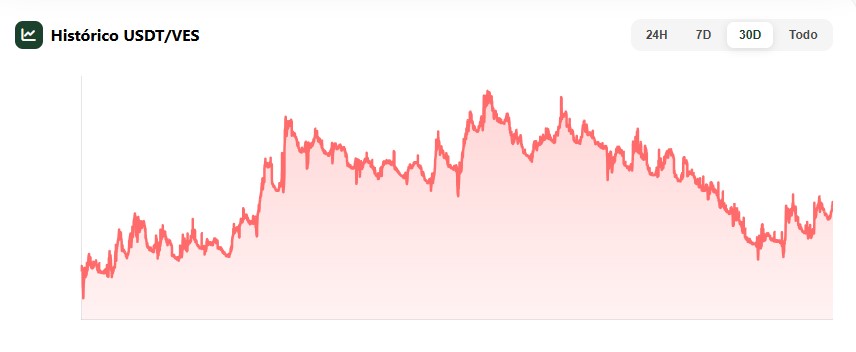
This bearish movement, which contrasts with the 11.6% increase experienced by USDT in Venezuela so far this year, far from being a sign of strengthening of the local currency or macroeconomic stability, seems to respond to a shift in demand. This is because citizens and companies would be stopping acquiring the digital asset to try to capture physical or electronic dollars through the national banking system.
USDT falls in Venezuela due to an “artificial phenomenon”
Alexis Lugo, specialist in the cryptocurrency industry, explains to CriptoNoticias that this bearish behavior in USDT It is the direct result of a distorted pricing structure.
According to the teacher, the fall in the value of the digital currency issued by Tether Limited against the Venezuelan bolivar does not respond to natural dynamics of global supply and demand. but to an “artificial phenomenon” caused due to the coexistence of multiple exchange rates in the country as a result of State intervention in the exchange market.
All this is being maintained artificially. People are stopping buying in open USDT markets in order to be able to obtain some type of currency, either in cash or electronically through banking. So for me, the fact that the price of USDT is falling responds solely and exclusively to this phenomenon that is totally artificial.
Alexis Lugo.
The current scenario in Venezuela is characterized by the existence of three exchange rates for the US dollar. The first is the one imposed by the Central Bank of Venezuela (BCV), the second is the one that arises from bank auctions — which is the State’s intervention mechanism — and the third is the price of the crypto asset USDT, which is linked to the greenback, in the main peer-to-peer (P2P) markets operating in the country.
The current gap shows a significant distortion in the exchange market, where the most critical distance is between the official rate (BCV) —475 bolivars per dollar— and the USDT —630 bolivars—, reaching a notable 32.6%. For its part, the bank rate —550 bolivars— acts as an intermediate point, standing 15.79% above the BCV, but still 14.54% below the value of the digital currency.
In practical terms, This reflects strong pressure on the official exchange rate and a market preference for the stablecoin, which remains the most expensive of the three.
Lugo points out that the appearance of a third rate—that of auctions—adds a layer of complexity that, in his opinion, directly impacts the price of USDT in local P2P commerce and further distorts the exchange market.
In Lugo’s opinion, this situation has encouraged the search for arbitration and has forced economic actors to modify their hedging strategies in digital assets. to prioritize access to physical or electronic currencies within the traditional financial radareven if this implies higher operating costs.
Venezuelan economist and business consultant Asdrúbal Oliveros agrees with this vision, who in his recent participation in the CriptoNoticias podcast assured that the corporate sector mutated and stopped using USDT for its commitments, due to the return of traditional dollars to the country’s banks.
Now, it is necessary to clarify that, in addition to economic pressure, there is a barrier that limits the use of digital currencies in the Caribbean country: education.
Even though 25% of the Venezuelan population already uses cryptocurrencies – according to independent estimates – the country still lacks technical knowledge to manage your assets in wallets or take advantage of the efficiency advantages offered by USDT.
This educational gap causes many Venezuelans to maintain a conservative stance, preferring the physical dollar despite the security risks and custody difficulties it entails compared to digital assets.
Lack of a well-founded economic policy in Venezuela
The root of the problem, according to Lugo’s analysis, lies in the lack of a clear and founded economic policy on the part of the Venezuelan State that allows managing the foreign exchange market in a coherent manner.
He comments that this dynamic not only affects digital asset investors, but also has a direct impact on the cost structure of companies Venezuelans.
He points out that, as a result of this distortion, the productive sector of the Caribbean country is forced to bid in bank auctions to obtain foreign currency. But they do it at high prices, with a 20% surcharge, to import raw materials.
And taking into account that the regulations require them to set the prices of their final products based on the lowest official rate, Lugo warns that a preventive increase in the cost of goods that ranges between 20% and 25%, fueling inflation and reducing the purchasing power of the population.

The need to be honest about the exchange rate
The “ordinary citizen” is the most vulnerable link in this network of distortions, as Lugo identifies it. He sees that, while the businessman tries to overcome the exchange gap, The end consumer is faced with increasingly expensive products on the shelves.
The professor and CEO of the Criptoneros educational initiative is emphatic in pointing out institutional responsibility in this crisis: “The State is to blame, because you cannot blame the average citizen. Yes, it is true that there are people who speculate, but it is also true that people take advantage of this to cover themselves from inflation, to leverage themselves economically.
To resolve this situation, Alexis Lugo sees it necessary to “honest” the exchange rate, a measure that, he explains, would imply eliminating the current official rates and leaving a single one that is governed by the market. In practice, such a reference would reflect the cost of USDT.
However, it also recognizes that lifting these restrictions abruptly is a complex economic challenge that the Venezuelan State has avoided to stop an immediate inflationary jump.
The drop in price and demand for USDT among Venezuelan citizens should not be interpreted as a loss of relevance of digital currencies, but rather as a symptom of a fractured economy, Lugo suggests. For him, it is more than clear that, as long as an artificial gap persists between the official rate and the real cost of foreign exchange, the market will continue to operate under a logic of survival which, ultimately, stifles growth and makes daily life more expensive.