
Fashions pass, but bitcoin moves on.
Be careful what you listen to and read in the “crypto” world!
Eleven years are few for history and many for this market.
When CriptoNoticias published its first note, in April 2015, bitcoin was trading around $250, Ethereum had not launched its main network, and no one suspected that Elon Musk would end up becoming the CEO of dogecoin (DOGE).
Today, with more than a decade of uninterrupted coverage, it is worth stopping, not only to celebrate, but to do a more useful exercise: review what the market taught us about itself, and about us.
Fashions pass, bitcoin continues
So many years of coverage left us with an uncomfortable certainty for those who bet on the broad ecosystem: in this market, Cycles repeat, projects die, and bitcoin continues.
We report the rise of ICOs in 2017when hundreds of tokens promised to revolutionize everything from the supply chain to the healthcare industry.
We cover the summer DeFi of 2020, the boom of NFTs in 2021, the collapse by Terra/LUNA in 2022, the FTX contagion that same year.
We also report the metaverses. Readers who have been with us since 2021, at least, will remember how the idea was promoted that we would all go “live in the metaverse.”
Each wave swept away capital, media attention and, in many cases, the savings of real people.
Bitcoin went through all that. Not because it is immune to volatility—it clearly is not—but because its proposal does not depend on a founding team, a quarterly roadmap, or the token being useful on some platform that exists today and may not exist tomorrow.
The lesson is not that bitcoin is perfect. The thing is The “crypto industry” as a whole has a very high mortality rateand that forces specialized journalism to clearly distinguish between bitcoin and the rest of the projects that try to copy it.
CriptoNoticias makes that clear in its mission statement:
Empower your audience and business partners about the Bitcoin ecosystem and its economic, political and social implications. We do this through the creation and dissemination of information and knowledge quickly and accurately, with high editorial and journalistic standards, using different digital channels and formats.
CriptoNoticias mission statement.
Nobody eliminates bitcoin cycles (at least, for now)
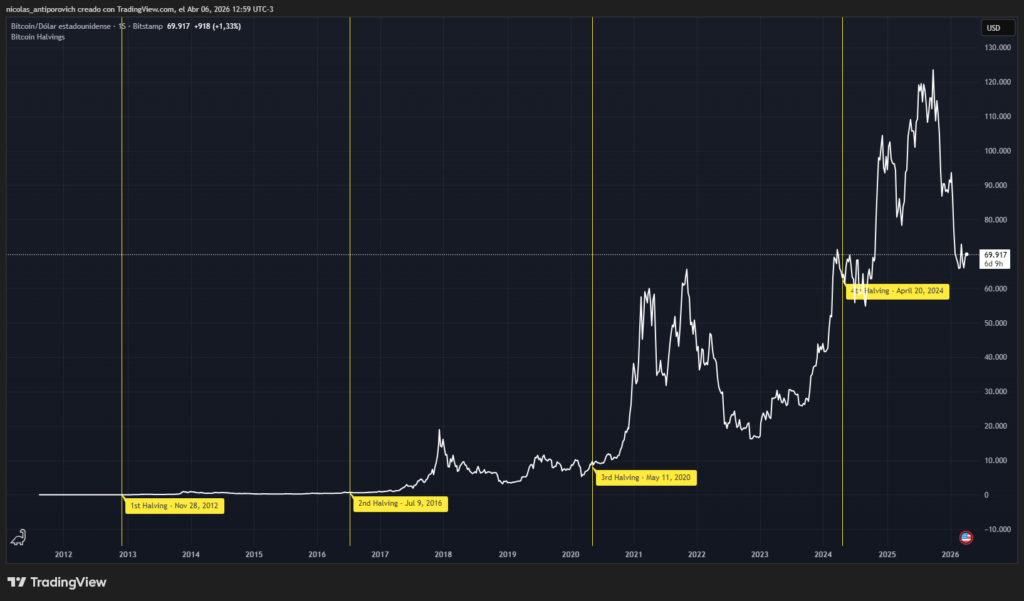
Every bull cycle brings with it a narrative that justifies why this time is different. In 2017 there was mass adoption via ICO. In 2020 and 2021, the entry of institutional ones. In 2024 and 2025, spot ETFs and the incorporation of bitcoin into the reserves of some states and large companies. AND On each occasion, the market rose, generated euphoria, and then he violently corrected.
Eleven years of own data—published news, recorded prices, documented cycles—show a pattern that no macroeconomic argument has been able to definitively nullify: Halvings continue to impact the offer.
Market psychology continues to oscillate between extreme fear and extreme greed. The 70%, 80% corrections keep happening. Whoever internalizes that does not become immune to the market, but at least they are not surprised when the difficult part of the cycle arrives. And the hard part always comes.
It’s statistical: most price predictions will fail
We save file. It is a blessing and a condemnation. We have recorded predictions from analysts, funds, executives, ecosystem personalities (and even some of our own) that did not withstand the passing of the months.
Price targets that were never reached—neither up nor down. Mass adoption dates that were forgotten. Projects declared “safe” that collapsed weeks later…
This is not a criticism of those who analyze the market. The problem is not the analyst: it is the certainty with which those analyzes are sometimes taken.
Bitcoin is one of the most difficult assets to predict in the short term: it operates 24 hours a day, 7 days a week, it is global, it is sensitive to variables ranging from the monetary policy of the Federal Reserve to a tweet from a figure with millions of followers.
Eleven years of coverage taught us to Report analyzes for what they are: supported hypotheses, not oracles. And to distrust, with polite firmness, those who do not allow margins of error in their projections.
Bad news must also be given
Every time we publish a bearish note—a pronounced correction, a significant hack, an adverse regulation, the collapse of a project—a portion of the audience reacts (and they express it on social media) with hostility.
That if we are pessimistic, that if we sell fear, that if we work for those who want to lower the price… We understand it. No one enjoys reading that something they invested in is going down.
But Journalism that only publishes good news is not journalism: it is marketing.
And in a market where information asymmetry can be costly, the omission of bad news has a real cost to the reader.
We have reported hacks, scams, bankruptcies, manipulations and corrections with the same dedication with which we cover all-time highs. That consistency does not make us popular at all times of the cycle. It makes us usefulwhich is what matters.
The source always has an incentive
In the “crypto” ecosystem, almost no one speaks from a neutral place.
The analyst projecting a price may have an open position. The fund that recommends an asset may have already purchased it. The influencer promoting a token perhaps received an allocation. The executive who declares that his project “is fine” has legal and financial obligations that lead him to say so, even if it is not entirely true.
This does not invalidate what they say. Sometimes they are right. But our extensive experience teaches us to read not only the content of a statement, but the context of the person issuing it.
What position do you have open? What economic incentive exists behind that message? At what point in the cycle does that statement occur?
Good journalism is not the one that repeats what the sources say: it is the one that reads between the lines, contrasts, and gives the reader the necessary information to form their own criteria.
Our motivation: what does the reader need to know?
Eleven years later, the market continues to be volatile, complex, fascinating and, at times, implacable towards those who do not respect it.
We will continue to report it as always: no euphoria when it rises, no drama when it falls, and with the same question as a compass that we used from the beginning: what does the reader need to know to make better decisions?