
Many of the initial bitcoin hodlers have already exited the market.
This cycle, according to Battaglia, “starts from USD 60,000 and ends at USD 1 million.”
For trader and communicator David Battaglia, bitcoin (BTC) is currently going through an unprecedented phase in its history. According to his market view, the digital currency has entered what he defines as a “second secular cycle.”
Unlike the four-year cycles that typically pace bitcoin, a secular cycle represents a paradigm shift that can last decades. Battaglia poses that the market structure has mutated because a considerable part of the initial investors – who acquired their coins in the first years of the asset’s life – would have already liquidated their positions.
“The true bitcoin cycle that must be understood is this,” says the trader when describing the current situation. From his analysis, this capital rotation means that the coins are going “from the initial holders to new buyers in the last two years,” he stated.
This technical and fundamental change redefines price projections, placing the asset in a stage of maturity as a global reserve.
Under Battaglia’s interpretation, bitcoin’s trajectory is divided into two major eras. “From 0 to 100,000 dollars constitutes the first secular bullish cycle of bitcoin,” explained the trader. For him, $100,000, the price reached on December 5, 2024 (as seen in the graph), represents a fundamental psychological and technical barrier that has already begun to be processed by the market.
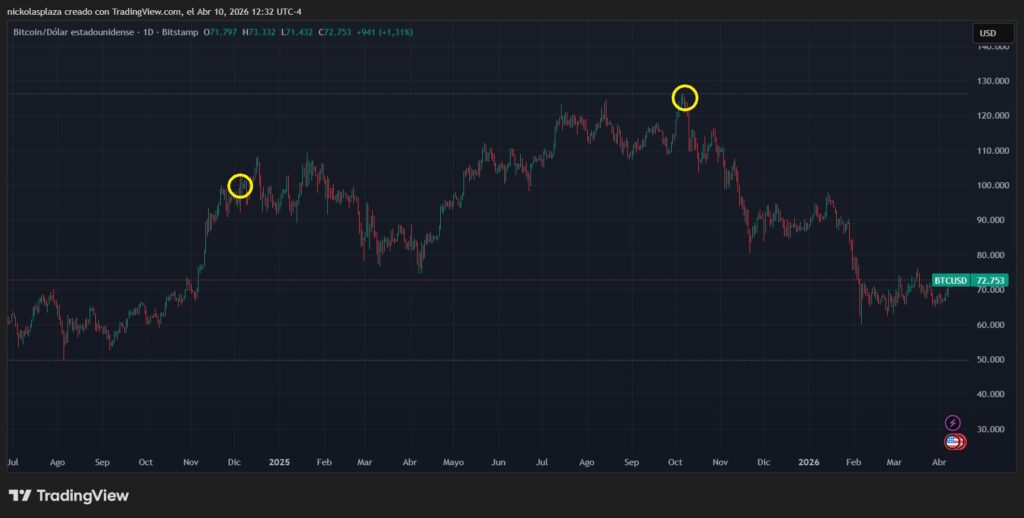
Consequently, The analyst projects a massive growth trajectory for the phase that has just begun. “Now the second secular cycle of bitcoin begins,” he stated. According to their analysis, this new period “starts from $60,000 and ends at $1 million,” placing the latter price as the final objective of the trend.
The factors behind structural change
The consolidation of this thesis is supported by the massive inflow of capital with the approval of bitcoin exchange-traded funds (ETF) in January 2024, which allowed large managed capital to flow into the asset in a regulated manner.
Added to this flow is the example of companies such as Strategy, led by Michael Saylor, whose aggressive accumulation strategy has consolidated it as the company with largest bitcoin reserves in its treasury with 766,970 BTC.
These factors, according to Battaglia, “changed the structure of the market by absorbing millions of coins.” while the price fluctuated between 40,000 and 126,000 dollars (historical maximum).
For the trader, the $60,000 level is decisive “because it marks the definitive capitulation of the retail investor who only seeks to take advantage of the cycle.” This term refers to the small retail investor who operates out of emotion and who tends to abandon the market due to volatility, leaving the supply in the hands of entities with greater retention capacity.
Bitcoin adoption and geopolitics
Battaglia identifies two additional keys to this new secular cycle. The first is the arrival of banking giants in the bitcoin ETF sector.
On April 8, the Morgan Stanley Bitcoin Trust (MSBT), a Morgan Stanley fund, debuted, as reported by CriptoNoticias. Eric Balchunas, Bloomberg Intelligence specialist, described this launch as the most important since bitcoin ETFs began operating in the United States.
The second key is geopolitical in nature and links Iran. Following a two-week ceasefire agreed with the United States following clashes that began on February 28, the Persian country has begun collecting BTC as transit fee for oil tankers in the Strait of Hormuz.
“All this marks a new beginning for bitcoin, as a global and versatile asset in any situation, whether in times of peace or war,” Battaglia pointed out.
There is skepticism in the market for the price of bitcoin
Despite the prevailing optimism, positions have emerged that oppose this bullish vision. Market analyst Willy Woo has introduced a dose of skepticism based on on-chain models. Woo notes that these traditional models suggest that the bottom of the market could be much lower than Battaglia estimates.
The specialist locates real technical support—the price level where demand is expected to stop a decline— in the area of “between $46,000 and $54,000”. Woo warns that a bear market could prove more severe if macroeconomic conditions worsen. His main concern lies in an eventual breakdown of the traditional stock market, an event that, in his opinion, would “irremediably drag down digital assets.”
While Battaglia maintains a structural enthusiasm that points towards a million-dollar valuation driven by state adoption and large investors, analysts like Woo urge caution.