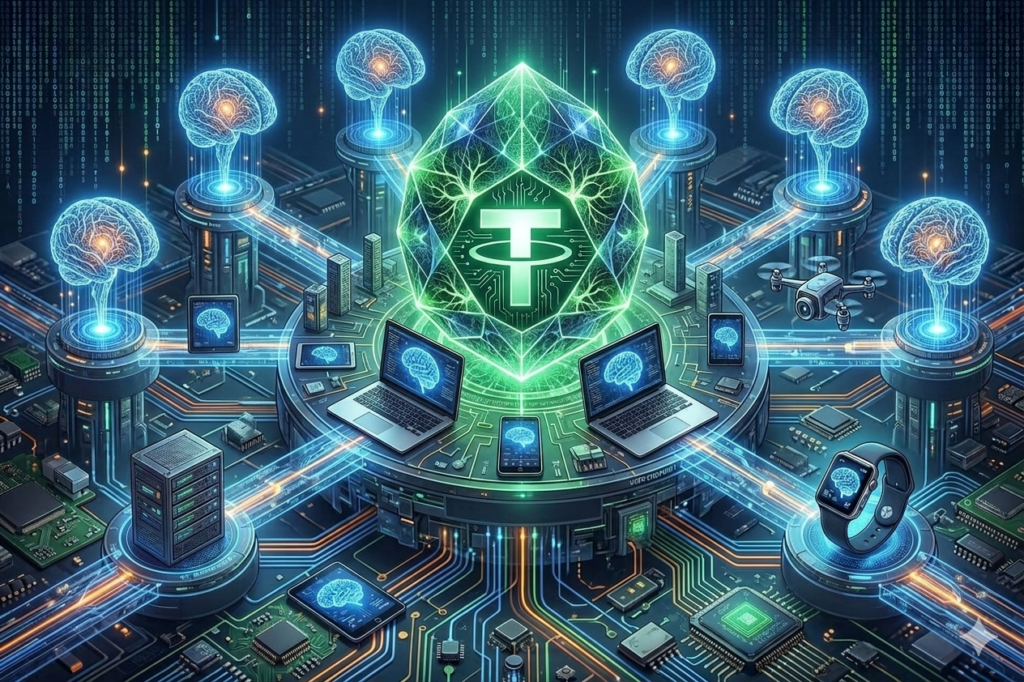
The platform is compatible with iOS, Android, Windows, macOS and Linux.
Tether proposes that the AI of the future is local, works peer-to-peer and resists connection outages.
Tether introduced the QVAC SDK, an open source, cross-platform development kit intended as a universal foundation for creating, running and evolving artificial intelligence languages on any device. The proposal is part of what the company calls the “era of stable intelligence”, a scenario in which humans, autonomous machines and AI agents will coexist on a large scale.
According to your statementthe SDK enables working with multiple AI capabilities, such as language models, speech recognition and synthesis, translation, OCR, and more, through a unified API. It is built on QVAC Fabric and integrates local inference engines such as whisper.cpp, Parakeet and Bergamot, making it easy to combine different functions without modifying the application logic.
QVAC SDK does not depend on the cloud
One of the key elements is your approach “local-first“, which allows developers to run and tune models directly on devices such as smartphones, personal computers or industrial servers. This eliminates the need to rely on the cloud and It allows the same code base to work without changes on iOS, Android, Windows, macOS and Linux. Under this model, intelligence stops being an external service and becomes in the hands of the user.
For consumers, this means that everyday tools (such as writing assistants, translation, voice transcription or smart search) can operate immediately on the device itself, without sending sensitive data to remote servers. Additionally, applications continue to function even with limited connectivity or internet outages, enhancing their usefulness in real-world scenarios.
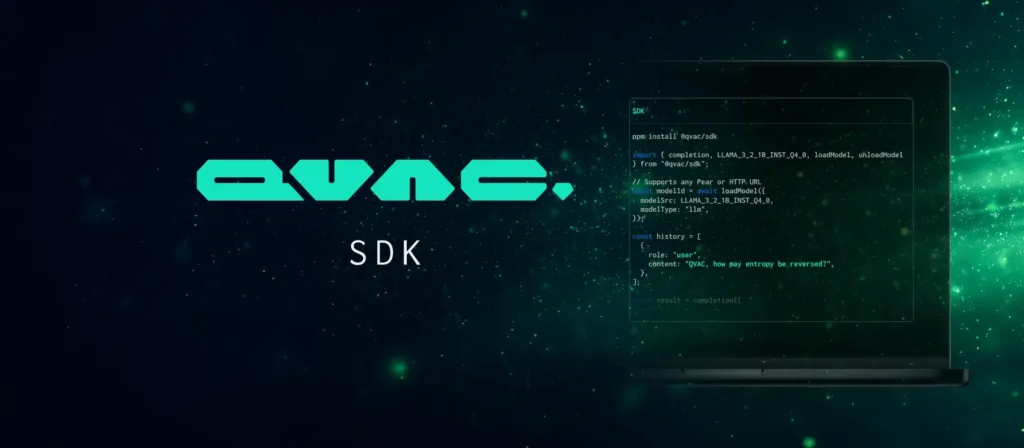
The SDK also incorporates peer to peer (P2P) capabilities based on Holepunch technology, that allow you to distribute models, run inferences and even move towards decentralized training without centralized infrastructure. The purpose of this technology is to reduce single points of failure and address the physical and technical limits of cloud-only models.
Tether’s vision for the future of AI
For his part, Paolo Ardoino, CEO of Tether, said: “The world is approaching a moment in which billions of humans share the planet with billions of autonomous machines and trillions of AI agents. “The current model, which routes every decision through a centralized server, will not scale to meet that reality.”
Andoino highlighted that centralized AI is a dead end, with single points of failure and latency “at the speed of light”, designed for “a smaller world”, so he considered that QVAC adapts to the needs of the future.
Tether maintains that this launch reflects a broader change in the industry: the move from data center-dependent AI to a device-centric model, where privacy, speed and user control are priorities. Along these lines, the company plans to continue investing in QVAC’s open source ecosystem, including developments in robotics and brain-machine interfaces, with the aim of consolidating a new generation of distributed intelligent applications.