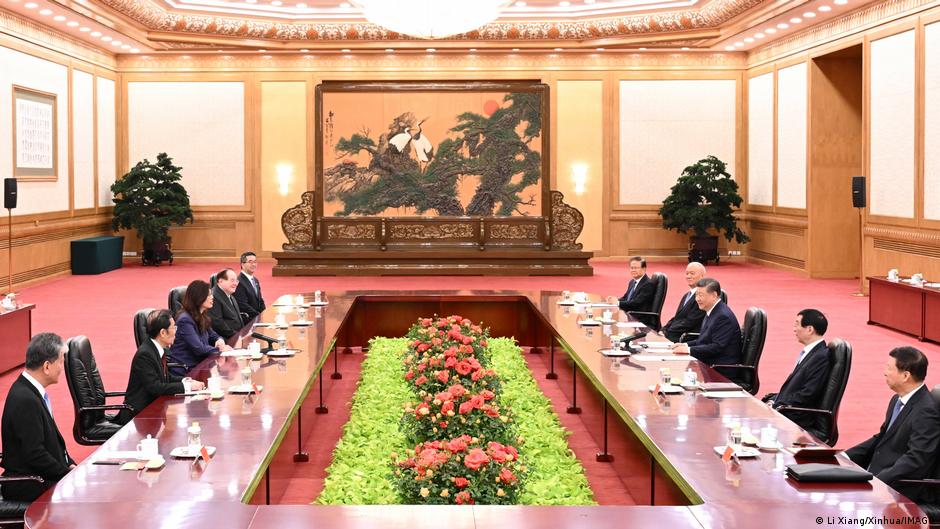
“The world today is no longer peaceful, which makes peace all the more valuable,” Chinese President Xi Jinping stressed in opening remarks at a meeting with Taiwan’s Kuomintang (KMT) Party Chairman Cheng Li-wun.
Xi, speaking as head of the Chinese Communist Party, said, “The leaders of the two parties are meeting today to safeguard the peace of our shared home and promote the peaceful development of cross-Strait relations.”
Cheng echoed Xi’s comments, saying both sides should adopt institutional solutions to prevent war and “thus making the Taiwan Strait a model for world peace and conflict resolution.”
Both Xi and Cheng reiterated their opposition to Taiwan independence, although neither explicitly mentioned unification.
Michael Cunningham, a senior fellow at the Stimson Center, told DW that Xi’s comments were largely routine.
“There was no direct threat to Taiwan, or any indication of pressure at any time to unify,” Cunningham said.
“This is basically how they [China] Look at this: Someday Taiwan will be ruled by Beijing, and there’s nothing they can do to put pressure on them because they believe it’s going to happen,” he said.
KMT supports closer ties with Beijing
The KMT is Taiwan’s main opposition party and has traditionally advocated closer ties with China while opposing Taiwan’s formal independence. Following the 2024 elections, the KMT became the largest party in the Legislative Yuan, the island’s main legislative body, giving it significant influence over lawmaking and the ability to obstruct the Democratic Progressive Party (DPP) government of President Lai Ching-te.
Cheng, long considered sympathetic to better relations with Beijing, has become the first Kuomintang leader to visit China in ten years, at a moment of rising tensions with the ruling DPP, which Beijing refuses to recognize as legitimate.
China views self-ruled Taiwan as its own territory destined to eventually join the mainland and reacts sharply to political steps that suggest a move toward formal independence.
The Xi-Cheng meeting marks a rare high-level cross-strait exchange since Beijing suspended talks in 2016, when the DPP won the presidency.
Trump’s role in cross-Strait relations
With a US-China leaders’ summit expected next month, analysts told DW that Xi could use Cheng’s visit to pressure Trump to soften his language on Taiwan or even halt US arms sales to the island.
In a speech on Friday marking the anniversary of the Taiwan Relations Act, which authorizes Washington to provide arms to Taiwan, President Lai warned against false notions of peace.
Lai said, “Compromise with authoritarians only comes at the expense of sovereignty and democracy. It will not bring freedom, let alone peace.”
In Taipei, the KMT-led majority in the Legislative Yuan has blocked President Lai’s proposed supplemental defense budget of NT$1.25 trillion (€34.33 billion, $40.2 billion), which includes potential arms purchases from the US.
Days before Xi met Cheng, China’s Foreign Ministry reiterated its opposition to US arms sales to Taiwan, while the island is still heavily dependent on US arms.
William Yang, senior analyst at the International Crisis Group, said Xi could ask Trump to reduce or stop arms sales. And if he doesn’t get the response he’s seeking, the Chinese president “may refuse to visit Mar-a-Lago later this year,” Yang said.
Peace appeal and political leverage
Jae Ian Chong, associate professor of political science at the National University of Singapore, told DW that Xi’s emphasis on peace could be used as leverage in negotiations with Washington.
“If Xi can tell Taiwan to stop advocating for US arms purchases, he can tell Trump to stop sales,” Chong said.
Chong said Cheng’s visit could weaken pro-Washington voices within the KMT by uniting pro-Beijing voters ahead of Taiwan’s legislative midterm elections in November.
Yang said the talks could resonate with the Taiwanese public at a time when Trump’s ongoing involvement in the Middle East has raised fears of conflict elsewhere.
“Taiwanese people’s trust in the United States is declining, while suspicion is increasing,” Yang said.
With Trump declaring himself world peacemaker in 2024, Cunningham said the peace narrative emerging from the Beijing meeting could help Xi put pressure on Washington.
While US policy calls for resolving cross-Strait disputes through peaceful “ways”, Cunningham said Xi could pressure Trump to issue softer language supporting a peaceful “resolution” of the Taiwan Strait issue.
Cunningham said, “Xi may say to Trump in May: ‘Taiwan wants a peaceful solution. We want a peaceful solution. Don’t you also want a peaceful solution to the Taiwan issue?’
Military pressure continues
Despite the peace rhetoric, Taiwan’s Ministry of National Defense on Wednesday reported the detection of 15 aircraft and 24 naval vessels operating around Taiwan since Cheng departed for China.
“China’s military coercion and threats of military action did not diminish as a result of Cheng’s visit,” Chong said.
While the meeting expressed Beijing’s willingness to engage in talks, Chong cautioned that the substance remains unclear.
“We still have to wait and see what China is willing to agree to,” he said.
Additional reporting: Chia-Chun Yeh in Taipei
Edited by: Ole Tangen Jr.