11 April 2026
Witkoff, Kushner reach Islamabad
Reuters news agency quoted Pakistani sources on Saturday as saying that US President Donald Trump’s special envoy Steve Witkoff and son-in-law Jared Kushner have arrived in Islamabad for talks with Iran.
A US government plane carrying top officials landed in the Pakistani capital.
Vice President JD Vance will lead the US delegation at the talks.
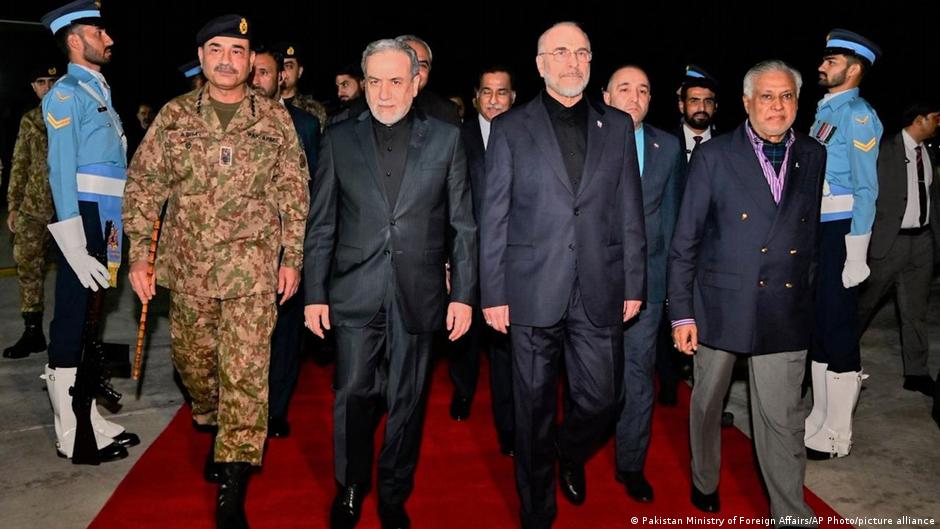
The Iranian delegation arrived here a day earlier on Friday.
https://p.dw.com/p/5C13P
11 April 2026
Why has Pakistan emerged as a mediator between America and Iran?
Pakistan’s role as a diplomatic mediator in the escalating global conflict may have surprised some, but there are many good reasons for Islamabad’s involvement. And this is not the first time that Pakistan has stepped in.
Here’s how Pakistan emerged as a key mediator in the Middle East conflict:
Pakistan has good relations with Iran
- Iran was the first country to recognize Pakistan after it declared independence in 1947, and remains a close neighbor – at least in geographical terms, as the two countries share a border 900 kilometers (565 mi) to the south. Culturally, Pakistan and Iran are both Muslim countries, although Pakistan is predominantly Sunni, while Iran is mostly Shia. Still, the late Iranian supreme leader, Ayatollah Ali Khamenei, was a central religious and political figure for Shias around the world, including in Pakistan, where at least 22 people were killed and more than 120 injured in clashes in Karachi following his death in the initial wave of US-Israeli strikes.
Pakistan has long-standing diplomatic relations with the United States
- The United States considers Pakistan a Major Non-NATO Ally (MNNA), despite past tensions over Pakistan’s alleged harboring of terrorists, including former al-Qaeda leader Osama bin Laden. Islamabad signed on to US President Donald Trump’s so-called peace board, while Trump has also called influential Pakistani Field Marshal Asim Munir “my favorite field marshal”.
Pakistan has its own interests
- Pakistan imports most of its oil from Gulf countries, which are vulnerable to Iran’s fire, so it has suffered losses elsewhere due to damage to oil and gas infrastructure and disruption of supply lines due to the closure of the Strait of Hormuz. Pakistan has seen fuel prices rise by nearly 20% since the war began, putting pressure on the government of Prime Minister Shehbaz Sharif.
Pakistan has already mediated in international conflicts
Previous Pakistani arbitrations include:
- 1972: US President Richard Nixon’s historic visit to China at the height of the Cold War, paving the way for the establishment of diplomatic relations between Washington and Beijing in 1979.
- 1988: Geneva Accords, leading to Soviet withdrawal from Afghanistan
- 2020: Facilitation of contacts between the Taliban and the United States, leading to talks in Qatar that ultimately culminated in the withdrawal of American and NATO troops from Afghanistan.
https://p.dw.com/p/5C0vD
11 April 2026
America, Iran will hold talks in Islamabad
The United States and Iran are set to hold high-level talks in Islamabad on Saturday aimed at ending their six-week war.
But Tehran’s demands for commitments on Lebanon and sanctions relief have raised doubts over whether the talks will succeed.
A US delegation led by Vice President JD Vance, along with envoy Steve Witkoff and advisor Jared Kushner, is on its way to Pakistan. The Iranian team led by Parliamentary Speaker Mohammad Baqer Qalibaf and Foreign Minister Abbas Araqchi arrived on Friday.
“Our intentions are good but we are not trusted,” Qalibaf said upon reaching the Pakistani capital, according to Iranian state TV.
Qalibaf said talks would not begin unless Washington blocks Iranian assets and extends a ceasefire to Lebanon, where nearly 2,000 people have been killed in Israeli attacks on Iran-backed Hezbollah militants since the war began on February 28.
The United States and Israel say Lebanon is not covered by the ceasefire, which Iran rejects.
US President Donald Trump took a tough stance ahead of the talks, saying Iran had “no card” to play other than blocking the Strait of Hormuz, which Trump described as “short-term extortion of the world using international waterways”.
“The only reason they’re alive today is to talk!” Trump said in a post on his Truth social platform.
The talks come amid a fragile two-week ceasefire that has halted US and Israeli attacks on Iran but has failed to reopen the Strait of Hormuz or stop Israeli attacks on Lebanon, while Hezbollah continues to fire rockets.
https://p.dw.com/p/5C0vC
Welcome to our coverage
Good morning!
The US and Iran will hold talks in Islamabad on Saturday that could lead to an end to their six-week war, although Tehran has sowed doubt by earlier demanding commitments and sanctions on Lebanon.
Pakistani Prime Minister Shehbaz Sharif, who has facilitated the talks, has described the talks as a “make or break moment”.
Here are the main developments from Friday:
- Trump says Strait of Hormuz will ‘open soon’
- Israeli strikes on Lebanon killed 357 people on Wednesday, Lebanese officials said
- German Red Cross chief warns of humanitarian disaster in Lebanon
- Lebanon, Israel to hold US-brokered talks next Tuesday, Beirut confirms
- Israel refuses ceasefire with Hezbollah ahead of Lebanon talks
Our Friday live blog has all this and more in-depth coverage of the Iran war.
https://p.dw.com/p/5C0tf