Published on April 11, 2026Last updated April 11, 2026
DW’s live coverage: Artemis II returns to Earth
Click below to watch DW’s live coverage of the Artemis II crew’s return to Earth.
https://p.dw.com/p/5C0m2
11 April 2026
Artemis II crashes into Pacific Ocean after historic Moon trip
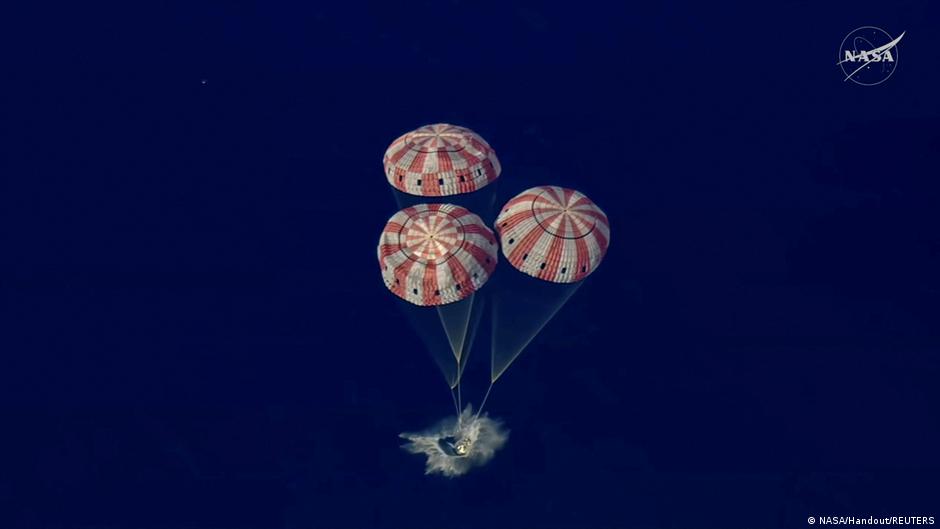
The four-member crew of Artemis II landed in the Pacific Ocean off the coast of California after a 10-day journey to the Moon, for the first time in more than half a century.
The NASA mission broke the record for the crew going deeper into space than any other human.
American astronauts Reed Wiseman, Victor Glover and Christina Koch and Canadian astronaut Jeremy Hansen returned to Earth aboard their Orion spacecraft, called Integrity.
After a communications check, Mission Commander Wiseman said, “We clearly have you.”
He added, “What a trip.” “We are stable.”
https://p.dw.com/p/5C0mB
11 April 2026
Communications with Artemis II restored after expected blackout
Following the expected six-minute blackout before the scheduled splashdown, communications with the Artemis II Orion spacecraft have just been restored.
“Houston. Sincerity. We’re with you,” mission commander Reed Wiseman said after checking the voice after the communications loss.
https://p.dw.com/p/5C0nj
11 April 2026
Communication with Artemis II lost as expected
Communication with the Artemis II Orion spacecraft is lost, as expected before the scheduled splashdown, as it enters Earth’s atmosphere.
There is a blackout for the last six minutes.
https://p.dw.com/p/5C0ng
11 April 2026
Service module separates from Orion
The Orion capsule carrying four Artemis II astronauts has fired its propulsion system as planned before re-entering Earth’s atmosphere.
https://p.dw.com/p/5C0mC
11 April 2026
Artemis II prepares to fall to Earth
As the Artemis crew prepares to land in the Pacific Ocean near Southern California in less than two hours, NASA shared some breathtaking photos taken by the crew during their record-setting mission.
NASA also shared a video of the Orion spacecraft coming close to our planet.
https://p.dw.com/p/5C0lb
Read – NASA’s billion-dollar space race intensifies
NASA’s new effort to send manned missions to the Moon and Mars is neither cheap nor for the faint of heart. But who ultimately bears the costs and what does everyone on Earth still get out of all this?
Read more from DW’s Timothy Roux here.
https://p.dw.com/p/5C0fP
10 April 2026
Read: Why NASA, ESA and others want to return to the Moon?
Nearly six decades after humans first set foot on the Moon, space agencies and commercial companies want to use it as a gateway to Mars. But not only this.
Read more about the renewed interest in Moon missions here.
https://p.dw.com/p/5BvN2
10 April 2026
WATCH: Artemis crew sets a new record for space travel
Astronauts aboard Artemis II traveled further into space than anyone else in history. During the six-hour flight, the crew captured never-before-seen images of the far side of the Moon.
Here’s a recap of some of the key moments.
https://p.dw.com/p/5BvMz
How will the Orion spacecraft return to Earth?
Re-entry into Earth’s atmosphere will be an important test of the Orion spacecraft’s heat shield.
The Orion spacecraft’s 16.5-foot-wide (about five meters wide) heat shield is manufactured to withstand temperatures up to 5,000 degrees Fahrenheit (2,760 Celsius).
The heat shield protects the four crew members inside the spacecraft from the scorching heat of re-entry to Earth.
The heat shield ablative material is made of Avacoat which contains silica fibers. As the spacecraft returns to Earth, the Avakot continues to rotate and destroy in a controlled manner.
The Orion spacecraft will enter the atmosphere at a speed of about 25,000 miles per hour (40,234 kilometers per hour). The spacecraft will slow to 19 miles per hour (30 kilometers per hour) as it falls to Earth.
NASA is confident that the heat shield will remain intact when Orion enters Earth’s atmosphere.
However, during the Artemis I mission in December 2022, the Orion capsule did not melt as NASA expected. The heat shield experienced excessive burning which was not in line with NASA’s expectations.
https://p.dw.com/p/5BzT8
10 April 2026
In pictures: What the Artemis crew captured from space
The Artemis II lunar flyby marked a rebirth for human space flight, and the crew sent back some unprecedented photos from space.
https://p.dw.com/p/5BvLK
10 April 2026
Artemis II mission cost
NASA’s Artemis 2 was the first manned mission to the Moon since 1972. But how much does it really cost, and who’s paying for it?
Find out in our cell phone explainer!
https://p.dw.com/p/5BvLH
10 April 2026
Why does the Artemis II mission matter?
A successful return to Earth would clear the way for the Artemis III mission, which could see humans return to the Moon. Without a clean return, NASA will not proceed with a crewed landing.
The return of the crew will confirm that NASA can safely return astronauts to the Moon.
It will be the fastest and hottest crew re-entry since the Apollo 13 mission 56 years ago.
https://p.dw.com/p/5BvLC
10 April 2026
When does the Artemis crew return to Earth?
The Artemis II mission is scheduled to end with a landing in the Pacific Ocean off the coast of San Diego in Southern California. The splashdown is planned for shortly after 8 pm US Eastern Time (0100 GMT) on April 10.
Water landing allows NASA to retain the capsule for inspection.
The recovery effort will involve U.S. Navy ships and divers to secure the spacecraft. The astronauts will be helped and then transported to a Navy ship, and after medical examinations, they will return to NASA’s Johnson Space Center in Houston.
https://p.dw.com/p/5BvC4
Welcome to our coverage
The lunar flight conducted by the crew of Artemis II attracted much attention after breaking the record for the farthest journey in space by any human.
But this was by no means the end of the mission. The return to Earth is the riskiest and most critical phase. Everything needs to work perfectly – and they only have one try to get it right.
We will follow the crew as they attempt to return safely to Earth.
https://p.dw.com/p/5BvAI