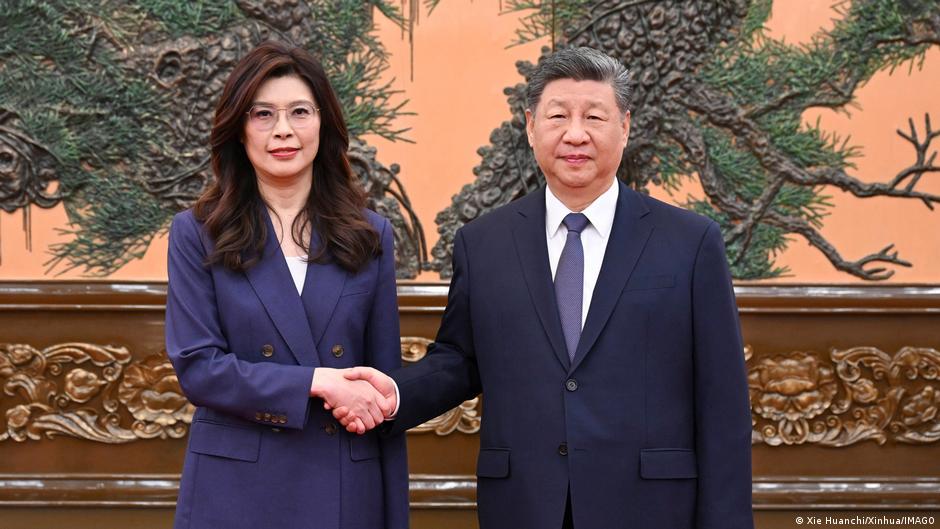
Taiwan’s opposition Kuomintang (KMT) leader Cheng Li-wun met Chinese President Xi Jinping in Beijing on Friday, ending her visit to China this week, and called for a “peace” mission to ease tensions.
Cheng, known to be a proponent of closer ties with Beijing, is the first KMT leader to visit China in a decade, amid tensions over Taiwan’s ruling Democratic Progressive Party (DPP), whose leadership is not recognized by Beijing.
Beijing has framed Cheng’s visit as a signal that there is political space for Chinese interests in Taiwan. Beijing considers Taiwan a breakaway Chinese province that should be “reunified” with the mainland. Xi has said he prefers to do this diplomatically, but often threatens to use force.
‘No tolerance’ for Taiwan’s independence
Xi reiterated his position during talks with Cheng on Friday, calling for efforts to pursue “reunification”, while also warning that China “will absolutely not tolerate” Taiwan independence.
The Chinese leader also told Cheng that “the general trend of compatriots on both sides of the Straits getting closer, getting closer and uniting will not change.”
“This is an inevitable part of history,” Xi said during the talks, Taiwanese media reported.
He also said China is willing to strengthen dialogue with Taiwanese groups, including the KMT, “that oppose Taiwan independence…on a common political basis.”
He said, “The KMT and the Communist Party should strengthen political mutual trust… unite compatriots on both sides of the strait, and join hands to create a bright future for reunification.”
Cheng reiterated Xi’s stance, telling reporters after the talks that “by opposing Taiwan independence, we can avoid war.”
He also previously told Xi that the Taiwan Strait would no longer be “a focal point of potential conflict” and that “both sides should rise above political confrontation.”
Political pressure on Taiwan
China severed high-level contacts with Taiwan in 2016 after the DPP’s Tsai Ing-wen won the presidency and publicly rejected Beijing’s claims to the island.
Since then, cross-Strait relations have steadily deteriorated. China regularly conducts large-scale military exercises around Taiwan, sometimes using fighter jets and warships to simulate a blockade of the island.
Since the DPP’s Lai Ching-te took over from Tsai after the January 2024 elections, Beijing has refused to talk to her, lambasting Lai as a “separatist”.
KMT blocks defense spending bill
The 2024 elections also resulted in a divided government, as the KMT was able to form a de facto coalition with the Taiwan People’s Party (TPP), which held the majority of seats in Taiwan’s parliament.
The opposition has used that power to block progress on passing a $40 billion special defense budget submitted by the DPP, which continues to control Taiwan’s executive branch and the presidency.
Taiwan’s Defense Minister Wellington Koo warned lawmakers on Thursday that the budget is needed to counter the serious threat from China.
“China is continuously and continuously expanding its military capabilities, and the military threat it poses to us is becoming increasingly serious,” Kuo said after KMT members decided to abandon a round of talks on the budget.
The KMT has said there is “no connection” between Cheng’s visit to China and government defense spending plans.
Trump’s China visit is near
Cheng’s visit comes just weeks before a planned summit between Xi and US President Donald Trump in May, with US-Taiwan relations likely to top the agenda.
The US is Taiwan’s largest supplier of arms and maintains political support for the self-ruled island, while being careful to avoid making statements that would suggest it recognizes Taiwan as an independent country.
The US has supported the defense spending plan, which Cheng has since opposed in favor of a smaller amount with the option to buy more US weapons later.
In February, the wall street journal The report said Trump was blocking a separate $13 billion US arms package for Taiwan “to avoid disrupting the upcoming summit”.
Edited by: Carl Sexton