Fatuma Muhammad was glowing as she arrived for an interview with DW just hours before her inauguration as a local councilor in the Dutch municipality of Apeldoorn – her first political office, apart from her job as a lawyer.
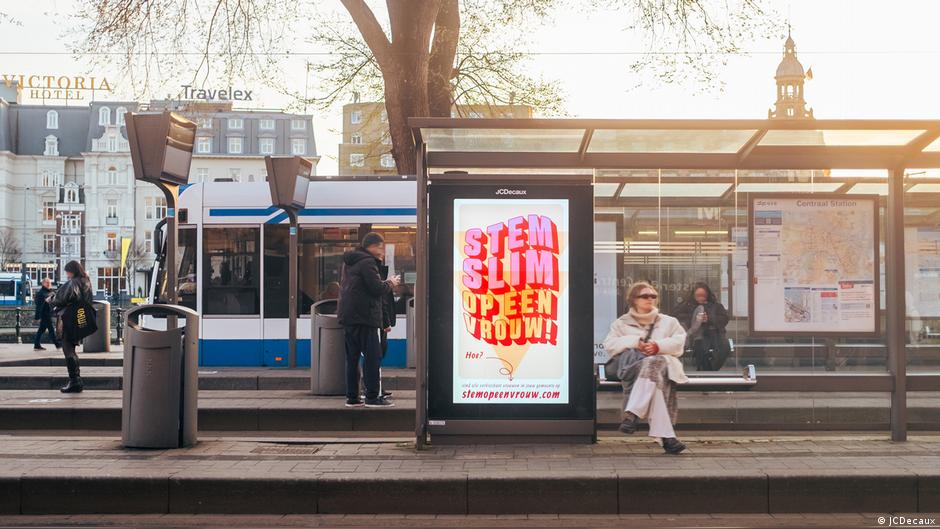
Her election was not certain: she was ranked 15th on the candidate list of the left-leaning Grönlinks-PvdA, yet she gained one of the party’s six seats. Muhammad climbed the ranks because of preferential voting, or “smart voting”, as the campaign calls Stem op een Vrouw (Vote for a Woman).
How does this work?
Voters in the Netherlands do not just choose a party but rather select a specific candidate on the party list. Candidates are ranked by parties, usually with their leaders at the top.
“We see more men, and then we see women further down the list,” says Zahra Runderkamp, political scientist and lead researcher at Stem op ein Vrouw.
Voters prefer the candidates at the top of these lists, but to promote women’s representation, Stem op een Vrouw encourages voters to support lower-ranking women, especially those just below the projected seat threshold.
This strategy has helped Muhammad and 503 other women across the Netherlands get elected in the latest elections.
Women are particularly under-represented in local politics.
At the national level, women’s representation in parliament in the Netherlands is currently 43.3%. This is well above last year’s EU average of 33.6% and the highest level since the first female Dutch MP was elected in 1918.
At the local level, however, a different picture emerges: in nationwide municipal elections in March this year, women turned out only 36.9%. And without the strategic preferential voting described above, this percentage would have been 32.7%, according to Stem op ein Vrouw.
Runderkamp is proud of the number of women claiming the seat – a record in her organization’s nearly 10 years of campaigning. But gender equality is still far from being achieved.
clear left-right partition
Gender equality varies greatly from party to party, and in the Netherlands there is a clear trend from left to right. The only party that had a majority of female candidates in the last elections was the leftist Party for the Animals, with just over half.
Only 2% of the candidates of the conservative Reformed Political Party (SGP) were women. But, in a way, it is a feminist success: until 2013, the SGP, based on its interpretation of the Bible, banned women altogether from running for political office. Only after a seven-year legal battle and a court ruling that its position was discriminatory did the SGP change its rules.
SGP is an extreme example of this. But only 32% of candidates across all parties were women.
“You can’t deny that voters need more than just smart voting to hack the system a little,” Runderkamp says, adding that parties should work on equality of those electoral lists. However, the obstacles do not begin and end with electoral lists.
How many jobs are open for women?
Research shows that girls often view politics as a male-dominated space, a perception that becomes stronger as they age and is associated with lower levels of political interest.
Less representation also means less visible role models. Runderkamp says this sends an early message that politics “isn’t really the place for them.”
She suggests that this is a self-reinforcing cycle: with fewer women in office, policies are less likely to reflect women’s everyday realities. This can deepen political alienation and discourage women from moving forward.
The strain on a woman is trying to break that cycle. Along with its campaign to get more women elected, the group also connects aspiring candidates with experienced women in politics to network, learn how the system works, and gain a foothold. For example, Fatuma Muhammad attended training sessions on how to apply for political positions and how to campaign.
But barriers not only affect those who enter politics, they also affect those who remain in politics.
In the Netherlands, local councilors also perform political work in addition to their jobs, mostly in the evenings and at weekends. Since women still perform a disproportionate share of unpaid care work, this may not be consistent. “I think the question is how open it is for women to participate, and especially to stay for four years and run again,” says researcher Runderkamp.
Furthermore, a 2024 Ipsos I&O report commissioned by the Dutch Ministry of the Interior found that 55% of female politicians faced aggression while in office, compared to 37% of men.
Even before assuming office, Muhammad has faced aggressive insults. “I started using TikTok for my campaign and I got a lot of racist comments sometimes,” she said.
Women increasingly leave politics
Do female politicians leave office earlier and more often than men due to aggressive behavior?
Across Europe, women are reportedly leaving politics due to threats and smear campaigns, with research from British non-profit HateAid finding that they suffer significantly more abuse than their male peers.
Runderkamp cautions that there is no clear statistical evidence for this: “In political science, we are not certain that hatred and aggression are direct causes of leaving politics,” he said. Rather, she discussed, such factors prevent women from running for office or holding office.
On the day of his inauguration, Muhammad is determined to complete his term. She also plans to bridge the gap between people and politicians: “I’m really happy that I can now represent more people of color, but also young women.”
She knows it won’t be a 9 to 5 job, but Muhammad is keen to start her political work. “However, Sundays are for rest,” she says, smiling.
Edited by: R. How