
With DATUM, miners build their own block and use the pool to share the reward.
OCEAN’s purpose in allowing mining with DATUM is to decentralize BTC mining.
This April 11, Bitcoin blocks 944643 and 944644 were processed consecutively by two different miners using decentralized templates. According to data from the mempool.space explorer, these miners operated under the labels “ZettaPow” and “Data Factory” and earned rewards of almost USD 230,000 each, considering the block subsidy (3,125 BTC) plus block commissions.
Luke Dashjr, lead developer and CTO at OCEAN, explainedaccording to his vision, the implications of this event: “Instead of two blocks made by the same pool, we get blocks made by two independent miners, exactly the same as if they were not using any pool.”
In traditional mining pools, such as Foundry USA, Antpool, among others, it is the pool who provides the template that organizes the order of transactions in a block. Therefore, decide which transactions to include in each one and how it is built. Individual miners only contribute computing power to calculate the hash. That concentrates a key network decision — which transactions are confirmed and in what order — into a few entities.
The DATUM protocol, launched in early October 2024, inverts that model: each miner builds his own block template and use the pool only to share the reward with other participants. According to a publication of that same April 11 from the OCEAN team, this decentralizes the construction of blocks without eliminating the economic benefits of pool mining.
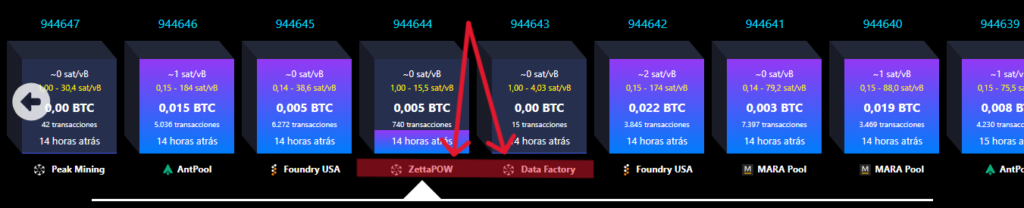
At the time of this writing, since the implementation of DATUM, OCEAN miners processed 687 blocks of Bitcoin.
The OCEAN model points to a specific problem. According to mempool.space, the three largest pools concentrate a significant portion of the global Bitcoin hashrate: Foundry USA controls 31.5%, Antpool 18%, and F2Pool almost 11%. Added, all three exceed 60% of the network’s total computing power.
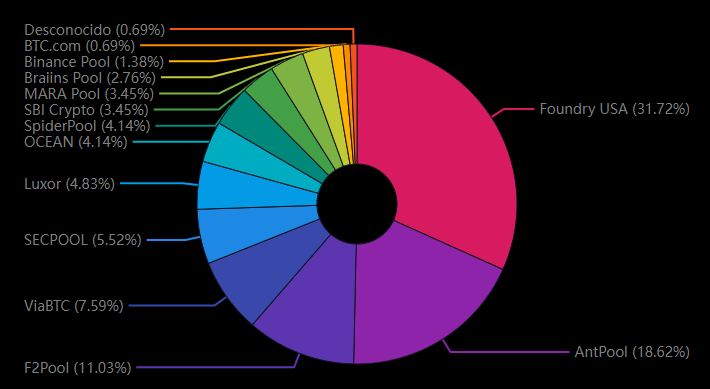
That concentration is relevant because a set of miners that controlled more than 50% of the hashrate could, in theory, execute what is known as a 51% attack: rearrange recent blocks, reverse transactions or censor payments.
However, that scenario is unlikely in practice given that large pools and their miners have a direct interest in the stability and reputation of Bitcoin, since such an attack would destroy the value of the asset on which their business depends. What does exist is the technical ability to concentrate decisions on which transactions are confirmed, something that occurs independently of any attack.
The 51% attack does not represent a definitive risk because miners, faced with any suspicious concentration of power, can leave the pool to join another, regulating the distribution of hashrate in the Bitcoin network.