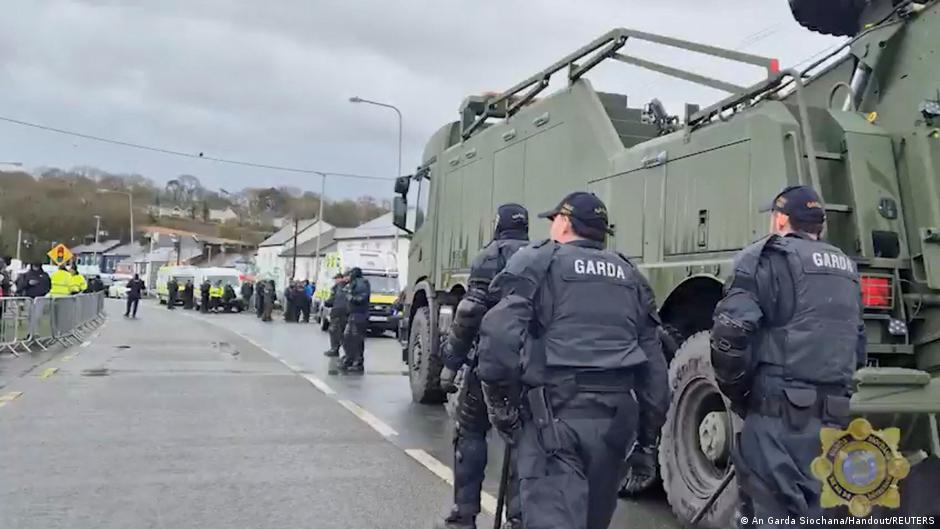
Police in Ireland used pepper spray and made arrests to disperse protesters blocking the country’s only oil refinery.
Authorities moved to disperse protesters to restore supplies after five days of nationwide protests over rising fuel prices.
Law enforcers, supported by armed forces personnel, moved to reopen the Whitegate refinery in County Cork on Saturday and escort fuel trucks.
National broadcaster RTE posted a video showing several officers dragging a protester with a tractor.
After Irish Defense Forces joined police in breaking up the protests, Irish police chief Justin Kelly said on Saturday that the actions of fuel protesters “are putting the state at risk.”
Kelly told reporters that blocking “critical national infrastructure such as fuel depots and refineries” had led to “fuel shortages which have a direct impact on emergency services such as hospitals, ambulance services and fire services.”
“We will carry out more such operations in the coming hours and days,” he said.
How did the protests start?
Protests began on Tuesday over rising prices of petrol and diesel due to the Middle East war.
The protesters, consisting mostly of truck drivers, farmers and transport operators, partially blocked Ireland’s only oil refinery and restricted access to at least two other fuel depots in Galway and Foynes, County Limerick.
This led to further fuel distribution shortages, threatening emergency services and freight traffic.
“We can’t continue to trade with the cost of fuel, the cost of wages, everything,” protester Paddy Murray told RTÉ. He said the government needs to take steps to help.
The protests have also disrupted bus services across the country and tram services in Dublin.
What has the Irish government said?
Kevin McPartlan, chief executive of Fuel for Ireland, said about 600 of the 1,500 filling stations around the Republic of Ireland were dry.
Operations at the port, operated by Irish Rail, were seriously affected, disrupted by the fuel protest blockade. Officials said the port is near capacity, meaning ships may have to anchor offshore or be diverted.
Michael Martin, Prime Minister of Ireland (known as Taoiseach), warned that protests could force the country to cut off fuel shipments amid a global shortage. He called the situation “unconscionable, it’s illogical, it’s hard to understand.”
Justice Minister Jim O’Callaghan said it was “unacceptable” that protests continued despite the worsening fuel situation.
“While we all acknowledge the impact of high fuel prices and strive to mitigate that impact, no group in our republic deserves to hold our people to ransom in this way,” he said.
Earlier government measures, including tax cuts and exemptions, failed to offset rising oil prices linked to the conflict in the Middle East.
Edited by: Carl Sexton