The US-Iran talks in Islamabad were seen as a test of whether the fragile ceasefire could lay the groundwork for a more durable peace. Instead, the talks ended without any agreement.
But even though no agreement was reached, the talks were not entirely in vain. They were the highest level direct meetings between the two sides since the 1979 Islamic Revolution.
And despite the alleged failure of talks, diplomatic channels remain open, at least until the April 22 temporary ceasefire deadline, with Pakistan urging both sides to maintain force.
US Vice President JD Vance, who led the US delegation, called the US offer his “final offer”, which Iranian officials called “unfair” and “excessive”.
But while there is still a significant gap to be bridged between Washington and Tehran, domestic pressure on the Iranian regime is also playing a major role.
A practical start, but no success
Public reporting on the details of the US proposal remains fragmented and disputed. But hardline Iranian lawmaker Mahmoud Nabavian, who was part of the delegation in Islamabad, claimed
Those claims have not been independently verified, but they show how quickly hardliners in Tehran moved to portray the US position as maximalist and abusive.
Iran’s Parliament Speaker Mohammad Bagher Qalibaf, who was also part of the Iranian negotiating team, had a very measured tone.
After the talks, he said that Iran had entered with “goodwill and the necessary will”, but that previous wars had left Tehran with “no trust in the other side”. He said the US now understood Iran’s principles, and it was up to Washington to “earn our trust or not.”
The contradictory positions show that within the Iranian camp, there appear to be different priorities: one side is trying to keep the doors of diplomacy open, the other is trying to make it clear that any agreement will come at a very high political cost.
The real pressure is inside Iran
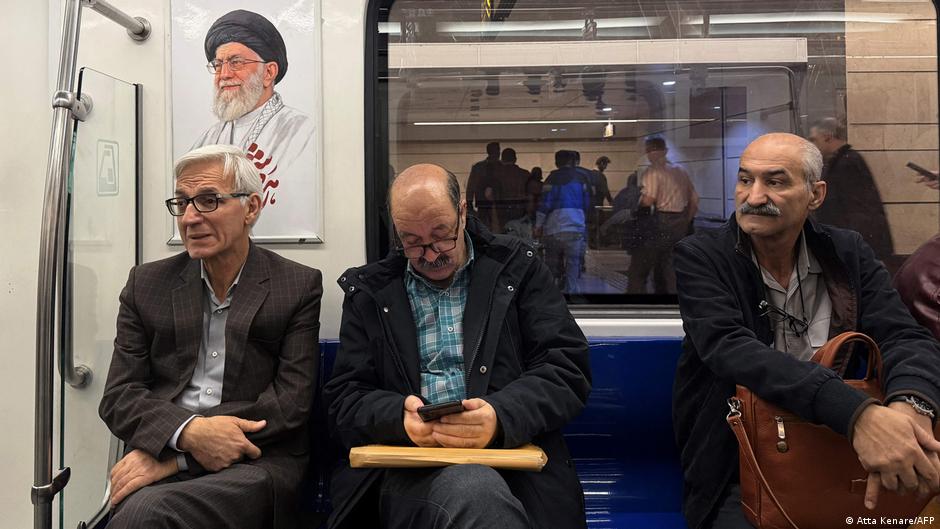
The failure of the talks was bad news for most ordinary Iranians, whose country and infrastructure have been damaged by nearly six weeks of heavy bombing and airstrikes.
A resident of Tehran told DW that the company where he worked was linked to Mobarakeh Steel and that after the plant was attacked and closed, some workers were told not to return.
“The accounting staff is still there, but there’s no one left in sales,” he said. He said he was still hopeful that an agreement would be reached so that damaged factories could be rebuilt and people could return to work.
Another resident of Tehran described a deep sense of economic collapse. “Thousands of people have become unemployed,” he told DW, adding that many can no longer even buy basic goods, exacerbating the economic crisis that led to mass protests across Iran earlier this year.
He said, “A product that cannot be purchased is useless.”
He also said that the internet shutdown since the war began on February 28 has affected countless jobs and strained family life. “Society is in deep economic, political and social crisis,” he said.
The sense of unease in a country still reeling from massive, nationwide anti-government protests this year is one reason the clerical regime may still try to keep diplomatic channels open and return to the negotiating table.
Iran’s government may still have repressive power, but the economic and social costs of returning to full confrontation are rising rapidly.
Is a deal still possible?
Despite the failure in Islamabad, some remain hopeful that diplomatic efforts will eventually yield some meaningful result.
Nazila Golestan, a Paris-based political activist, told DW that a prolonged war is neither in the interests of the increasingly isolated regime in Tehran, nor in the interests of the Iranian people, who have seen their cities, factories, energy facilities and other infrastructure destroyed by bombing.
He said, “Continuing the war is harmful to the people, while continuing the talks is in their interest.”
Golestan said the main issue is not just whether Iran and the United States can reach a deal. “The main problem is Israel,” he said.
His statement reflects a broader concern among Iranian observers: Even if Tehran and Washington find some common ground, regional actors and competing agendas could still complicate or undermine peace efforts.
What leverage does Tehran still have?
While Iran still has cards to play, namely its threats on the Strait of Hormuz, the war has significantly weakened its hand.
But the option of closing the strategic waterway or attacking ships trying to pass through it has also become arguably even riskier.
Soon after the talks ended in Islamabad, President Donald Trump announced a US naval blockade of Iranian ports to take effect from Monday afternoon.
The sharp rhetoric used by Trump just hours after the Islamabad talks ended shows how delicate this moment is for Iran.
The ceasefire still stands and neither side appears ready to close the door to further talks.
But inside Iran, people are no longer measuring events based solely on strategy or prestige. They are measuring it on the basis of lost jobs, rising prices, factory closures and the fear that if diplomacy fails again, survival in the next round of war could be even more difficult.
Edited by: Carl Sexton