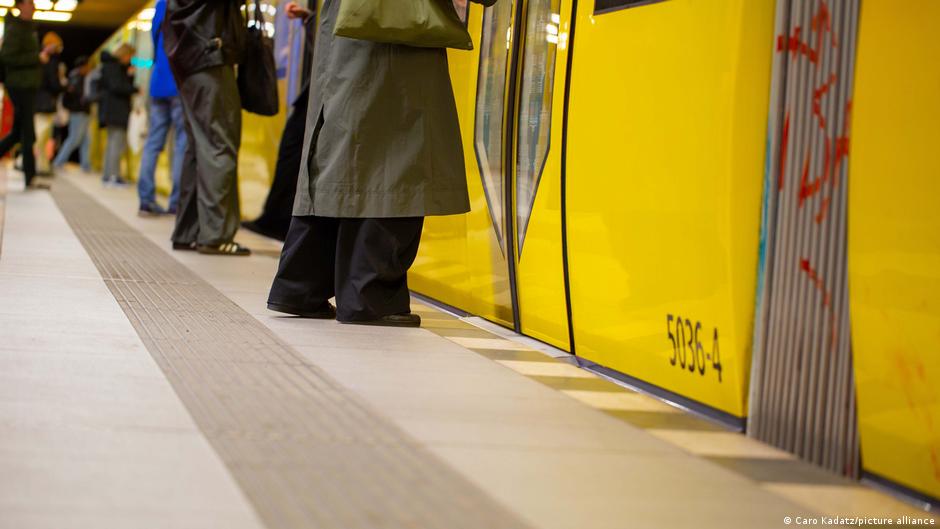
Does everyone who boards a public bus or train in Germany know that traveling without a ticket is a criminal offense that usually carries a fine of €60 ($70)? Or that those who don’t pay the fine could be jailed?
The somewhat cumbersome German word for this harsh punishment is “retributive prison sentence” – literally “substitute prison sentence” – and can be as long as a year. In recent years, about 7,000 to 9,000 people have spent time in prison for fare evasion in Germany.
Justice Minister Stephanie Hubig now wants to change that. In an interview with the daily Neue Osnabrucker ZeitungThe centre-left Social Democratic (SPD) politician said she wanted to “decriminalize” ticketless riding and would like to avoid sending people to jail for it in the future. Hubig said: “Are the people who can’t afford tickets and end up in jail really belong there?”
civil violation vs criminal offense
Hubig wants to downgrade fare evasion from a criminal offense to a civil infraction, for example, by placing it on the same level as illegal parking.
She points to a clause in last year’s coalition agreement, which the conservative Christian Democratic Union (CDU) and its sister party, the Christian Social Union (CSU), formed with the SPD, states that the new government will examine “which rules are unnecessary and can be repealed.” According to Hubig, prison sentences for fare evasion fall into this category. She estimates the cost to an already overburdened justice system at around €200 million a year.
Hubig has received support from the German Bar Association (DAV), which represents approximately 60,000 lawyers throughout Germany: “The public benefit of criminalizing fare evasion is questionable, while the harm it causes to society is enormous,” Sven Walentowski, executive director of the DAV, also pointed out. Neue Osnabrucker Zeitung.
Police union opposes plans
Hubig made his proposal public at Easter and received a quick response from the CDU/CSU after the holidays. His deputy parliamentary group leader, Günter Krings, said in Berlin on Tuesday: “It would be better if the Justice Ministry focused its attention on the real problems of criminal law.”
The GDP, one of Germany’s police unions, also warned against the change. Spokesman Andreas Roskopf said Hubig’s plan risks that “many people will not care whether they have a ticket or not.”
This could mean that Hubig’s proposal could suffer the same fate as that of his predecessor Marco Buschmann of the neoliberal Free Democratic Party (FDP). The former Justice Minister announced in 2023 that he would at least consider downgrading the offense from a criminal offense to a civil infraction. Meanwhile, a survey conducted at the time by polling firm Infratest-Dimap found that nearly two-thirds of citizens were in favor of no longer sending fare evaders to jail.
Initiative to provide relief to fare evaders
Over the years, Freedom Fund Initiative Fighting against this law, which ultimately dates back to the Nazi era and came into force in 1935. The organization is funded by donations and, according to its own figures, has bailed out approximately 1,700 people. On Tuesday, Leo Ihsen, a spokesman for the organization, said: “What is happening is outrageous: Most of the people who are jailed for traveling without a ticket have never been convicted of a crime in court. They simply got a summary judgment with a fine and then are jailed because they were poor. Every year, this madness affects 9,000 people in Germany.”
On its website, the initiative now lists 13 German cities that have opted to refrain from filing criminal charges against people caught traveling without a ticket. These include cities like Frankfurt am Main, Cologne, Bonn and Leipzig.
This article was translated from German.