The end of the Orbán era began at 9:11 pm CET on Sunday with a simple Facebook post on a blue background.
The message posted by Hungarian opposition leader Peter Magyar was brief and to the point: “Prime Minister Viktor Orbán just congratulated us on our victory over the phone.”
Although only about half the votes cast in Hungary’s parliamentary election had been counted at the time, the landslide defeat of Orbán’s Fidesz party and the historic victory of Peter Magyar’s opposition Tisza party were already becoming clear.
Largest majority since the end of communism
Despite starting the election campaign from an incredibly strong position after 16 years in power, Fidesz was easily swept aside by Hungarian voters.
Tisza, on the other hand, received the largest two-thirds majority received by a party since the end of the communist dictatorship in Hungary in 1989/90. What’s more, it did so with a record turnout of nearly 80%.
It was the groundbreaking result that many in Hungary no longer thought possible after 16 years of Orbán’s autocratic rule: Just ten minutes after Magyar’s Facebook post, the outgoing prime minister came on stage and briefly conceded defeat in front of a few hundred supporters.
Orbán said his party would “serve our country and the Hungarian nation beyond the opposition,” adding that they would “never, never, never give up.”
party atmosphere
A short time later, enthusiastic crowds of mainly young people poured into the streets of Budapest and other towns and cities across the country.
In scenes reminiscent of 1989/90, thousands of people celebrated the end of Orbán’s rule.
The country’s largest independent online news outlet wrote about “an end to tyranny” and “toppling the Orbán system” or simply said “it’s over.”
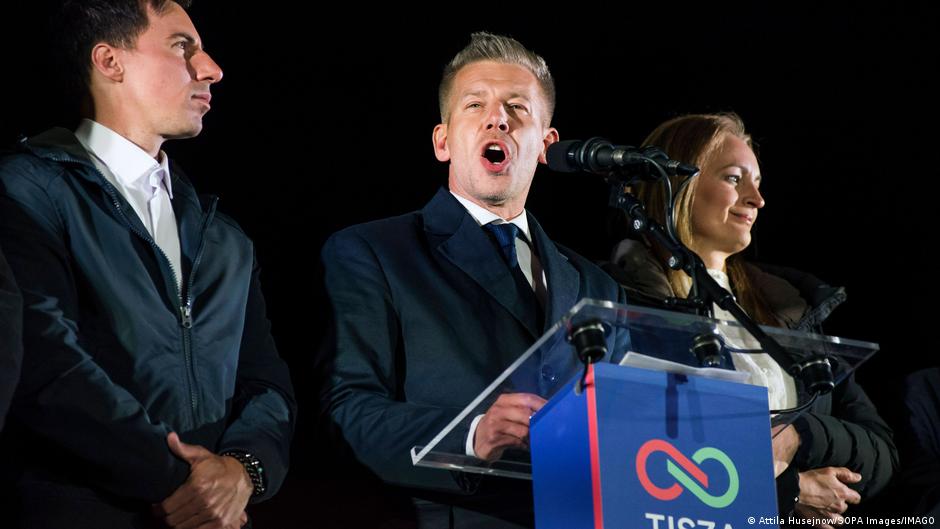
During this, Peter Magyar gave a 40-minute victory speech in front of thousands of supporters. There were many emotional statements and big promises in his address but no victorious sentiment or vengeance. It was a speech full of clever declarations and cordial words to those who voted for Orbán.
He said, “From today our country has become alive again.” “We have been empowered to build a functioning and humane country. We will work every minute and every second to earn this trust.”
‘A strong partner for NATO and the EU’
When he said that Hungary would once again be a European country and a strong partner of NATO and the EU, the crowd chanted “Russians go home!” Started raising slogans. and later “Europe! Europe!”
Magyar called on the country’s most senior civil servants, the President, the Attorney General, and the two highest-ranking members of the judiciary, to resign and promised to restore the system of checks and balances.
He also extends a hand to Fidesz voters: “I will also be your prime minister and will make sure that we will be able to accept each other, even if our opinions are not the same.”
‘a new era’
Many Hungarian political scientists late Sunday evening generously filled their initial analyzes with hyperbole.
Robert Laszlo, an election expert at the Political Capital Institute, wrote on Telex calling for “a new era” and the fact that with a two-thirds majority, Tisza could begin “the demolition of the Orbán regime.”
Political scientist Daniel Rona said that when it comes to the reason for Fidesz’s defeat “Orbán should look in the mirror.”
In fact, the election result can only really be understood in light of the Orbán system’s years of arrogance, arbitrariness and abuse of power.
The outgoing Prime Minister freed the state and public administration from disloyal civil servants and took over the judiciary and large parts of the media, while consistently claiming that Hungary was the freest country in Europe.
He created an extremely corrupt system, while also declaring that no one protected the country’s interests better than him.
During the Orbán era, which began in 2010, when Fidesz won its first two-thirds majority, all critics were viewed as traitors and enemies of the nation.
For 16 years, Hungary has been mired in a never-ending campaign of hatred, which recently culminated in a series of outrageous, absurdly bizarre accusations against Ukraine.
At the same time, Orbán spent years ingratiating himself with Russian President Vladimir Putin and other dictators in the most humiliating ways.
Many factors led to this historic outcome
For a long time, many Hungarian observers felt that it was no longer possible to peacefully oust Orbán at the ballot box.
Several key factors combined to make the impossible possible – and in the process give a democratic opposition party a historic two-thirds majority.
First, the majority of Hungarians had a deep desire to no longer live under the Orbán system; Second, electoral laws were clearly distorted in this election, working against Orbán; Third, a talented, charismatic political leader and fourth, the withdrawal of almost all other opposition parties from the elections.
It is also likely that the increasing open support for Orbán from Moscow and Washington later proved a hindrance to the autocratic prime minister.
Orbán’s defeat is a major personal blow to both Vladimir Putin and US President Donald Trump as both had supported Orbán openly – and in the case of Russia, also behind the scenes.
what lies ahead?
Whether Orbán’s defeat marks the beginning of the end for populist right-wing conservatism and right-wing extremism in Europe is difficult to say.
Orbán’s ally, Fidesz co-founder and far-right writer Zsolt Bayer, sounded decidedly pessimistic in this regard, saying on Sunday evening that Hungary had been a “bastion of patriots” and that with the fall of this bastion “hope for building strong nation states in Europe was now lost for a long time.”
In sharp contrast, many governments across Europe congratulated election winner Peter Magyar late Sunday evening. They undoubtedly hope that the days of vetoes, ongoing blockades and agitation are now over and that more normalcy will return to the EU.
At this time it is impossible to say how quickly the system in Hungary will be changed and how successful the change will be.
Marton Gergely, writer and editor-in-chief of the weekly newspaper hvgexpressed hope that Peter Magyar would not abuse his overwhelming parliamentary majority, and said it was now up to the winner to prove he would rebuild democracy, even if, as Gergely said, “the statistics mean he won’t need to.”
This article was originally published in German.