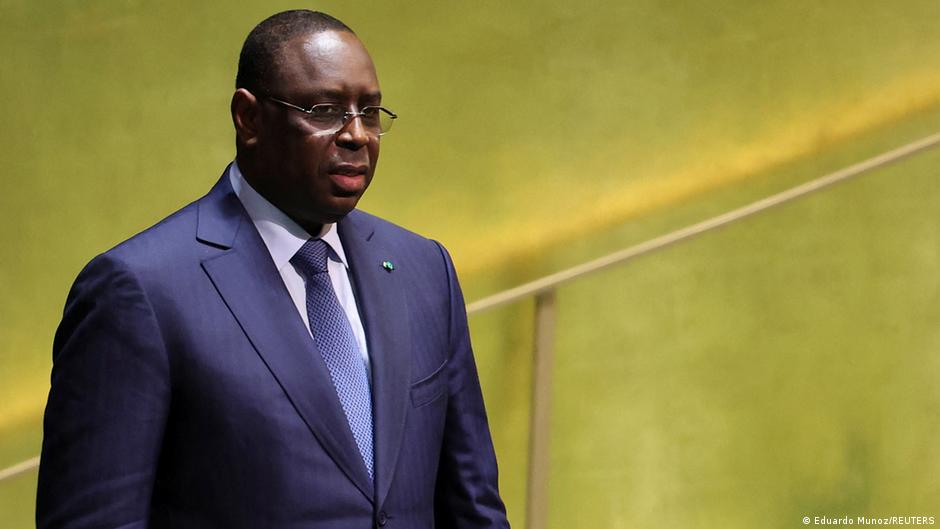
Burundi last month nominated former Senegalese President Macky Sall to succeed UN Secretary-General Antonio Guterres, whose second and final term ends on December 31, 2026.
In his vision statement for the role, Sall said the United Nations needed to be reformed, streamlined and modernized.
But Senegal said in a diplomatic note to the African Union (AU) that it “has not, at any level, supported the application”, nor was it “linked to the relative initiative taken by the Government of Burundi.”
And Sall’s ambitions for the top UN post do not have the full support of the AU, which he chairs between 2022 and 2023.
Nearly 20 AU member states have rejected SAIL’s bid. Major countries include South Africa, Algeria, Rwanda, Liberia and Senegal.
How was the bid revealed?
On 2 March, Burundi, which currently holds the role of rotating AU chair, submitted Sall’s nomination in a letter to the President of the UN General Assembly.
According to the Institute for Security Studies (ISS), a South Africa-based think tank, “the presentation blurred the line between a national initiative and a continental endorsement.”
ISS said the timing of the letter, which was signed by Burundian President Evariste Ndayishimiye, “just two weeks after the AU summit, may have created the impression of formal AU support, which may have caused some confusion…”
The ISS noted that AU processes require candidates to undergo formal review by nominating committees before the Executive Council can endorse them either unanimously or by a two-thirds vote.
Following questions and objections from member states, Burundi reopened nomination on 26 March under the AU’s so-called tacit procedure, which limited member states to 24 hours to object or ratify.
The tacit procedure is widely used in multilateral institutions, allowing decisions to be taken if no formal objections are raised within a specified time frame.
By the close of business on 27 March, about 20 AU member states had broken silence on the draft decision, blocking its adoption.
Opposing countries say procedures were violated
Rwanda, which openly criticized the process and confirmed its opposition through senior officials, described Ndayishimiye’s attempt as a “gross violation of process”.
“This was too much for many AU member states, who could not accept such an order and such an insult from their chairperson. They then decided to break the silence, block his decision and remind President Ndayishimiye that the African Union is governed by the rule of law,” Rwandan Foreign Minister Olivier Nduhungirehe wrote on X.
Nigeria’s Permanent Mission to the AU also broke its silence and argued that established procedures and principles were not followed in the decision making.
Zibi So, a senior researcher at the ISS Regional Office for West Africa and the Sahel, said that “the AU has an established process in this region that allows for a thorough assessment of candidates.”
“And in this instance, the silence process did not allow discussion on a very important matter like the candidacy for the post of secretary general,” So told DW.
In a letter to the AU Commission, Nigeria said Africa should refrain from contesting the post of Secretary-General, arguing that it is Latin America and the Caribbean’s turn under “the time-honored principle of continental rotation in the appointment of the UN Secretary-General”.
what happens next?
Even without AU support, Sall remains a candidate for UN chief, and member states are free to vote for him on an individual basis.
Sall joins three other candidates in the race to replace Guterres starting January 1, 2027: former Costa Rican vice president Rebecca Grinspan; Rafael Grossi, Director General of the International Atomic Energy Agency (IAEA); and former Chilean President Michelle Bachelet.
He is scheduled to be interviewed by member states in the second half of April.
Edited by: Keith Walker