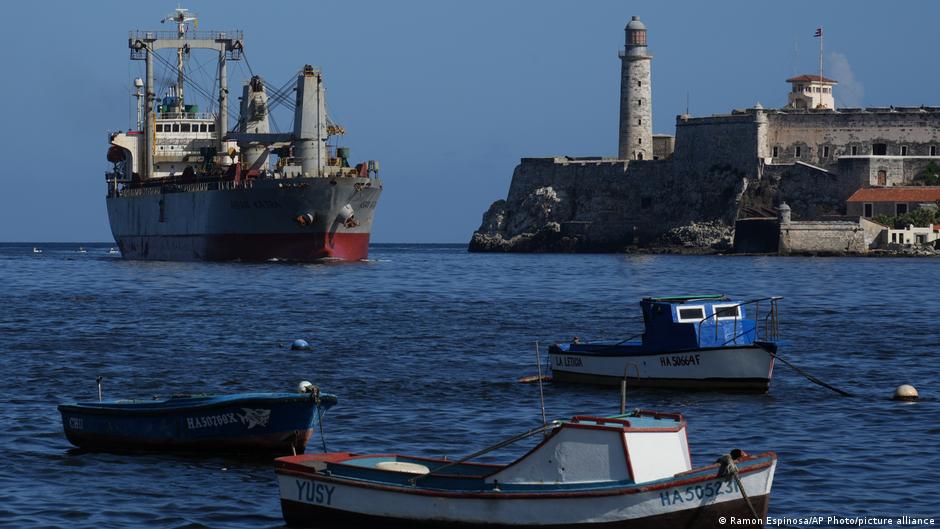
Cuba took delivery of 15,000 tons of rice donated by China on Sunday when the first of several promised shipments arrived at the port of Havana, helping to somewhat ease an acute shortage on the Caribbean island.
“This noble gesture of solidarity will reach millions of consumers in all provinces, in addition to our health and education institutions,” Cuban President Miguel Diaz-Canel wrote on social media.
“The heartfelt ties of friendship and cooperation that unite [Cuba and China] Are strong in important moments,” he said.
Chinese Ambassador Hua Xin said on Cuban television that the delivery represented “the largest food aid from China to Cuba in recent years.”
The shipment is the first batch of 60,000 tons of rice that Beijing has promised to help deal with the dire economic situation in the communist country, which has worsened since the United States ousted Venezuelan President Nicolas Maduro in January and blocked Venezuelan oil exports to Cuba.
Cuba is facing blackouts amid economic crisis
According to data from the state-run Electric Union (UNE) compiled by the Spanish EFE news agency, 64% of Cuba was due to be subject to a simultaneous blackout on Sunday.
The Cuban government recently acknowledged that the island’s energy situation is “dire,” “critical” and “extremely stressed,” with some blackouts in the capital Havana lasting 22 hours or more.
Last week, a record was set when 70% of Cuba’s territory was simultaneously without electricity during the moment of highest energy consumption. This week, the impact of these disruptions has fluctuated between 58% and 65% of the island.
The Havana government has called the current US oil embargo – imposed on top of a general US trade embargo since 1962 – “genocide” and accused Washington of “suffocating” the island.
Cuba requires about 100,000 barrels of oil per day to meet its energy needs, of which only 40,000 barrels are supplied by domestic production. Various independent studies estimate that between $8 billion and $10 billion would be needed to revitalize Cuba’s energy system.
America’s threat against Cuba
Meanwhile, the administration of US President Donald Trump continues to increase political pressure on Cuba, fueled by radical Cuban-Americans in Florida who have called for US-inspired regime change in their homeland for decades.
But ousting Diaz-Canel is unlikely to be as straightforward as the operation to remove Maduro in Venezuela in January, not least because of the lack of a clear alternative.
“The security apparatus in Cuba has systematically destroyed every alternative or potential alternative energy source,” Orlando Pérez, an expert on US-Latin American relations at the University of North Texas at Dallas, told the Reuters news agency.
The Cuban military is a more cohesive and ideologically stronger fighting force than Venezuela’s and is more likely to resist foreign intervention.
Havana is considered more advanced in surveillance and intelligence after years of cooperation with the Soviet Union during the Cold War and more recently with China.
Edited by: Sam Dusan Inayatullah