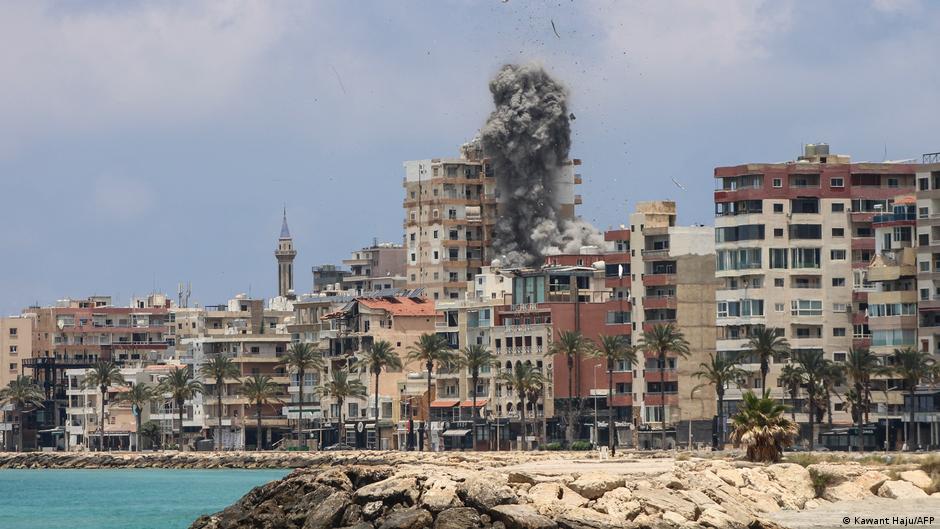
The Israeli military has now told locals in Tire several times that they should evacuate the southern Lebanese city, which was previously home to more than 100,000 people as well as about 10,000 displaced people from surrounding areas. But her father and other members of his family are staying, says Lily, a community worker from Tyre.
Lily, who did not want to give her full name for security reasons, is now staying with friends in the Lebanese capital Beirut. But whenever she can, the 29-year-old woman returns to Tire to deliver medicine and food.
“Tyre is a haunted city,” she tells DW. Since the beginning of March, a steady stream of locals have been seen coming under ongoing Israeli airstrikes. Drone and artillery attacks have continued on Tire this week, with Israel saying it is targeting the Lebanese militant group despite a new ceasefire between Iran and Israel.
“Three weeks ago, you had a pharmacy open every two or three days, then close for security,” Lilly adds. “Some grocery stores are open but you can count them on fingers. And it’s hard to get supplies. No one wants to come with tires by road because it’s risky.”
never ending worries
Sometimes the Israeli military warns that it will target a certain building, Lilly says, “but then they actually target four buildings. Or the building they warned about won’t be affected for a week. So, there’s no specific time and it keeps everyone worried because they don’t know what’s going on.”
She adds that at other times, Israeli forces do not even give warning of an attack. On Sunday, the historic family home of a close friend, located near an area of Tire classified as a World Heritage Site by UNESCO, was completely destroyed.
“There was no warning, but luckily, there was none,” said Lily, adding that her 32-year-old friend, who previously volunteered with the Red Cross, was actually in the process of moving to France for a new job. The main casualties were a dozen cats that the family was caring for.
“She’s devastated,” Lily says. “We’re all devastated. And we’re asking why. Because, you know, there was no military target there. Unless cats are now considered military targets.”
Lilly says some of the other questions many people in southern Lebanon are asking are: will they ever be able to return to their homes, how long will Israeli forces remain in their country, and whether the army could advance even further into Lebanon.
In March, Israel’s Defense Minister Israel Katz said that locals would not be able to return to southern Lebanon until “the safety of northern Israeli residents is guaranteed.”
Israel has marked a “yellow line” in southern Lebanon that it says establishes a security buffer zone to protect its citizens from Hezbollah attacks. This line is approximately 10 kilometers (6 mi) from the border. But for the first time since 2006, there have been reports of Israeli troops being active across the Yellow Line and Lebanon’s Litani River. In addition to Tyre, Israel also recently issued evacuation orders for another southern city, Nabatieh, which is also beyond the yellow line.
‘Change from limited border defence’
In late May, Israeli Prime Minister Benjamin Netanyahu said he wanted troops to “deepen and expand” their hold on Lebanese territory. The Israeli government has previously said it wants “freedom of operations” in Lebanon, although experts say this mostly refers to air strikes.
All these indicate “a shift from limited border defense to a strategy of territorial control and deterrence”, experts from the Institute for Applied Geopolitics, a US-based risk consultancy, discussed in a paper. june briefing. “The scale and symbolism of the operation evoke Israel’s 1982 occupation, suggesting the potential reestablishment of a long-term security zone.”
In fact, Israeli armed forces have not even gone that deep into Lebanon, says Yossi Kuperwasser, head of the Jerusalem Institute for Strategy and Security and former head of the Israeli military’s research division.
“The depth to which the Lebanese army wants to go, and the government has agreed to go, is about 10 kilometers from the border – so that our communities on the southern side of the border are protected from direct fire from anti-tank missiles,” Kuperwasser tells DW.
The retired army chief admits there is debate over whether to go further into Lebanon. “We pay a heavy price for drones almost every day, we have some casualties, so this may influence the debate,” he says. “But as of now, I don’t know any new decisions [to go beyond the yellow line]”
Still, he says, the people of southern Lebanon are right to be concerned: “Because the more pressure is put on Israel, the more Israel will reconsider that policy.”
Security area, or territorial expansion?
David Wood, senior Lebanon analyst at the International Crisis Group think tank, says that, for the moment, the Lebanese are not too worried about “the Israeli occupation extending to Beirut.” “That said, the Lebanese fear that Israeli troops could advance into new areas such as Nabatieh in southern Lebanon.”
“I think they’re a big part of what’s going on right now [the Israelis] “Assume they have freedom of action,” suggests H.A. Hellyer, senior fellow at the Royal United Services Institute for Defense and Security Studies in London and the Center for American Progress in Washington. So, I think they’re using this special period to draw some new lines in the sand, to create this kind of safety zone.”
Although Israeli forces withdrew from a town in southern Lebanon last week, Hellyer says recent history shows that Israeli security zones often turn into permanently occupied or occupied areas. He points to Netanyahu’s recent comments about Syria controlling the Golan Heights and 70% of Gaza as examples.
However, both Hellyer and Crisis Group’s Wood argue that this does not mean that nothing can be done to rein in Israeli forces in Lebanon. This will mainly include America and other countries including Germany.
Hellyer argues, “They would not even need to impose negative sanctions on the Israelis.” “They just need to say, ‘We will no longer support this.’
Wood argues, “As Israel’s key ally, the US should pressure Israeli leaders to abide by a de facto ceasefire, then begin to withdraw and allow the Lebanese army to enter and establish control.” He points out that Israel’s buffer zone plan in southern Lebanon is not working anyway, as Hezbollah continues to launch drones and rockets at Israel and cause casualties to Israeli soldiers.
Lily, who was displaced from the city of Tyre, also doesn’t believe Israeli plans will work for her hometown, but for different reasons.
“I’ve talked to many people here and they all say they want to return home,” she tells DW. “After all, this is not the first time we have been invaded or occupied, this is not the first time we have been displaced, or lost a loved one or our homes. So, we will rebuild. Because that is the mentality of the people of the South. We are resilient and this is our land.”
Edited by: M. Sass