The project registers an initial volume of $1,500 per day with rapid growth goals.
The protocol uses active listening in Telegram to adjust the application to local failures.
The flow of remittances entering Venezuela is already in a phase of technological diversification that challenges the dominance of exchanges and centralized digital asset platforms. Given this scenario, P2P Protocol announced today, April 27, 2026, its official expansion in the country with a proposal based on decentralization and self-custody.
The initiative emerges at a time when the local debate is divided between those who prioritize the security of supervised exchanges and those who seek alternatives to avoid capital control and institutional intermediation.
The strategy, led by Don, — who requests that his last name be omitted for security and regulatory compliance reasons —, the firm’s chief operating officer (COO), seeks to turn the P2P.me application into a linking tool for the Venezuelan diaspora.
The next step is to open the market so that Venezuelans living abroad can carry out transactions in Bs within the country through remittances. We are implementing a way for people living in countries with dollars and euros to exchange USD Coin (USDC, stablecoin issued by the company Circle) through the app and make payments with local fiat currency.
Gift.
In a financial environment with strict controls and increasing supervision, the majority of Venezuelan users traditionally opt for guardianship of core platforms due to their ease of use.
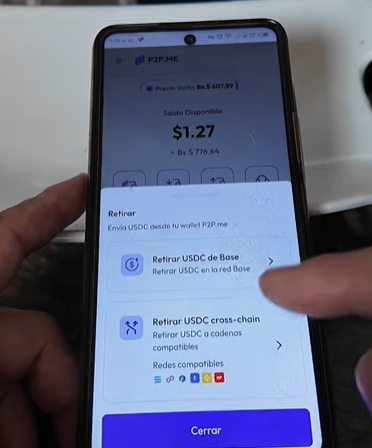
However, P2P Protocol maintains that privacy is an increasing value in contexts of economic pressure. “Highly regulated countries, with a need for individual financial freedom, are target markets,” says Don, highlighting that the structure of the protocol allows it to operate without the typical restrictions of traditional banking systems.
Decentralization vs. regulation
For this system to be viable in the Venezuelan context, the company has recently released the source code (SDK) of its protocol, as reported by CriptoNoticias on April 21, 2026. This move is key, since it allows local developers to integrate fiat money exit “ramps.” They assure that with this, the exchange of digital assets to bolivars becomes a more fluid process and less dependent on a single central entity.
Despite this technical opening, the current figures reflect an operation that is still in the initial stage. With one month of formal presence, The platform registers an average daily volume of $1,500a modest figure compared to the giants of the market.
According to data from early 2026, the national currency market recorded more than 225,000 updates to its order book in just one day. In addition, the Venezuelan currency surpassed other world currencies in terms of frequency of adjustments.
Despite this, the P2P Protocol team plans to multiply its current volume by ten in the short term, relying on incentive campaigns for “Historic Maximum” that refunds 100% to selected users when daily volume records are reached.
In order to mitigate these barriers to entry, the organization maintains direct communication with a community of 250 members on Telegram. Through this channel, the protocol collects data on local payment frictions to make technical adjustments to the application in real time.
The development of P2P.me in Venezuela thus adds to a regional pattern in Latin America, where decentralized technology attempts to solve the inefficiencies of cross-border payments. This is already happening in Cuba and other Hispanic countries with Mostro, which does not focus on a stablecoin like USDC, but on bitcoin, to exchange digital currency for fiat money directly, without intermediaries and without identity verification.
In this new scenario, the success of the proposal will depend on its ability to offer an efficient alternative to users who, beyond convenience, prioritize total control over their financial assets.