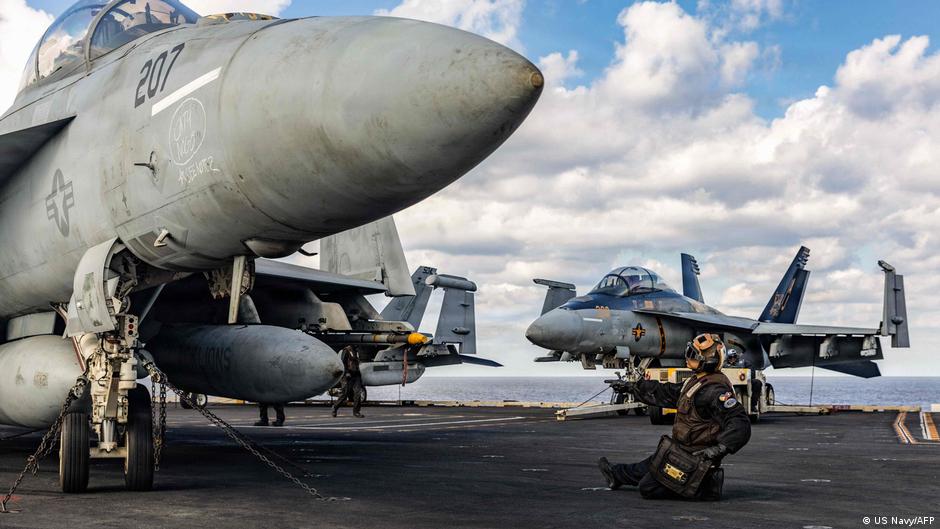
Donald Trump likes to give the impression of being a strong president who fully utilizes the powers given to him under the US Constitution. As Commander-in-Chief of the Armed Forces, he is allowed to launch a military operation, but he must formally notify Congress within 48 hours. In the case of Iran war, he did this on time on March 2.
But now a second deadline is approaching: A military operation is only allowed to last 60 days without the approval of members of the House of Representatives and the Senate, the two bodies that make up Congress. That deadline expires on May 1.
If a resolution to the war is not reached between Washington and Tehran by then, the President will have to take further steps to legitimize his military campaign against Iran.
What is ‘War Power Resolution’?
Nearly 240 years ago, America’s Founders divided responsibility for war in the Constitution: The President is commander-in-chief of the armed forces, but only Congress can declare war.
The War Powers Resolution of 1973 is a federal law that determines how authority is to be divided between Congress and the President during war.
The Associated Press reported, “It says the Constitution’s framers intended that Congress and the President use their ‘collective judgment’ to send troops to ‘hostilities.'” “The War Powers Resolution calls on the President ‘in every possible instance’ to ‘consult the Congress before imposing the armed forces of the United States.’
The proposal is widely seen as a lesson from the Vietnam War, a conflict the US had been fighting since 1955 but which Congress did not formally authorize until 1964. But when it was enacted in 1973, then President Richard Nixon was not in favor of it. However, his veto was overridden by a two-thirds majority in Congress and the law went into effect.
Only Congress can declare war, but this usually does not happen. The last declaration of war was made by Congress on June 4, 1942, against Bulgaria, Hungary, and Romania, allies of Nazi Germany during World War II. Instead, several past presidents have used the resolution’s vague wording to authorize the use of military force abroad.
The war powers proposal is believed to preserve Congress’ role in modern conflicts without a formal declaration of war, while maintaining presidential flexibility in sensitive situations.
30 day extension possible
By law, the President can extend the original 60-day period once by an additional 30 days – specifically to allow the orderly withdrawal of troops.
Stormi-Annika Mildner, head of the Aspen Institute Germany think tank, considers this the most likely scenario. “I assume Trump will use the additional 30-day period, arguing that progress has been made, the ceasefire is in place and the end of the war is in sight, which means additional time is needed to complete the process,” Mildner told DW.
However, this argument will be weakened if the situation in the Strait of Hormuz continues to escalate and there are serious and persistent violations of the ceasefire. “If the conflict escalates any further, implementing or justifying these 30 days will become even more controversial than before,” Mildner said.
the new York Times That points to another possibility: Trump could argue that the 60-day rule doesn’t apply in this specific case. His predecessor Barack Obama made a similar argument in 2011 regarding UN-sanctioned air strikes in Libya. Obama said at the time that the military campaign did not involve sustained warfare, especially not with ground troops.
Five resolutions, five rejections
As a rule, presidents have sought public support and especially congressional approval before major military actions – for example, George W. Bush did so before invading Iraq in 2003. Trump’s decision not to do so in the case of US-Israeli attacks on Iran has created a vulnerability that opposition Democrats in Congress have repeatedly exploited.
Since the beginning of March, there have been a total of five votes in both houses on resolutions intended to impede Trump’s actions. Given Republican majorities in both houses, the proposals failed, though in some cases by only small margins.
Mildner said, “Other than passing resolutions, Congress has only limited means to actively end the war.” “An effective tool would be to cut funding. Politically, however, this is hardly feasible.”
The US military is deeply embedded in society, and cutting funding to the troops would likely make little sense.
looking forward to midterms
However, the five votes so far don’t mean that the sixth vote – after the 60-day deadline – will pan out the same way. according to the new York TimesMany Republicans have already signaled they may reconsider how they vote. John Curtis, a Republican senator from Utah, made his position clear with the opening line of his essay on April 1:
“I will not support military action lasting more than 60 days without congressional approval.”
However, Mildner believes it is “not particularly likely” that such approval would be granted.
“For many Republicans, it is much easier politically to vote against resolutions to end the war than to actively authorize its continuation. The latter involves clear co-responsibility for the duration, costs, and risks of the operation – and therefore considerable political vulnerability, especially with an eye to the medium term,” she said.
Midterm elections will be held on November 3 and all 435 seats in the House of Representatives and 35 out of 100 seats in the Senate will be contested. Midterms often serve as an opportunity to punish a sitting president. This year, opinion polls show Trump’s Republicans could lose their majority in both houses.
Jonathan Katz, a U.S. political adviser at the Brookings Institution think tank, told DW that candidates are watching the polls very closely, especially in states and districts where close contests are expected.
“That said, voting against Trump’s military action is a politically risky move with the midterm elections looming,” he said. “Republican members of Congress will be looking for cover rather than confrontation with a president who has a history of targeting Republicans in Congress who are not considered loyal.”
One reason for the president’s poor approval ratings is the high cost of living, which has been exacerbated by steep increases in fuel prices as a result of the Iran War. Even within Trump’s generally unified MAGA base there has been vigorous criticism of the war. So the President is under immense pressure to find a face-saving solution before the midterms – regardless of how Congress ultimately gets involved.
This article was originally written in German.