
Momentum and profitability indicators suggest that we are in a corrective phase
Activity in Ethereum and Solana advances separately from the price, evidencing network demand.
The cryptocurrency market has been going through a consolidation phase since the beginning of 2026, characterized by prices trapped in ranges and a global environment marked by uncertainty. However, behind this apparent calm, early signs of stabilization are beginning to emerge, according to the most recent report from Fidelity Digital Assets.
In your second quarter analysisthe firm proposes a deeper reading of the current cycle by evaluating metrics such as unrealized profitability (NUPL), market momentum and network usage, beyond simple price behavior. In this context, bitcoin (BTC) remains the main axis of resilience of the ecosystem.
One of the central findings is that the recovery is not uniform. Bitcoin registers a NUPL of 0.21, placing it in an intermediate “hope-fear” zone, indicating that investors maintain moderate profits, with no signs of euphoria.
In contrast, ether (ETH) has a NUPL of -0.12 and solana (SOL) of -0.67, reflecting accumulated losses among its participants. This divergence confirms that Capital is concentrating on BTC, while the rest of the market continues in a corrective phase. In line with this, bitcoin’s dominance has resumed an upward trend after having fallen during the second half of 2025, reinforcing its role as a safe haven asset within the market itself. At the time of the report, BTC was trading around $77,000, amid sideways momentum.
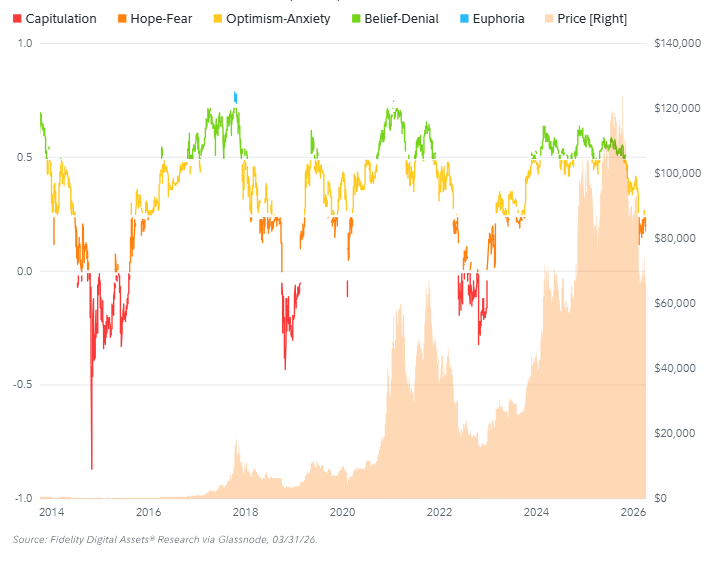
Historically, NUPL levels like the current one in bitcoin have preceded positive returns in the medium term, suggesting that the market could be in an early stage of rebuilding.
Network Metrics: Strong Fundamentals with Mixed Signals
Beyond the price, the report also analyzes activity on the networks. On Ethereum, transactions increased by 34% quarterly, exceeding 2 million daily, while active addresses grew by a similar proportion. At Solana, growth was even more pronounced, with active addresses up 50% and new addresses up 35%. Nevertheless, Fidelity warns that part of this increase could be driven by low-value transactions or even “spam” type activity, favored by lower commissions, which forces us to clarify the reading of real demand.
In the case of Bitcoin, the metrics reflect structural strength with some recent adjustments. The hash rate fell below 1,000 EH/s, affected by factors such as energy costs and weather events, although without altering its long-term upward trend. This suggests that the network remains robust, even in an environment of less dynamism in on-chain transactions. In turn, momentum indicators show a slowdown in the uptrendconsistent with a corrective phase within a broader cycle.
The performance of the main assets reinforces this diagnosis. So far in 2026, bitcoin accumulates a drop of close to 25%, while ethereum falls by 31% and solana by 38%, in an adjustment process after the gains recorded at the end of 2025. Added to this are liquidation events for more than $4.6 billion between January and February, which intensified the downward pressure and forced a deleveraging process in the market.
The data shows a relevant divergence: While prices remain subdued, activity on networks like Ethereum and Solana continues to grow, which indicates that the structural demand for the use of the network maintains, although it is not yet fully reflected in the valuations.
Macro and geopolitical pressure limits the rebound
The macroeconomic context has also played a determining role. The persistence of inflation, uncertainty about interest rate policy in the United States and volatility in traditional markets have reduced risk appetite. Added to this are geopolitical tensions such as the war between Russia and Ukraine and conflicts in the Middle East, as well as trade frictions between large economies, factors that have generated recurring episodes of risk aversion and have limited a sustained rebound in digital assets.
Fidelity maintains that current indicators are consistent with a corrective phase that could be laying the foundation for a stronger recovery.
Taken together, the data reflects a market that remains in transition. Bitcoin continues to act as the main support of the ecosystem, concentrating liquidity and setting the pace of the market. However, to confirm a new bullish cycle it will be necessary to observe a broader participation of the rest of the assets, more favorable macroeconomic conditions and, above all, that these signals begin to be translated in a sustained manner into prices.