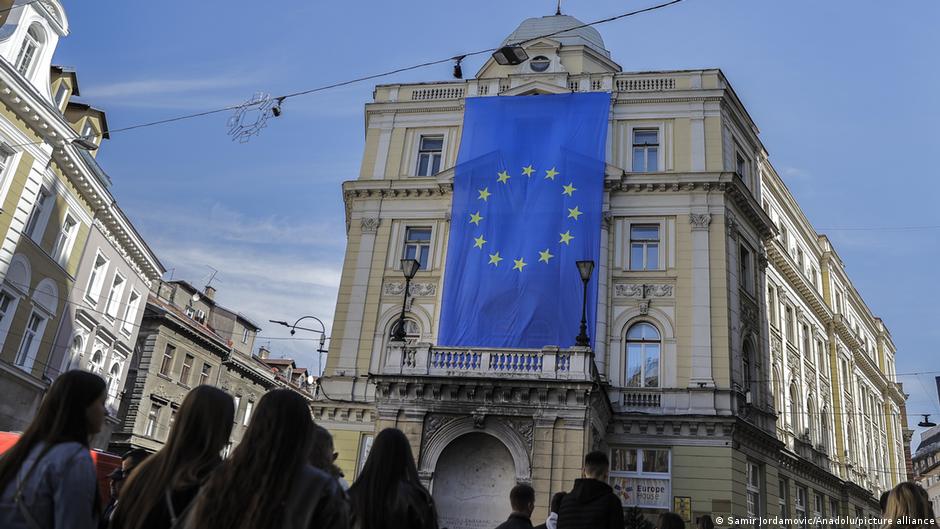
The Southern Interconnection Pipeline, designed to link Bosnia-Herzegovina to a liquefied natural gas terminal in neighboring Croatia, could thwart Bosnian aspirations to join the European Union.
The project is strategically important for the country, as it will reduce Bosnia’s dependence on Russian gas. Following Russia’s full-scale invasion of Ukraine, the EU has pressured both member states and candidate countries to cut ties with Russian energy.
For Bosnia, which imports almost all its gas from Russia, the pipeline could be an important step towards diversification and a link to the European gas market via Croatia.
Why is Brussels concerned about Bosnia’s pipeline plans?
In March, Bosnian lawmakers passed legislation that effectively named a specific company based in the United States, AAFS Infrastructure & Energy, as the project’s investor. The company was only founded in late 2025 and reportedly has no known experience in building pipelines.
This has raised alarm bells in Brussels. Before final approval of the deal, EU Ambassador to Bosnia-Herzegovina Luigi Soreca wrote to Bosnia’s leadership encouraging them to follow EU rules.
He stressed that authorities should “carefully consider obligations” under the Energy Community Treaty when drafting energy legislation. He said that to maintain progress towards EU membership, it is “vital” that laws are in line with the European Commission’s recommendations.
For the EU, the issue is not the pipeline itself, but how it is being delivered. Brussels supports reducing dependence on Russian energy but insists that such projects follow transparent processes and public procurement rules.
Questions raised on newly formed American company
The planned deal has also raised eyebrows in Bosnia. Ivana Korajlić of Transparency International in Bosnia-Herzegovina warned that “avoiding any kind of transparent processes, avoiding any kind of competition” would set a “very dangerous” precedent.
In his view, AAFS Infrastructure & Energy was chosen to serve someone’s financial interest. Such “tailor-made laws” serve private interests rather than the public good and are not in line with EU standards, Korajlic said.
Korajlik also raised questions about the US company, saying it was unclear where the alleged US$1.5 billion (€1.3 billion) investment would come from and whether the company could carry out a project of this scale.
He said the company has ties to individuals close to US President Donald Trump, along with alleged lobbying efforts, suggesting that political influence may have played a role in its selection. DW sought comment from the company but did not receive a response before publication.
Bosnia’s difficult path to joining the EU
The dispute highlights broader challenges in Bosnia’s EU accession process, which has long been marked by slow reforms and political divisions. The country officially applied to join the bloc in 2016 and was granted candidate status in 2022.
Berta López Domenech, an analyst at the Brussels-based think tank European Policy Center, told DW that Bosnia’s formal EU membership talks were set to begin in 2024. However, progress has repeatedly stalled due to governance issues and failures to align with EU standards.
Domenech says Bosnia’s inability to adopt necessary laws in recent years has caused the EU to step back from its requirements and lower its standards. For him, it is “good news” that the EU is now standing by its criticism and insisting that the energy security law comply with EU guidelines.
EU funding on the line
But the matter is not just political. If Bosnia and other Western Balkan countries fail to carry out agreed reforms, there is a risk of losing vital EU funding. If implementation is delayed Bosnia could miss out on approximately €374 million under the EU development plan for the region.
This could provide significant benefits to Brussels. Domenech told DW that the freeze on funds has proven effective in the past in pushing Bosnia toward needed reforms.
Both Domenech and Korajlić underlined that it is unclear whether EU intervention will be enough to change the course of the project. But they agreed that change would be in Bosnia-Herzegovina’s interests.
For Korajlic, the outcome will show whether the country’s priority is “to align with EU standards or to serve someone else’s interests.”
Edited by: Cai Nebe