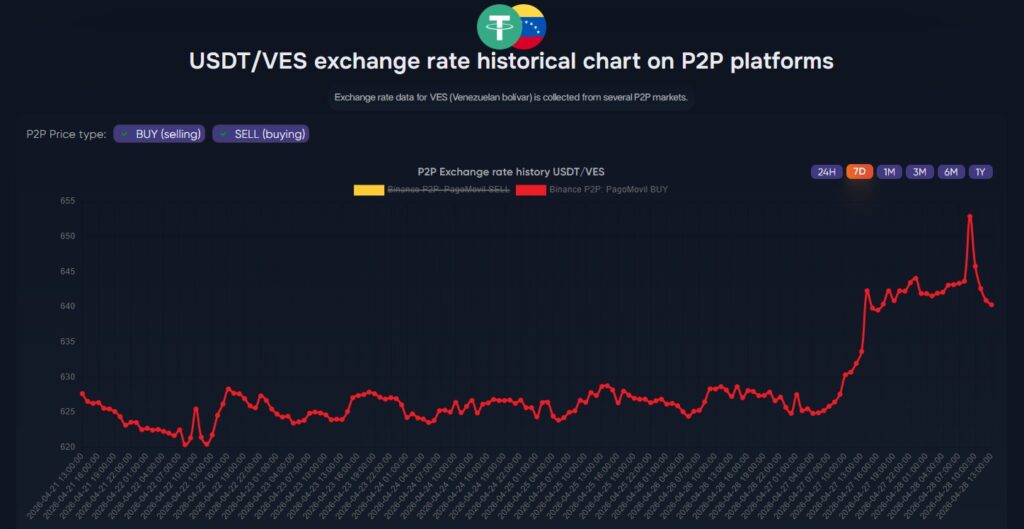
The Venezuelan economy faces a new variation in its exchange market. In the last seven days, the price of the USDT stablecoin in person-to-person (P2P) markets experienced an increase of 4%, surpassing the barrier of 640 bolivars.
This rebound not only shows an accelerated devaluation of the bolivar in the informal market, but also consolidates the digital asset as the main reference and thermometer of the unofficial dollar in the Caribbean country.
The main trigger for this escalation is the stoppage of foreign currency sales in the banking sector. The Bank of Venezuela (BDV), the financial institution with the highest volume of users in that country, accumulates at least three consecutive days without offering virtual dollars to its clients.
CriptoNoticias confirmed that, at the close of this report, It was impossible to acquire electronic currencies through the BDV.
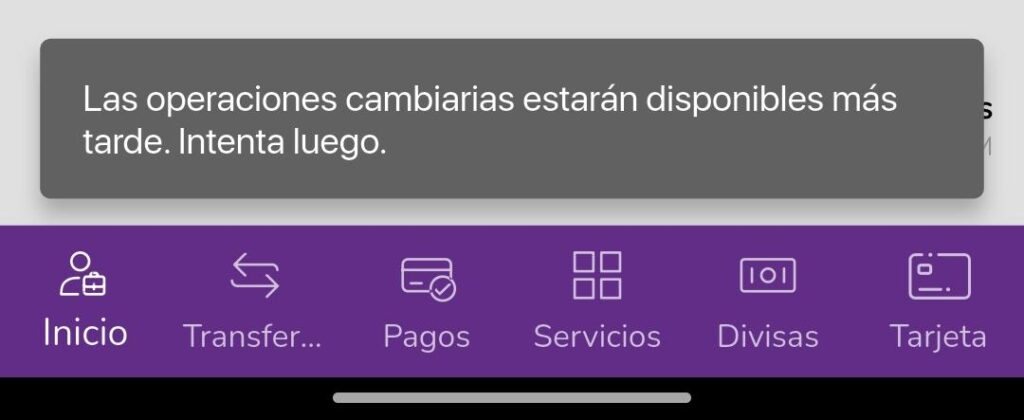
This absence of foreign currency in traditional banking has generated a supply strangulation effect which directly impacts the price of the crypto asset.
To measure the impact of this operational pause, it is necessary to observe the weight of the Bank of Venezuela in the exchange ecosystem. Some 524,320 clients have acquired foreign currency through their official channels until last March, a figure that represents double the registration obtained in February.
With more than 135.9 million dollars traded in this way and 1.5 million international cards issued – according to the bank’s own data – any interruption in the official supply of foreign currency by the financial institution leaves a liquidity gap that the P2P cryptocurrency market aggressively absorbs.
This situation means that, faced with the urgency of replenishing inventories or protecting capital against inflation, merchants and individuals turn to platforms such as Binance to acquire USDT, triggering demand for the asset and, consequently, its price.
And indeed that has been the case. According to the historical graph for the period from April 21 to 28 2026 below, the behavior of the USDT market shows a phase of initial stability between April 21 and 26, where the price oscillated close to 625 bolivars. However, as of April 27, coinciding with the lack of allocation in the BDV, a vertical upward trend is observed.
The price of the Tether Limited stablecoin, in Venezuelan currency, reached a maximum peak close to 653 bolivars before stabilizing slightly above 640 at the close of trading on April 28.
The use of USDT as a refuge of value and price reference in Venezuela has generated an exchange gap with respect to the official rate that already reaches 30%, as reported by CriptoNoticias.
This situation does not respond to a merely speculative spirit, but to a structural necessity. The lack of liquidity in foreign currency within the national banking system pushes citizens to take refuge in digital assets to overcome inflation—which reached 650% year-on-year—and the devaluation of the bolivar.
The consolidation of USDT above 640 bolivars reflects the fragility of the institutional supply of currencies. As long as the Bank of Venezuela and the rest of the entities keep the sale of dollars restricted, the cryptocurrency market will continue to dictate the pattern of the real value of the currency on the street, deepening the preference of Venezuelans for stablecoins to protect their assets.