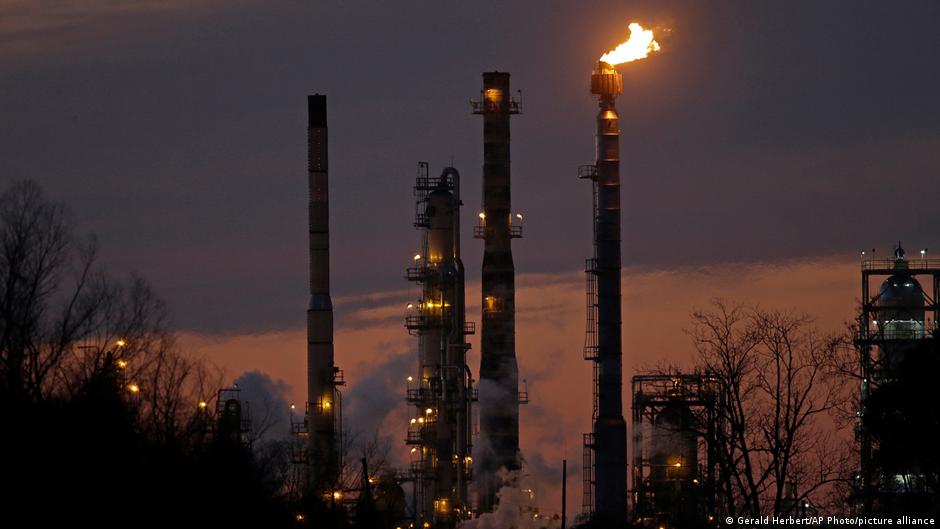
The dramatic rise in energy prices in the wake of the Iran war has led to calls for the EU to impose a so-called windfall tax on oil and gas companies, so that part of their profits could be used to help fund government relief plans.
Earlier this month, the finance and economy ministers of Austria, Germany, Italy, Portugal and Spain wrote a joint letter to EU Climate, Net Zero and Clean Growth Commissioner Wopke Hoekstra calling for such a levy.
He wrote that it would “send a clear message that those who benefit from the consequences of war must do their part to reduce the burden on the general public.”
Oil companies have made huge profits as a result of rising prices due to the war in Iran and the closure of the Strait of Hormuz.
An analysis by UK Guardian The newspaper, using data from Rystad Energy, found that major oil and gas companies would earn an additional $234 billion (€200 billion) by the end of the year if the oil price remains on average around $100.
It found that companies such as Saudi Aramco, Gazprom and ExxonMobil were among the biggest beneficiaries. financial Times French energy companies TotalEnergies reportedly made more than $1 billion after making a speculative purchase of about 70 cargoes of crude oil produced in the United Arab Emirates and Oman for loading in May.
This week, BP reported “exceptional” performance in the first three months of 2026, with profits more than doubling from the same period last year to $3.2 billion.
‘Delicate legal basis’
Governments calling for the tax said it would provide relief to consumers “without imposing additional burden on the public budget”.
Their letter highlighted 2022 as a precedent, when Brussels imposed a temporary “solidarity contribution” on energy companies, imposing a minimum 33% tax on all oil and gas company profits, up from the 20% average of the previous four years.
The EU announced a list of measures on 22 April This was intended to minimize the impact for consumers, but fell short of announcing a windfall tax.
However, critics say such a tax sits on fragile legal ground. In 2022, the EU used Article 122 of the EU Treaty – an emergency procedure that bypasses the European Parliament – to allow the European Commission to propose legislation and the European Council to adopt it by qualified majority rather than blind vote.
There’s another big problem, according to Christina Enache, an economist at the Tax Foundation Europe, a think tank that focuses on tax policy. He said the taxes could be retroactive if implemented at the national level.
Enache said that many of the 2022 taxes were retroactive, which in his view “conflicts with a core legal principle in most EU countries: non-retroactivity in taxation.”
They also highlighted the unequal treatment of similar companies, unclear tax base and lack of proportionality, which could lead to unexpected taxes being subject to legal challenges.
“In short, these taxes may be viable, but they are on the verge of constitutionality and legally controversial,” he told DW.
However, those in favor say the 2022 example clearly establishes a precedent and legal basis for the taxes. Antony Froggatt, senior director of Transport & Environment, an NGO advocating sustainable transport, said it is important that the EU takes leadership on this issue at central level, rather than leaving it to member states to target multinationals operating across borders.
“Instead of governments burdening taxpayers, it’s time the oil companies paid up,” he said. “It’s not unprecedented, there’s a mechanism and an experience for doing it,” Froggatt told DW. “Five member states have called for this, and I hope others will do the same.”
legal challenges
ExxonMobil sued the EU in 2022 in an attempt to block the windfall tax, while Jersey-based refining company Clash also took legal action against the levy.
Froggatt recognizes the challenges of getting the law right but says the 2022 tax was largely successful and it is important that the principle behind windfall taxes is widely accepted.
“Fossil fuel prices are rising and this is resulting in huge profits for companies,” he said. “Consumers are suffering because they can’t afford the same level of energy service they got in the past. It’s not the only mechanism, but it seems to be a good mechanism to get some of the extra profits back.”
Enache said the ongoing legal actions against windfall taxes reflect their complexity and fundamental unfeasibility. He argued, “There is no precise way to define ‘windfalls’ in a volatile industry without imposing higher taxes on ordinary profits.”
He also noted that tax rates based on a company’s past performance are “naturally harsh”, given how volatile the energy market can be. “Years of high profits often offset years of heavy losses.”
Does it work?
For businesses and ordinary consumers who are struggling with dramatic and sustained increases in their energy costs, there is no argument against a windfall tax on the companies that are booming on the back of price increases.
Yet there are doubts about the exact terms and effectiveness of the implementation of such a tax.
The EU’s 2022 windfall tax generated more than €26 billion in additional tax revenues. Enache stressed that this was a “relatively small contribution given the scale of the crisis” and said it was not worth the downside risks.
“They may generate some short-term revenues, but at the cost of higher uncertainty, weaker investment and higher prices,” he said.
Enache and Antony Froggatt both agree that the current crisis shows how the EU needs to develop stronger energy security, but they differ on how to do so.
“Instead of pursuing temporary policies, policymakers should implement long-term, pro-growth tax reforms that stimulate economic activity and production and energy diversification by supporting private investment,” Enache said.
Froggatt underlined that any windfall tax should be underpinned by a principle aimed at accelerating the transition away from fossil fuels towards more sustainable alternatives, even though the current crisis may force some governments to think they need to develop their own fossil fuel sources.
“This is the ‘messy middle’ of the energy transition,” he said. “Creating greater energy sustainability requires powering through this so-called dirty middle. And if we want greater sustainability we need to move much further, and faster, to reduce our reliance on fossil fuels.”
Edited by: Srinivas Majumdaru