When Viktor Orbán was first voted out of office by a narrow margin in 2002, he went through a deep personal crisis. “The Motherland cannot be in opposition!” He said at that time.
In other words, according to his self-image, only he and his Fidesz party could truly represent the interests of the Hungarian nation; He was their only legitimate representative. This statement left a deep impression on the Hungarian people.
It was the 2002 experience that prompted Orbán to use his two-thirds majority to establish the National Cooperation System (NER) from 2010, with the aim of preventing a repeat of his defeat. He not only tailored the electoral system to suit his party, but also created a vast clientelistic system, a sophisticated surveillance apparatus and a huge propaganda machine to secure his power. This system helped him remain in power for 16 years.
Perhaps that is why, until the election on April 12, a defeat for Orbán for his Fidesz party was unimaginable. When the results were announced in the evening, his defeat was so great that at first he seemed almost speechless.
He disappeared from public life for a few days. He then gave his only in-depth interview since election day to Patriota, a YouTube channel that has been loyal to his party. In it he talked about the “pain and emptiness” that he was filled with. Orbán also declared that he would “oppose the destruction of what we have built.”
Regarding mistakes made while he was in government, he admitted that he regretted that the expansion of the Pak nuclear power plant, done with Russian assistance, has not been completed. The journalist, a supporter, was clearly taken aback.
Much speculation in Hungarian society
What will happen now to Orban and the system he has built over the last 16 years? Does a dictator have a chance to remain in politics for a long time? Or is his career over? Will he leave the country, as rumors suggest? What will happen to his party, Fidesz, which was created entirely for him? What about the Orbán dynasty, which has amassed immense wealth, and the oligarchs and thousands of well-paid beneficiaries of the outgoing prime minister’s rule?
These are the questions Hungarian society is asking right now. In the search for answers, many media outlets are reporting on every single comment made by Orbán and his allies and every step taken by his oligarchs and cronies. It shows how many Hungarians felt as if they had been held hostage for years and how strong the desire for an accounting and systemic change is.
Rampant corruption and abuse of power
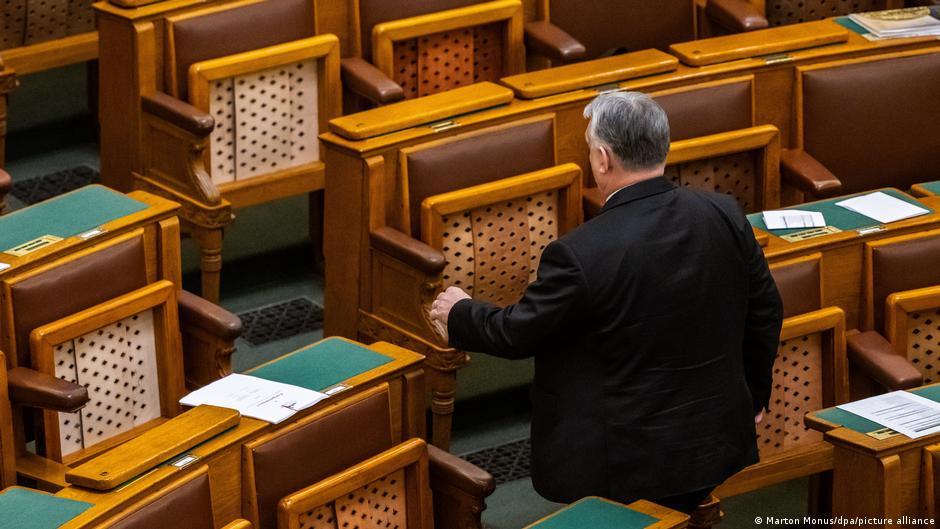
So far, Orbán has refused to take any responsibility for alleged abuses of power under his rule and has shown no public remorse. During the campaign, he announced that he would remain an MP, but would step down as head of Fidesz in the event of an election defeat, simultaneously ignoring the situation.
Instead, Orbán has actually resigned his parliamentary seat, but has not yet announced his resignation as party leader. He has offered to step down but has underlined that he is ready “to give back to the community”.
The party has said that it will organize a new leadership conference in June. The dilemma facing Fidesz is that it will disintegrate without Orbán, as the party is completely focused on him. And yet with them it will retain the reputation of being a corrupt and autocratic party among all except its small core voter base.
In a video posted on Facebook, Orban himself announced his future plans in a way that was quite remarkable in semantics: “What I need right now is not in parliament, but in the restructuring of the national party.”
For many Hungarians, this is a continuation of Orbán’s long-standing narrative: that the part of the Hungarian population that supports him is the true Hungarian, but no one else is.
Many see his move to give up his parliamentary seat as an attempt to shirk responsibility and assert dominance. Many believe that Orban may not want to humiliate himself by hearing criticism of himself and his system in parliament. At the same time, he apparently considers it beneath his dignity to simply remain an MLA.
Are oligarchs transferring wealth?
Political scientist Daniel Rona recently predicted on Hungarian news portal Telex that Orbán would wait to see how things develop in the coming months before making concrete decisions on how to shape his political and personal future.
Investigative journalist Szabolcs Pany wrote that Orbán was considering going to the United States and applying for asylum there, but that this is unlikely. This would destroy his work in Hungary, deal a fatal blow to his party and political community, and seriously damage his family lineage.
Orban’s father and younger brother are two of Hungary’s wealthiest businessmen, primarily involved in the mining and construction sectors. His eldest daughter Rachel and her husband Istvan Tiborz, one of Hungary’s richest men, moved to the United States last year. The European Anti-Fraud Office (OLAF) investigated Tiborz on several occasions based on alleged irregularities and conflicts of interest in relation to state tenders. It sent recommendations to Hungarian authorities and called for returning EU funds. In Hungary, the proceedings were postponed.
There are signs of movement among Orban’s allies too. A few days earlier, Hungary’s incoming Prime Minister Peter Magyar had accused those involved of transferring billions to foreign accounts to avoid anti-corruption investigations and planned asset recovery efforts. Although there is no concrete evidence, Hungarian media outlets have reported several financial transactions on behalf of oligarchs, such as Orbán’s childhood friend Lórinz Mészáros, a businessman and former politician.
Many in Orbán’s party are still in a state of disbelief over his election defeat, and have turned to religion in an attempt to explain it. Outgoing President of the National Assembly Laszlo Kovar described it as a “temporary victory for satanic forces”, but added that “in the end, the victory belongs to Jesus Christ.”
Zsolt Jeszczynski, a well-known influential figure in the Orbán camp, said he felt the outgoing prime minister had “inadvertently committed idolatry” during a visit to India in early 2025, thereby “opening the door to evil spirits in his life.”
Others have said that the defeat was caused by opportunistic profiteers in the Orbán system. But some Fidesz loyalists have blamed corruption and abuse of power for the party’s defeat.
This article was translated from German.