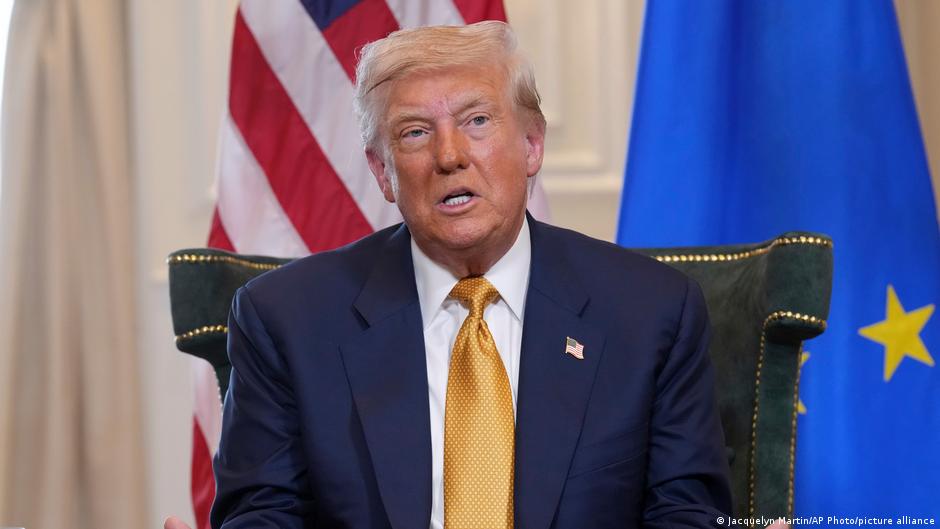
US President Donald Trump announced on Friday that he is raising US tariffs on cars and trucks from the European Union to 25% next week.
He accused the bloc of not following the terms of its trade deal with the US, without citing specifics.
Last year the EU agreed to remove any tariffs on US imports in exchange for a 15% tariff on most EU products when it struck a trade deal with the US, averting a major trade war.
EU lawmakers put forward legislation this March to implement the tariff cuts, but the process is not expected to be completed before June as EU governments and the European Parliament negotiate the final text.
What did Trump say?
“Based on the fact that the European Union is not in full compliance with our agreed-upon trade agreement, next week I will raise tariffs from the European Union on cars and trucks coming into the United States,” Trump wrote on Truth Social.
“Tariffs will be increased to 25%.”
Trump said no tariffs would be imposed on cars and trucks manufactured in American plants.
Could Trump increase the levy?
It is unclear what authority Trump could use to raise taxes on the EU.
The U.S. Supreme Court said earlier this year that Trump had exceeded his authority by using a federal emergency-powers law to impose unilateral “reciprocating” tariffs on countries around the world.
‘This is no way to treat partners,’ says EU MP.
Bernd Lang, chairman of the EU Parliament’s trade committee, said the latest tariff move “shows how untrustworthy the US side is.”
“This is no way to behave with close partners. We can now respond only with utmost clarity and firmness based on the strength of our position.”
Lange said Trump’s behavior is “unacceptable” and said the EU is honoring trade agreements with the US.
The German auto industry association has called for de-escalation
Hildegard Müller, president of the German Association of the Automotive Industry (VDA), told DW that the latest tariff push “represents a new and serious strain on transatlantic relations.”
“The costs resulting from these additional tariffs will be enormous for the German and European automotive industry at a time that is already extremely challenging, and will likely also have an impact on consumers in the United States.”
“The trade agreement reached between the EU and the US should be respected by both sides,” he said. “The automotive industry urgently calls on both sides to de-escalate tensions and rapidly negotiate.”
Edited by: Dmytro Lyubenko