Ethereum accounts for more than 50% of the total value of RWA, but its share has decreased slightly.
Solana has increased its activity in tokenized assets thanks to its low cost per transaction.
Grayscale Research, the analysis division of the asset management and investment fund company, projected in its research work that the tokenization of assets could become one of the most relevant structural changes for global capital markets. This will occur by gradually moving traditional instruments into cryptocurrency networks, which could encompass a universe of assets in excess of $300 trillion.
From a networking perspective, the report identifies two great competitive approaches within this new ecosystem. On the one hand, public networks such as Ethereum, Solana and BNB Chain, which are characterized by their high level of liquidity, permissionless access and a broad ecosystem of applications. On the other hand, emerge institutional networks like Cantondesigned to integrate privacy and regulatory compliance as core elements, facilitating their adoption into traditional financial structures. In this context, Avalanche appears as a hybrid model that combines elements of both worlds. And finally, it adds Chainlink, which does not compete as a broadcast network, but as a transversal infrastructure.
The report also highlights the role of institutional networks such as Canton. According to data from RWA.xyz, This network controls 93.8% of the total value of tokenized assets on-chain. It also houses more than $390 billion in tokenized assets. For Grayscale, in the short term Canton could concentrate an important portion of the market due to its alignment with traditional financial structures and its focus on privacy by design.
Then it is found Ethereumrepresenting over 54% of RWA’s distributed market share and hosting approximately $16 billion in tokenized assets and nearly $50 billion in total value locked in decentralized finance (DeFi). However, its leadership is not exclusive, since the growth of other networks introduces more diversified competitive dynamics, but all with a long-term projection.
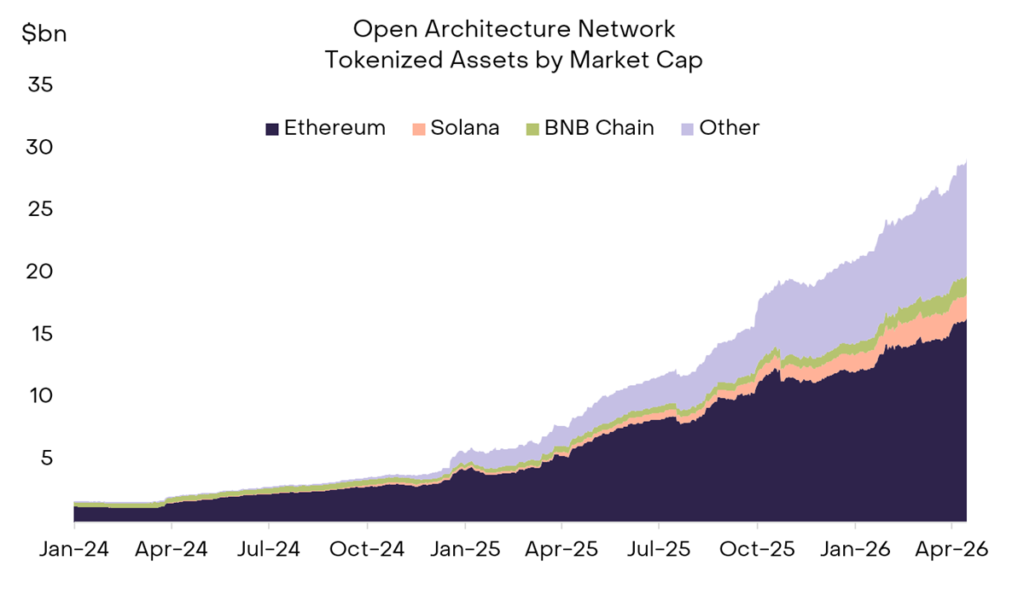
Solana, for its part, competes based on operational efficiency. Its high processing capacity with more than 1,000 transactions per second and low costs make it an especially attractive alternative for high-frequency use cases, such as retail trading of tokenized assets. The network has more than $2 billion in asset valuesas CriptoNoticias explained. And finally, name BNB Chainwhich enjoys a unique advantage in distribution through Binance and Avalanche, combining permissions with connectivity to underlying open networks.
For Grayscale, Chainlink occupies a different but strategic role. Rather than competing as an issuance network, it functions as a critical connectivity infrastructure, acting as an oracle layer that allows integrating external data, automating processes and connecting different networks throughout the life cycle of a tokenized asset.
For Grayscale, the market for tokenized assets remains relatively small, with a value close to $30 billion, which represents only a tiny fraction of the global financial system. Even so, The sector has shown accelerated expansion, with year-on-year growth of more than 200%driven mainly by the tokenization of US Treasury bonds, which account for nearly half of the market, followed by raw materials, private credit, funds and other financial instruments.
Beyond the current size, Grayscale emphasizes that the real impact of tokenization is in the transformation of financial infrastructure. Among the main changes are the almost immediate settlement of operations, the availability of markets 24/7, the reduction of the role of intermediaries, and the incorporation of greater programmability through smart contracts.