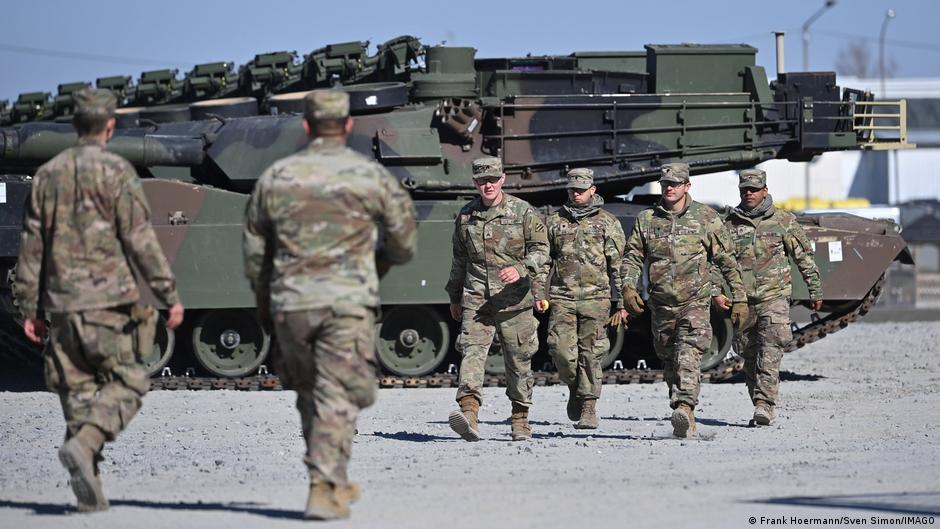
US President Donald Trump says he plans to “drastically” cut the number of US troops stationed in Germany, a day after the Defense Department ordered the recall of nearly 5,000 US service members.
“We’re going to cut, and we’re going to cut by more than 5,000,” Trump told reporters in Florida.
A Defense Department spokesman said the withdrawal would be completed over the next six to 12 months.
As part of the decision, a Biden-era plan to deploy a US battalion with long-range Tomahawk missiles to Germany has also been scrapped.
The announcement came after a public spat between German Chancellor Friedrich Merz and Trump earlier in the week. Meraz questioned Washington’s exit strategy in the Middle East and said Iran was “humiliating” the US at the negotiating table, to which Trump reacted angrily.
More than 50,000 American service members are currently deployed in Germany.
Top Republican says it sends ‘wrong signal’
Democrats in the US immediately criticized the planned withdrawal.
Republican lawmakers Senator Roger Wicker and Representative Mike Rogers, chairman of the Senate and House Armed Services committees, said they were also “very concerned.”
In a joint statement, they said the decision “risks weakening the resistance and sending the wrong signal to (Russian President) Vladimir Putin.”
He said any major changes to the status of US forces in Europe should be reviewed and coordinated with Congress.
“We expect the Department to engage with its oversight committees in the coming days and weeks on this decision and its impact on U.S. deterrence and trans-Atlantic security,” the statement said.
The two lawmakers also said Germany had heeded Trump’s calls to increase defense spending and had given U.S. forces access to its bases and airspace in its ongoing war with Iran.
How did Germany react?
German Defense Minister Boris Pistorius said on Saturday that a partial decline was expected and that Europe needed to take more responsibility for its own security.
He also said that “Germany is on the right track” by seeking to expand its armed forces, accelerate military procurement and build more infrastructure.
The US military presence in Germany, which began as an occupation force after World War II, peaked in the 1960s when thousands of US troops were stationed there during the Cold War.
The latest US data shows there are currently about 86,000 US troops in Europe, according to the US Defense Manpower Data Center and more than 11,000 National Guard and Reserve troops and civilian personnel, with Germany hosting more than 36,000 active-duty personnel.
A US defense official told The Associated Press that withdrawing 5,000 troops is unlikely to impact combat power, but “in terms of the message of American commitment, it is very different.”
Trump had long threatened to reduce the number of troops in Germany. It was not immediately clear which bases or operations would be affected by the decision.
For decades, dozens of major US military bases in Europe have played a vital role in US operations globally. Germany hosts several US facilities, including the US European Command in Stuttgart, a medical center in Landstuhl, and Ramstein Air Base. American nuclear missiles are also deployed in the country.
Earlier in the week, German Foreign Minister Johann Waddefull said Berlin was “ready” to cut US troops.
He stressed that large American bases in Germany “are not at all suitable for discussion” and cited the example of Ramstein, whom he said was “an irreparable act for the United States and us alike.”