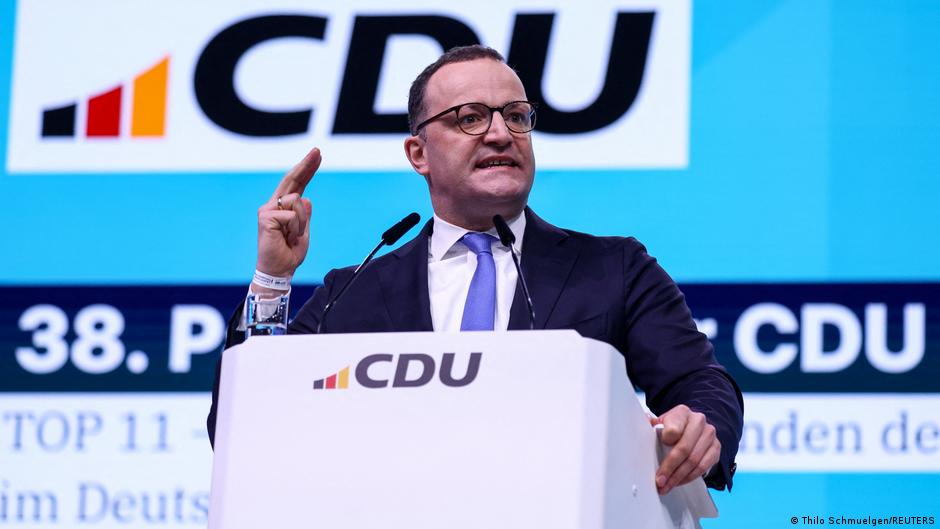
Despite still being only 45 years old, Jens Spann has a tumultuous career behind him. Germany’s COVID-era health minister – a job that left him facing investigations into the misuse of public funds – was re-elected leader of the parliamentary group of the conservative Christian Democratic Union (CDU) and its Bavarian ally, the Christian Social Union (CSU) on Tuesday with 85% of the vote.
The job was previously held by his CDU colleagues Helmut Kohl, Angela Merkel and Friedrich Merz, and it seems reasonable to assume that Spahn has ambitions to one day follow those figures into the Chancellery. Indeed, Spahn was once Merz’s rival in the battle to succeed Merkel as CDU leader – although they both lost to their preferred candidate, Annegret Kramp-Karrenbauer.
But to become chancellor, Spahn will have to win the election, and that could be difficult, as a recent poll found he is Germany’s least popular politician – behind even his boss Merz, whose approval ratings have fallen to unprecedented lows.
a flexible conservative
Nevertheless, Spann’s career has shown resilience. State prosecutors closed the investigation into his COVID-era dealings in March, and Tuesday’s vote shows he still enjoys the confidence of his parliamentary colleagues.
This is despite some differences in the ranks. Spahn’s main job is to ensure that the CDU/CSU’s 208 Bundestag members vote with the government, a task that has sometimes proven surprisingly difficult: as early as December 2025, he had to motivate several young CDU MPs to vote in favor of the coalition government’s new pension plan.
“There has been a lot of criticism from the outside,” Ursula Munch, director of the Tutzing Academy for Political Education, told DW at the time. “The results of his efforts to maintain the unity of the parliamentary group are certainly not entirely reassuring. But the challenges are certainly huge – there are huge issues to deal with and only a very narrow majority.”
Spahn may face a similar battle this year, when the Bundestag debates the government’s planned health care reforms.
dutch border boy
Spahn was born in 1980 in the small village of Ottenstein in north-western Germany, just a few miles from the Dutch border. This, he has often said, became important to his life, as his childhood experiences of cross-border shopping taught him to value the freedom of movement provided by the European Union. He now heads the German-Dutch parliamentary group.
He is both Catholic and openly gay, although his religion plays a larger role in the biography on his website, where he says his faith gives him “strength, peace and confidence” every day. On the contrary, he has largely kept his sexuality out of his politics. He told the German, “Being gay is not a political achievement in itself. As a program, it is not enough.” mirror Weekly magazine in 2012. “I don’t play politics with gay customers.” In 2017, she married her partner Daniel Funke, who works for the German media company Burda.
Spahn spent part of his adolescence and early twenties gaining banking qualifications at the WestLB bank in Münster, although he has been politically active since his youth: he joined the Junge Union, the youth organization of the Christian Democrats, at the age of 15, became head of the local CDU branch at 19, and was elected to the Bundestag just three years later in 2002. His formal education, meanwhile, barely had time to keep up with his growing political career: he earned a master’s degree in political science while he was still in Parliament.
He has since been a member of the Bundestag, taking on more significant roles: he became the party’s health policy spokesperson, spent three years as parliamentary state secretary in the Finance Ministry under veteran CDU politician Wolfgang Schäuble, before joining the cabinet as health minister in Angela Merkel’s fourth and final government in 2018.
The infamous ‘mask affair’
It was this job that proved fatal for the aspiring politician, because, when COVID-19 arrived in the spring of 2020, his job suddenly made him one of the most prominent political figures in Germany. Under his watch, the Health Ministry ordered huge quantities of protective equipment using the so-called “open-house” process – which is considered outside EU rules for government acquisitions.
Millions of face masks were later found to be defective, which meant the ministry refused to pay for them and resulted in a lawsuit, which could cost the state up to €3.5 billion. What’s more, at one point, Spahn’s ministry purchased 570,000 FFP-2 masks from her husband’s employer, Burda.
German Federal Court of Audit, federal audit officeWhat became known as the “mask affair” was sharply criticized. Spahn’s successor at the Health Ministry, Carl Lauterbach, ordered a special investigation into the scandal, and his report, leaked to the media last June, concluded that the affair had cost the state billions of taxpayers’ money. Nevertheless, the prosecutor’s decision to close his investigation suggests that Spahn has been cleared of personal wrongdoing.
This was not the only time Spahn’s financial management skills were scrutinized. At about the same time, the minister was being criticized for taking a loan of €4.1 million from a bank to buy a villa in Berlin, where he had previously been on the administrative board – the press at the time suggested that he had received favorable terms.
Populist flirting – but not with the AfD
Politically, Spahn has been moving steadily to the right of the CDU. He vocally criticized Merkel’s handling of the refugee crisis in 2015, and in 2024 – despite his love of open borders in his youth – he suggested that EU legislation to deal with illegal immigration needed to be suspended. As Health Minister, he also advocated using ultrasound to check the age of illegal immigrants.
Spahn is also known for engaging in populist rhetoric. When he took up his role as parliamentary leader last year, he caused a major backlash by suggesting that the government should treat Alternative for Germany (AfD) like any other opposition party – despite the fact that sections of the far-right party have been officially declared anti-constitutional. He later backtracked by saying that he had never intended to “normalize” the party.
How well he comes to grips with his Bundestag office during Merz’s tenure could decide Spahn’s future. When he was offered the position, many wondered whether it was wise for Merz to appoint an early rival to such an important role – but Spahn has shown loyalty to his boss and the Chancellor values his influence and management skills in the party. Whether he will ever become chancellor candidate for the CDU is an open question – there are several other politicians in the running. But at this age, he knows he can bide his time.
Edited by: Reena Goldenberg