
Chainlink (LINK) would be in a favorable position within the digital asset market, driven by the growth of tokenization and its role as key infrastructure.
This is highlighted by Ted Stamas, financial market analyst, in a report published this May 4, 2026. The author presents an investment thesis based on the long term and accumulation when he states that “chainlink will surpass [en rendimiento] to the S&P 500 over a four-year horizon.”
The S&P500 is known for having an annual return close to 10%, which would be 46% over 4 years, taking into account compound interest. According to Stamas’ thesis, the LINK cryptocurrency would surpass it in that period.
For him, the asset can surpass the main US stock index for the growth of the real-world asset tokenization industry (RWA, for its acronym in English), whose capitalization already exceeds $30.8 billion.
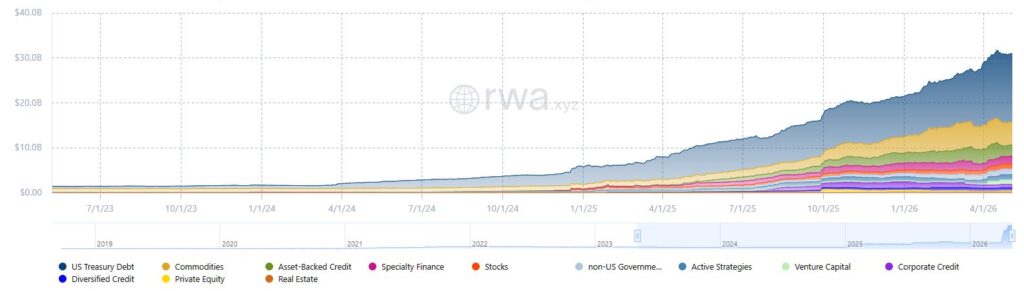
For Stamas, Chainlink occupies a central place in that trend. “Chainlink is the bridge that turns off-chain assets into digital assets,” he explains, referring to its role as a data provider for financial applications.
The analyst highlights that many of the most relevant use cases depend on this type of infrastructure. For example, decentralized finance (DeFi) applications require real-time prices, stablecoins need to verify reserves outside the network and RWAs demand reliable data to operate.
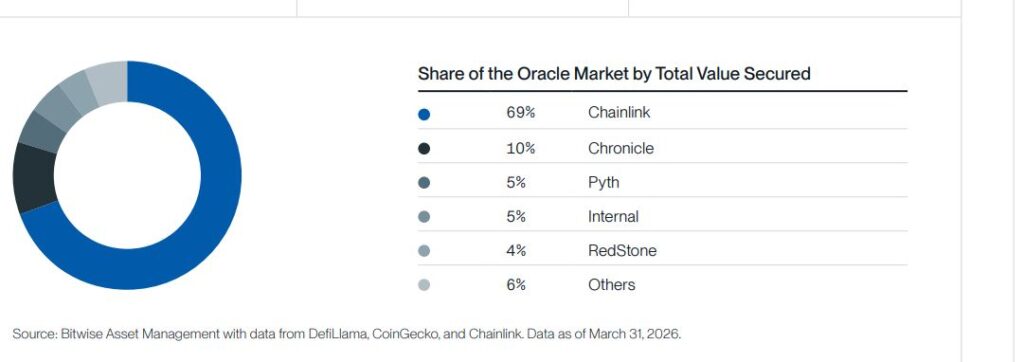
This position is reflected in his dominance within the oracle segment. According to a report from Bitwise, Chainlink concentrates close to 69% of the total insured value (TVS) in this type of infrastructure, far above other competitors. This reinforces its role as a key service provider within the ecosystem.
Another central point of the report is the integration with Amazon Web Services (AWS). Stamas highlights that this incorporation allows you to deploy Chainlink nodes and services in a simplified wayreducing implementation times from weeks to minutes. “What this alliance offers is simplified enterprise adoption,” the report notes.
This integration allows services like feeds Data collection, reservation testing, and execution environments are available within the AWS infrastructure, making it easier to adopt by large enterprises. Chainlink already worked with providers such as Google Cloud and Microsoft Azure, but the incorporation of AWS expands its reach within the corporate market.
The report also mentions the existence of financial products linked to the asset. These include the Grayscale Chainlink Trust (GLNK) and Bitwise Chainlink ETF (CLNK) exchange-traded funds (ETFs), which allow investors to gain exposure to the price of LINK without needing to directly purchase the token.
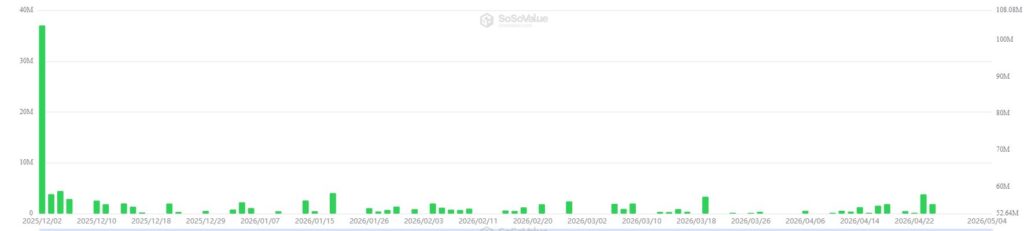
As CriptoNoticias has reported, these financial products debuted in December 2025, but, until now, they have not had an outstanding performance: they only raised about 107 million dollars, a limited figure compared to the size of the digital asset ETF market.
Regarding its economic model, Stamas points out that “LINK is used to pay for all Chainlink services,” which implies that an increase in the use of the protocol can translate into greater demand for the asset.
Furthermore, part of these commissions accumulates in protocol reserves, functioning as a purchasing pressure mechanism, while another part is distributed among node operators, who must deposit LINK in staking as a guarantee of good behavior.
The document also highlights that LINK’s supply is limited to around 1 billion tokens, with more than 70% already in circulation, which could amplify the impact of higher demand on price.
In this context, Stamas suggests that Chainlink’s future performance will depend on the expansion of Web 3.0 and the speed at which tokenization advances. “It’s not a question of if, but when,” he says.
The report concludes that, if these trends consolidate, Chainlink could position itself as one of the key infrastructures of the digital financial ecosystem in the coming years.