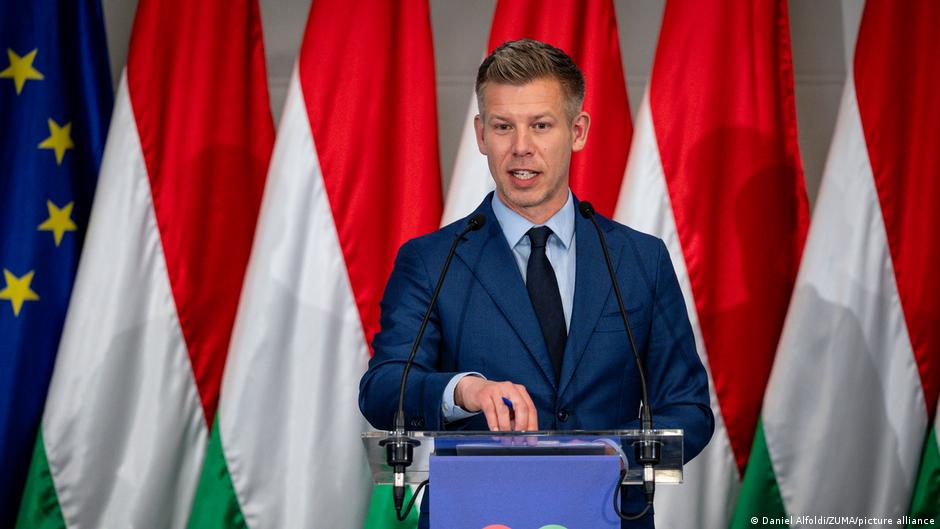
Hungary’s prime minister, Peter Magyar, is eager for a return to the EU mainstream and is moving quickly to mend fences.
Part of that mission is a plan to prepare the country to join the euro by the end of the decade.
Some, including the central bank governor, suggest the timeframe may be overly ambitious, given that outgoing Prime Minister Viktor Orban will hand over a sluggish economy and a fiscal mess.
But if euro accession is properly considered, Hungary could reap significant benefits.
Back into EU mainstream
Meeting the requirements of euro adoption will be a difficult task for the incoming government.
Cili Tan of the Economist Intelligence Unit says Magyar’s Tisza party has little room for change in its spending and reform plans, especially amid the ongoing crisis in the Middle East.
“We do not expect euro adoption within the next decade,” Tan told DW.
However, Tisza is highly motivated. Bringing Hungary back into the EU mainstream from the “illiberal” periphery, which Orbán had banned, was a key issue in the party’s election campaign. Joining the eurozone would drive that new message home.
But speed is paramount and Magyar is urging Brussels to free up €17 billion ($19.8 billion) of funding that was blocked due to Orbán’s democratic backlash and rule-of-law issues; The €10 billion amount must be used before it expires in August
Belt tightening across Hungary
According to a 2025 survey, about 75% of Hungarians are in favor of adopting the single European currency. However, almost as many said they understand the country is not ready to make the leap.
“The 2030 entry date may seem ambitious, but it is not impossible,” Julia Király, a former deputy governor of the central bank and a professor at the Hungarian Academy of Sciences, told DW.
“The main challenge is to meet the Maastricht criteria,” Kiraly said.
These criteria mark the required levels of EU inflation, debt, budget deficit, interest rates and currency stability that a country must meet before adopting the euro. Hungary currently fails miserably on those financial demands.
The biggest test will be the deep cuts in government spending needed to reduce the deficit. Tan suggests this would be “impossible” to achieve by 2030.
“Mr. Magyar is already committed to continuing many of Mr. Orbán’s fiscal wasteful policies while accelerating defense spending to meet NATO goals,” he said.
Pros and Cons of Joining the Eurozone
Nevertheless, attempting to join the Eurozone should also bring several potential benefits to Hungary.
Once the government announces its official bid to join, it should increase stability for its currency, the forint, and low inflation and interest rates.
Borrowing costs should also decline for both the government and the economy as a whole, as European Central Bank supervision helps to stabilize the financial sector.
Looking ahead, eurozone membership would remove exchange rate risks and transaction costs – something that is important for Hungary’s export-heavy economy.
The biggest compromise would be Hungary’s loss of autonomy over monetary policy and its ability to absorb shocks. But then the country would have access to eurozone liquidity and bailout facilities in trouble.
Eurozone partners likely to remain cautious
Hungary’s weak economy and fiscal position, not to mention 16 years of institutional decline, would likely make Eurozone members wary of Hungary joining the group.
They have not forgotten the Greek debt crisis, which proved highly contagious and costly, and which could complicate Hungary’s progress when it seeks the necessary consent from the remaining members.
They are also likely to see the risk that Hungary could change course and withdraw from the euro bid after the next elections in 2030, or return to a liberal path and become disruptive while remaining inside the single-currency zone.
“Hungary is likely to be viewed with suspicion,” analysts at London-based Capital Economics suggested in a recent analysis note. The country will need to “convince eurozone partners that entry into the euro is a shared goal across the political spectrum.”
A natural path to Hungary?
However, EU officials consider the move positive for the bloc.
European Commission President Ursula von der Leyen praised Hungary for “a return to the European path” – a path that European Central Bank President Christine Lagarde declared naturally leads to the euro.
“Within Central and Eastern Europe, Hungary’s adoption of the euro would signal renewed convergence and stronger political solidarity,” Tan said.
When Hungary joined the European Union in May 2004 with nine other countries, it committed to adopting the single currency. But it is one of three players in that group, along with Czechia and Poland, that have not yet taken the step.
Given that all the Visegrad Group economies are heavily dependent on exports to the eurozone, it is surprising that only Slovakia has joined so far. Now Hungary hopes to reap the kind of benefits that turned its northern neighbor into the “Tatra Tiger.”
“For key trading partners such as Germany, eliminating exchange rate risk and reducing transaction costs will support trade and investment flows, especially in the key automotive and electronics sectors,” Tan pointed out.
However, Hungary’s decision to target the euro is unlikely to have any impact on Czechia or Poland.
Popular opposition to the single currency, driven by fears of inflation and loss of autonomy, prompted serious negotiations on the topic in Prague and Warsaw. That said, by mid-April, even the euro was off the menu in Budapest.
Kiraly said, “It cannot be ruled out that, sooner or later, all EU member states may join the eurozone in order to achieve greater competitiveness compared to the United States.”
Edited by: Tim Rooks