Poland leads a movement that seeks to shield economies from geopolitical risks.
Official gold reaches its highest weight against US bonds in the last three decades.
Central bank vaults are receiving a steady flow of bullion not seen in decades. It happens that at the same time that the common citizen cautiously observes the price of gold in the showcases, monetary institutions acquired 244 tons of the precious metal during the first three months of 2026.
The movement is confirmation that the global financial map is changing its skin.
The figure, reported by the World Gold Council, comfortably exceeds the average of the last five yearsplaced total official reserves at a historical maximum of 38,666 tons for April 2026, as reported by CriptoNoticias.
To understand the magnitude, let’s imagine that almost One fifth of all the gold that has been mined in human history is now secure. locked away by governments.
Although jewelry and private investments remain the largest part of the pie, state appetite has grown so much that, late last year, the value of gold in the hands of central banks exceeded that of US Treasuries for the first time since 1996.
But why this sudden interest in an asset that does not generate interest and is also expensive to store? The answer is security. Because in a world where the dollar is being used as a tool of international sanctions, Many countries now view gold as the ultimate “life insurance.”
Unlike a national currency, the gold metal is not dependent on the economic health or political will of a single government.
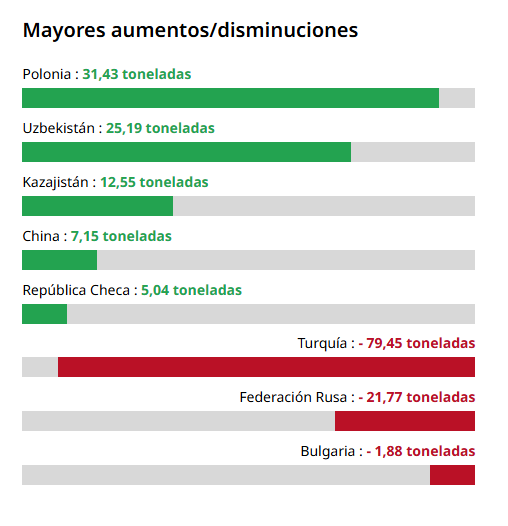
Poland, for example, led purchases this quarter with 31 tons, moving towards its ambitious goal of owning 700 tons. China, for its part, has now expanded its reserves for 17 consecutive months. For these countries, gold is the anchor that helps stabilize the ship when the waters of geopolitics become turbulent.
Gold as life insurance for nations
The above means that when there is a crisis and national currencies lose value or digital assets fail, gold maintains its historical value. Therefore, by purchasing tons of gold, these countries are “dropping the anchor.” They do this to ensure that if a financial or political storm breaks, its economy does not sink or be dragged down by global uncertainty.
Even so, this structural change is at the center of the debate. Some analysts observe that in this movement, banks achieve a logical protection against persistent inflation. However, other observers warn about the opportunity cost, such as the lack of immediate return.
Unlike sovereign bonds, which pay a periodic income to those who own them, gold is a “dumb asset” that only generates profits if its price rises. In periods of stability, having too much wealth accumulated in metal can mean giving up million-dollar profits that other financial instruments do offer.
In times of stability, a portfolio diversified in bonds and stocks is usually more efficient than a mountain of inert metal. Even in the digital world, cryptocurrency enthusiasts see this trend as validation of the search for havens of value, even as the gold market continues to operate in a very different league of maturity and volume.
However, the tangibility of gold is a double-edged sword. Unlike the decentralized nature of bitcoin, gold is physically confiscable.
For an ingot to serve as a shelter, it must be under direct control; Otherwise, the risk of a foreign power freezing reserves held in its own vaults is a real possibility. It is a sovereignty dilemma where central banks seek independence from the financial system in gold, but are tied to the physical security and geography of their vaults.
What is clear after this beginning of 2026 is that confidence in the traditional pillars of the international reserve is being reconfigured. In a multipolar financial environment, the shine of gold seems to be, for many central bank governors, the only light that does not flicker in the face of uncertainty.
However, this massive return to the tangible leaves in the air a question that already runs through the financial corridors: whether in a future of absolute digitalization, institutions will continue to trust in the physical weight of the metal or if the day will come when the currency created by Satoshi Nakamoto occupies that place in the state vaults. For now, the world go back to what you can touch.