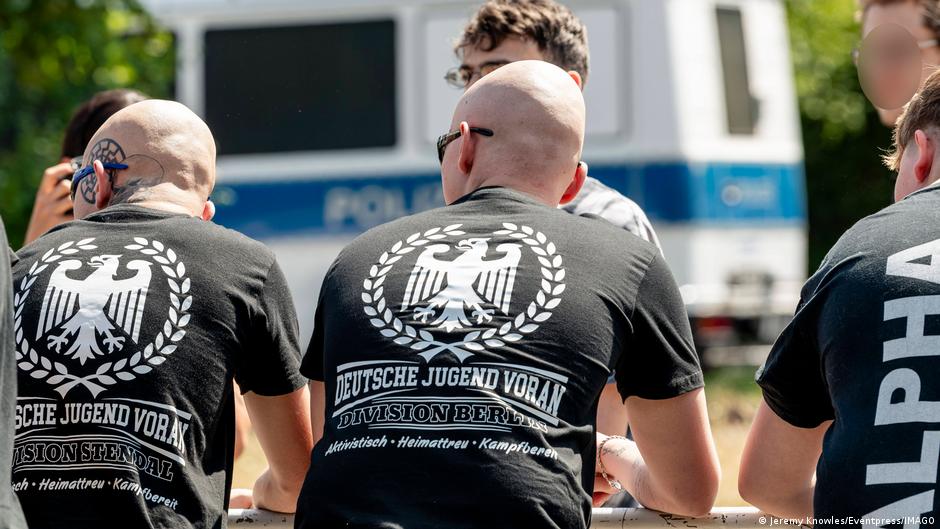
With names like “Deutsche Jugend Voren” (German Youth Lead the Way) or “Jung und Stark” (Young and Strong): Far-right extremists are coming together across Germany to spread hatred and violence. Over the past two years, security agencies and experts have been tracking increasing activities of violence and far-right propaganda within these circles.
Youth criminals primarily target the LGBTQ+ community, individuals they perceive to be immigrants, or young people they suspect to be left-wing. There have been repeated attacks in Berlin and other cities – particularly during Christopher Street Day and Pride parades.
With nationwide raids on the morning of 6 May, Germany’s top prosecutors cracked down on organized far-right networks: 600 police officers searched multiple apartments in twelve German states, targeting 36 suspects. No arrests have been made.
Youth, men and victims of violence
According to the Federal Prosecutor’s Office, because groups such as “Deutsche Jugend Voron” and “Jung und Stark” advocate violence against political opponents and as a result, it is investigating them as suspected criminal organizations.
In the wake of the raid, the federal prosecutor general said that members of the groups networked through social media and held regular meetings. According to a press release, they did not stop at calls for violence: “Some of the accused are accused of attacking members of left-wing ideology,” the federal prosecutor’s office said. “The victims were beaten by multiple attackers and suffered serious injuries.”
German Justice Minister Stefanie Hubig welcomed the measures: “Once again, it is clear: we are talking about the nationwide threat posed by violent right-wing extremism.”
The centre-left Social Democratic Party (SPD) issued a statement reiterating that right-wing extremism is the biggest threat Germany poses from within: “Terrorist right-wing extremist groups are gaining support – surprisingly, especially among young people,” the statement said.
Days before the raid, DW spoke to law enforcement officials in the German capital Berlin about young far-right extremists and their networks. The city has seen repeated marches by right-wing extremist groups – including alleged members of “Deutsche Jugend Voron” or “Jung und Stark”.
Wolfram Pemp is head of the right-wing extremism division at the Berlin State Criminal Police Office. He believes that today’s far-right scene is less structured than in the past. Far-right youth groups in particular pose a challenge for the police: “Youth groups are founded, renamed, re-founded and then quickly disappear into obscurity,” Pemp says in an interview with DW.
Germany has stepped up its fight against right-wing extremism by setting up special units, allowing authorities to take immediate action in cases of politically motivated crime – especially when it comes to teenagers. Quick indictments or summary judgments are handed down after searches or arrests: “Our goal is always to prevent careers in extremism,” says Wolfram Pemp.
For about two years now, the groups “Deutsche Jugend Voren” and “Jung und Stark” have been attempting to recruit young people. Their ideology is characterized by hatred and misanthropy: it is based on National Socialism under Adolf Hitler. From 1933 to 1945, the German Nazis murdered millions of Jews, Sinti and Roma, disabled people, and political opponents across Europe. Young members of today’s neo-Nazi groups stood out by wearing clothing and brands considered typical of neo-Nazis and skinheads.
Interior Minister Alexander Dobrindt said on Wednesday, “We do not accept calls for violence or violent attacks; instead, we take decisive action against them.”
Children and adolescents are often victims of racist violence
The rise in support for right-wing violence among young people has long caused concern for security officials. In an April 2026 report, the Berlin victim counseling service “Reachout” noted that children and teenagers are increasingly becoming victims of right-wing attacks. As a result, counseling centers have been set up.
However, in an interview with DW, Parto Tavanger of “Reachout” pointed out that victims face many difficulties, especially when dealing with the police. “We have observed that victims are often also listed as perpetrators in investigation files,” Tavangar said.
Tavanger called for victims of racist and far-right violence to be given a greater voice in German society: “These are human rights that must be recognized!”
This article was translated from German.